
The short answer
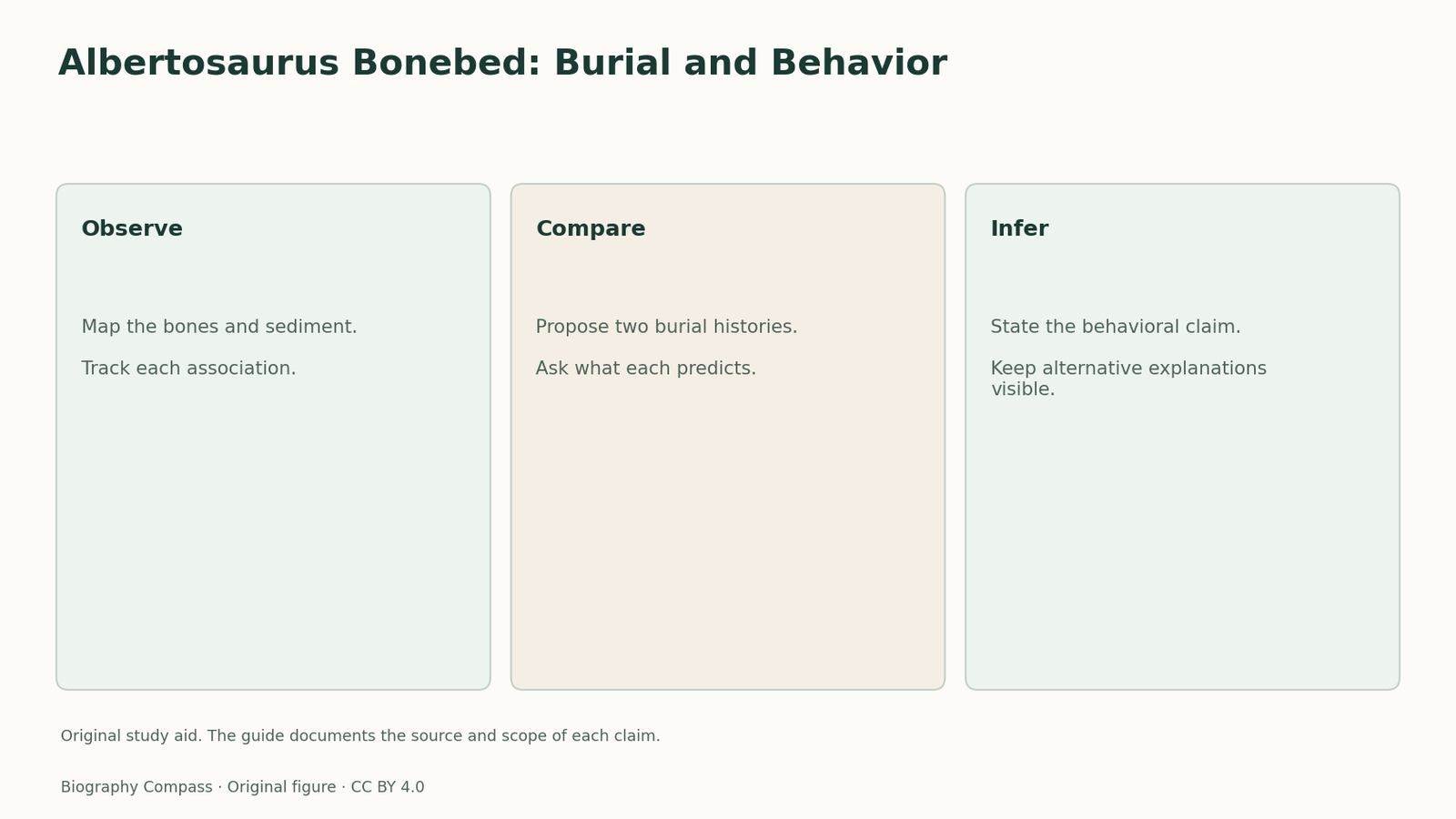
Several animals can end up buried together for more than one reason. A behavioral hypothesis becomes stronger when it is tested against the evidence of burial.
Evidence at a glance
Can a bone concentration establish group behavior?
Match each piece of evidence to a specific inference.
| Evidence | What it supplies | How to read it |
|---|---|---|
| Concentration | Several remains occur in one deposit. | Describe association precisely. |
| Deposition | Sediment and bone condition constrain burial history. | Test how material could accumulate. |
| Behavior | A proposed pattern before death. | Compare alternative explanations. |
Chronology
A timeline of the turning points
Historical collection
Early work documented the bonebed.
Comparative studies
Separate papers examine burial and behavior.
Separate deposition from behavior
Research on the Alberta site examines the sediments and the condition of fossil material. This concerns how a concentration formed and was preserved. Currie and Eberth also published a paper on possible gregarious behavior. That concerns what animals might have been doing before the remains entered the deposit. The two questions are connected, but one description cannot substitute for the other.
Build two predictions for the same pattern
For an original exercise, draw twelve bones in one layer. In model A, several animals were already together when they died. In model B, material from separate places was later brought together. Both models can leave a cluster on the sketch. Add observations about sediment, wear and whether bones retain anatomical connections. The value of each observation depends on whether the two models would predict different outcomes.
Choose evidence that can narrow the story
Suppose the sketch shows an intact joint beside several loose fragments. Record that joint as evidence that at least those parts remained together. It does not resolve the history of every object in the layer. Compare the direction, surface wear and association of other pieces separately. The exercise is designed to test reasoning, with no claim that its invented count or layout reproduces the Alberta excavation.
Use the field history to locate the evidence
The historical study traces distinct discoveries of Albertosaurus material, while the bonebed papers discuss the deposit as evidence. The original naming paper and the concentration are therefore different records even when the same name appears in both. A good note on a behavioral hypothesis identifies the particular deposit, the observations supporting the interpretation and the alternatives that were considered.
Continue the chronology
Related history guides
Biography context
Explore Canada through connected lives
Connected biographies
The researcher behind the records
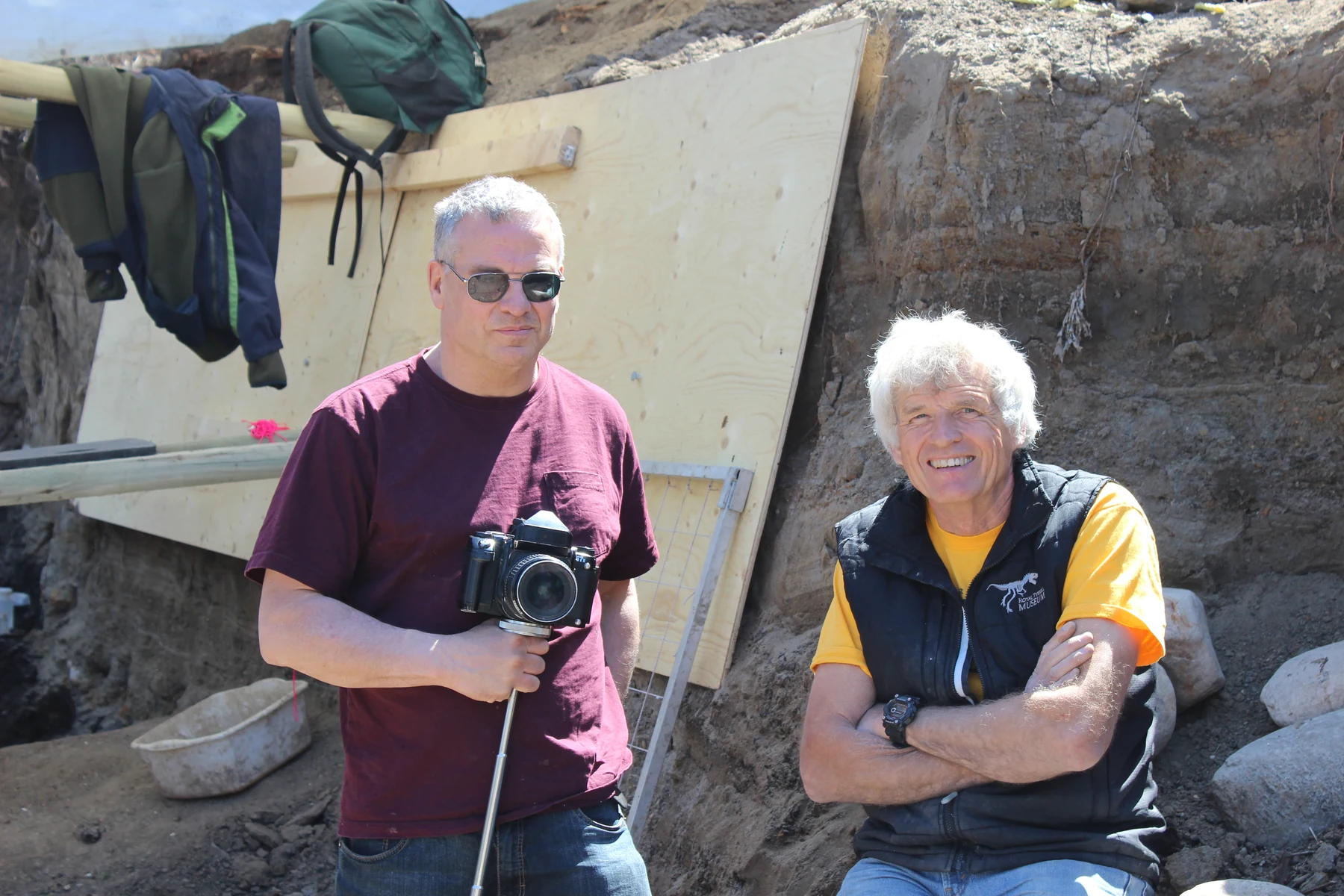
born 1949
Philip Currie
Vertebrate palaeontologist and museum researcherCurrie connected field excavations, museum preparation and anatomical research in the study of dinosaurs.Read biographyQuick answers
Common questions
- Does a bonebed automatically show the animals hunted together?
- No. A behavioral interpretation must be weighed against evidence about death, movement and burial.
Primary and institutional sources
How this history was checked
Publication dates and specimen records describe different events. Invented exercises are labelled. This article was reviewed on 5 November 2026.
- David Eberth and Philip Currie, Canadian Journal of Earth Sciences, 2010Stratigraphy, sedimentology, and taphonomy of the Albertosaurus bonebed
- Philip Currie and David Eberth, Canadian Journal of Earth Sciences, 2010On gregarious behavior in Albertosaurus
- Darren Tanke and Philip Currie, Canadian Journal of Earth Sciences, 2010A history of Albertosaurus discoveries in Alberta, Canada