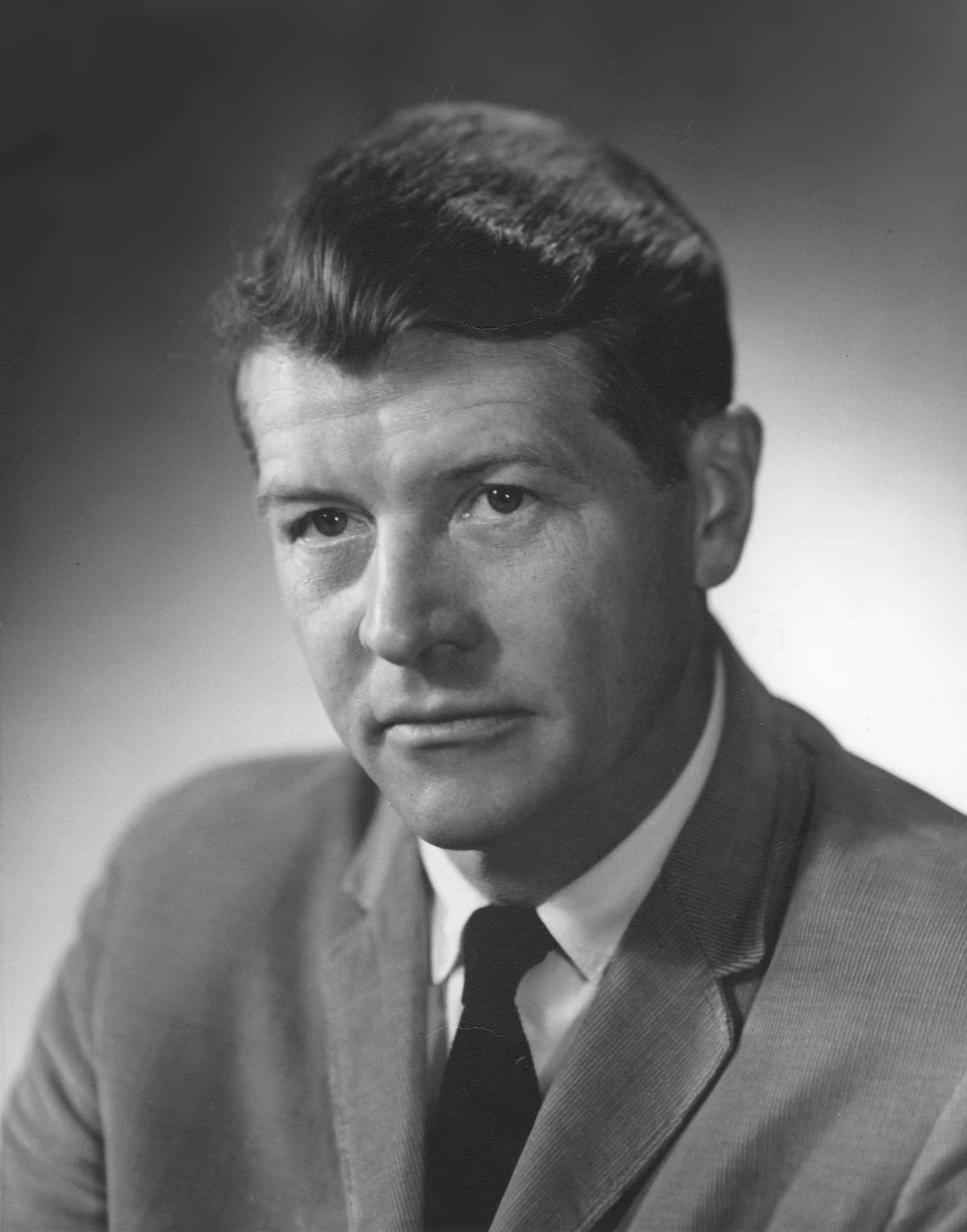
In this biography
Quick facts
- Born
- 25 June 1911
- Died
- 2 February 1980
- Birthplace
- New York, NY, USA
- Country
- United States
- Nationality
- Not independently established
- Known for
- Determining protein chemistry and sequence relationships with Stanford Moore
Why this life matters
Determining protein chemistry and sequence relationships with Stanford Moore
Timeline
Key moments
Birth
William H. Stein was born in New York, NY, USA.
Ribonuclease sequence paper
Coauthored the oxidised-ribonuclease sequence study with Hirs and Moore.
Nobel recognition
Received Nobel recognition for the work described in the official award record.
A change from organic chemistry to biochemistry
William Stein was born in New York City in 1911. He attended Harvard, graduating in 1933, before moving from an initially disappointing year of graduate chemistry into biochemistry at Columbia. Under E. G. Miller he studied the amino-acid composition of elastin and completed his doctorate in 1937. The subject connected chemical measurement with a material of biological importance. It also introduced a recurring practical difficulty: proteins could not be understood reliably without methods capable of identifying and quantifying their constituent amino acids.
A long partnership at Rockefeller
Stein joined Max Bergmann’s Rockefeller group in the late 1930s. Stanford Moore arrived in 1939, and the two began a collaboration that continued after wartime interruption and Bergmann’s death. Their early work improved amino-acid analysis, eventually moving from starch columns to ion-exchange separations. With Darrel Spackman, they helped develop an automatic analyser. Those methods were not simply ends in themselves. Stein’s autobiography describes the need to analyse proteins and peptides in useful yields as the reason for devising better instruments and procedures.
Fragments supplied relationships as well as totals
The ribonuclease programme involved collaborators including C. H. W. Hirs, Spackman and Derek Smyth. Different enzymatic cleavages produced overlapping peptides, whose relationships helped establish an ordered chain. The 1960 Hirs–Moore–Stein paper was a major stage, followed by revisions and confirmations in 1963. Chemical modification studies also addressed residues important for catalytic activity. These connected investigations should not be compressed into a claim that an amino-acid analyser directly generated a complete three-dimensional picture of the enzyme.
Recognition for structure and catalytic activity
Stein shared part of the 1972 Nobel Prize in Chemistry with Moore for contributions connecting ribonuclease’s chemical structure with the activity of its catalytic centre. Christian Anfinsen received the other half for complementary folding research. Stein also served as editor of the Journal of Biological Chemistry from 1968 to 1971. He died in New York in 1980. His career combined collaborative method development with increasingly specific biological questions: composition constrained sequence, sequence informed structural interpretation, and activity experiments tested what particular chemical features contributed to function.
Quick answers
Frequently asked questions about William H. Stein
- Who collaborated with Stein on ribonuclease?
- Stanford Moore and colleagues including Hirs, Spackman and Smyth contributed to the sequence and analytical programme.
- Was the 1960 sequence the last publication on its assignments?
- No. Revisions and confirmations followed in 1963.
Keep exploring
Lives connected to this story
- Frederick Sanger
Compare the insulin sequencing programme with the later ordering of a larger enzyme’s peptide fragments.
- Stanford Moore
Compare calibrated amino-acid amounts with peptide-order inference.
- Christian B. Anfinsen
Follow the distinct experiment on recovery of a protein’s active conformation.
Sources and further reading
Explore the evidence
These references support the biography and offer further reading. Official records, first-person accounts and independent reporting provide different perspectives; image records document attribution and licensing.
- 1. Hirs, Moore and Stein, Journal of Biological Chemistry, 1960The sequence of the amino acid residues in performic acid-oxidized ribonuclease
- 2. Stanford Moore, National Academy of Sciences, 1987William H. Stein: A Biographical Memoir
- 3. The Rockefeller University Hospital CentennialForm and Function: The First Sequence of an Enzyme, Ribonuclease
- 4. Nobel Prize OutreachWilliam H. Stein — Nobel lecture
- 5. Nobel Prize OutreachWilliam H. Stein — Facts
- 6. Nobel Prize OutreachWilliam H. Stein — Biographical