In this biography
Quick facts
- Born
- 30 August 1930
- Birthplace
- Omaha, Nebraska, United States
- Country
- United States
- Nationality
- Not independently established
- Known for
- Developing Berkshire Hathaway from a textile company into a diversified group and explaining business decisions in annual shareholder letters
- Birth
- 30 August 1930 in Omaha, Nebraska
- Education
- University of Nebraska, 1950; Columbia master’s degree, 1951
- Investment partnership
- Established in Omaha in 1956
- Berkshire control
- Buffett’s partnership took control in 1965
- Berkshire CEO
- 1970–2025; succeeded by Greg Abel on 1 January 2026
- Later board transition
- Chairman emeritus and continuing director from 18 September 2026; Howard Buffett became chair
Why this life matters
His career shows how investment judgment and business ownership can interact, while his letters document both an influential approach and decisions he acknowledged as mistakes.
Timeline
Key moments
Born in Omaha
Warren Edward Buffett was born on 30 August.
Study and partnership work
Graduated from Nebraska and Columbia, worked with Benjamin Graham, and established his own partnership in 1956.
Berkshire and insurance
His partnership took control of Berkshire in 1965; Berkshire acquired National Indemnity in 1967.
Textile operations closed
Berkshire shut its textile business; Buffett’s annual letter examined the failure and accepted responsibility for staying too long.
Chief executive succession
Buffett’s November 2025 letter anticipated the handover; Greg Abel became CEO on 1 January 2026.
A separate chair transition
Berkshire named Buffett chairman emeritus on 18 September while he remained a director; Howard Buffett became chair.
Omaha, study and an investment partnership
Warren Edward Buffett was born in Omaha, Nebraska, on 30 August 1930. His early business interests included delivering newspapers and other small ventures. After attending the Wharton School, he completed his undergraduate education at the University of Nebraska in 1950 and a master’s degree at Columbia in 1951. There he studied with Benjamin Graham, whose methods strongly influenced his thinking.
Buffett worked in his father’s brokerage business and later at Graham-Newman before returning to Omaha. In 1956 he established an investment partnership using money contributed by a small group of partners. This was a business of managing shared capital, rather than the creation of Berkshire Hathaway itself, which already existed as a textile enterprise.
Taking control of an existing textile company
Buffett’s partnership began purchasing Berkshire shares in 1962 and took control in 1965. The company carried a long textile history; Buffett did not found it. In his fiftieth-anniversary account, he described how a disagreement over a share repurchase led him to buy more of a business whose underlying economics were poor. He later regarded the decision as a serious error.
Berkshire acquired National Indemnity in 1967, establishing an insurance business alongside textiles. That move helped change the group’s direction, but it did not instantly eliminate the older operation’s difficulties. Understanding the transition requires following both the development of new activities and the capital still tied to an industry that continued to struggle.
A group of businesses and a network of managers
Over subsequent decades Berkshire combined insurance, ownership of operating companies and holdings in publicly traded businesses. These are different forms of ownership. Buying shares in another company does not make Berkshire its day-to-day operator. Insurance also brought float: funds held ahead of future claim payments, accompanied by the continuing obligation to meet those claims.
Greg Abel’s first annual letter, covering 2025, describes a group spanning railroads, energy, manufacturing, services and retail, with operating managers responsible for their businesses. It credits Buffett and Charlie Munger with shaping the organization. This is Berkshire’s own explanation of its system, but it usefully complicates the image of one person making every decision inside a large collection of companies.
Sources for this section: [4]
Writing about failure as well as success
Berkshire decided to close its textile operation in July 1985. Buffett’s letter for that year examined why investment in machinery had failed to create lasting advantages when competitors could make similar improvements. He praised the efforts of managers and workers and faulted himself for delaying the exit. The closure affected an operating community, not merely an entry in a portfolio.
His public explanations became an important part of his reputation. They offer evidence of how he presented decisions and revised earlier judgments. Reading those explanations as history does not require treating every conclusion as a universal rule. The textile account is particularly valuable because it records the limits of effort and management skill within an unfavorable business.
Sources for this section: [3]
Philanthropy and two leadership handovers
Buffett’s November 2025 message announced further gifts to family foundations and discussed accelerating the distribution of his wealth. He also said Greg Abel would take over Berkshire’s executive leadership at year-end. The company’s 2026 proxy confirms that Abel became chief executive on 1 January, ending Buffett’s CEO tenure, which had begun in 1970.
A later change concerned the board. On 18 September 2026 Berkshire announced that Buffett had become chairman emeritus while remaining a director, and that Howard Buffett had been elected chair. These separate transitions supersede older descriptions of him as chairman and CEO. His later role therefore belongs alongside, rather than obscures, the long operating career and the charitable plans he described.
Quick answers
Frequently asked questions about Warren Buffett
- Did Warren Buffett found Berkshire Hathaway?
- No. Berkshire was an existing textile company. Buffett’s partnership began purchasing shares in 1962 and took control in 1965.
- Is Warren Buffett Berkshire Hathaway’s CEO in 2026?
- No. Greg Abel became CEO on 1 January 2026. Buffett’s CEO tenure ran from 1970 through 2025, according to the company’s proxy statement.
- What changed in September 2026?
- Berkshire named Buffett chairman emeritus on 18 September while he remained a director. Howard Buffett was elected board chair; this was separate from Abel’s earlier CEO appointment.
- Why does the textile business matter to his biography?
- It was the original Berkshire operation under his control and a prolonged commercial failure. His 1985 letter accepted responsibility for remaining in it too long and explained the eventual shutdown.
Keep exploring
Lives connected to this story
- Jeff Bezos
Compare company-building and shareholder communication in two careers with distinct operating and board leadership transitions.
- Indra Nooyi
Compare the separate timing of executive and chair succession in two major American companies.
Sources and further reading
Explore the evidence
These references support the biography and offer further reading. Official records, first-person accounts and independent reporting provide different perspectives; image records document attribution and licensing.
- 1. University of Nebraska–Lincoln, Encyclopedia of the Great PlainsBuffett, Warren — historical biography by Thomas Johansen
Used for historical birth, education and partnership facts only. Its old current-role and wealth statements are stale. Other archival university biographies contain conflicting education or acquisition dates; the 1950 Nebraska graduation and 1965 control sequence follow this entry and Berkshire’s own retrospective.
- 2. Warren Buffett / Berkshire Hathaway2014 annual letter and Berkshire — Past, Present and Future, published 2015
- 3. Warren Buffett / Berkshire Hathaway1985 chairman’s letter — shutdown of the textile business
- 4. Greg Abel / Berkshire Hathaway2025 annual shareholder letter, published 2026
- 5. Warren Buffett / Berkshire Hathaway10 November 2025 message, philanthropy and executive succession
- 6. Berkshire Hathaway2026 proxy statement — chief executive chronology
- 7. Berkshire HathawayBuffett becomes chairman emeritus and Howard Buffett elected chair, 18 September 2026
Later primary release supersedes the March 2026 proxy’s chair title. As reviewed on 21 October 2026, distinguish chairman emeritus and director from CEO and board chair.
- 8. Mark Hirschey / Wikimedia CommonsWarren Buffett KU visit — full-original history and CC BY-SA permission
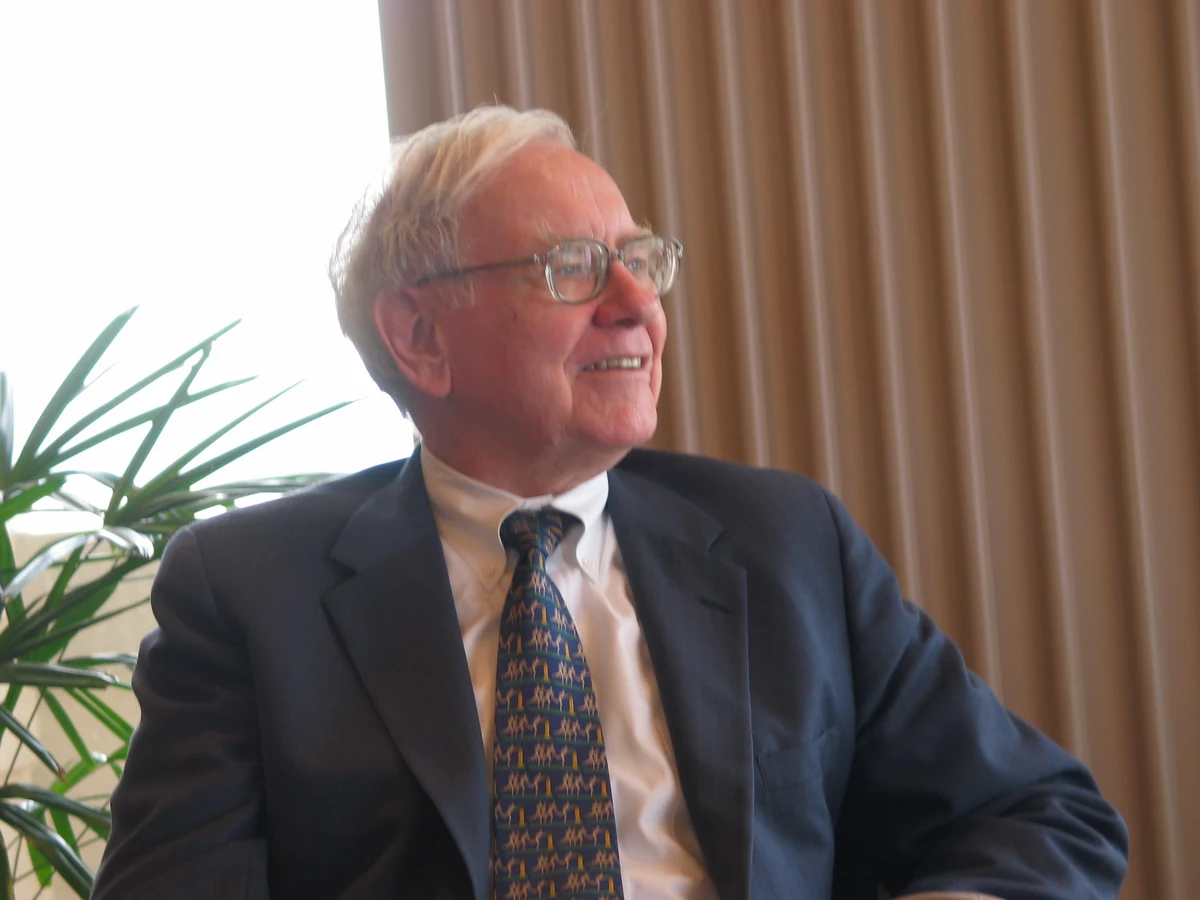
Use earliest full 2272×1704 upload from 2007, showing the 6 May 2005 visit. Current file was cropped, color-adjusted and recompressed in 2009. CC BY-SA 2.0 permission is publicly confirmed under VRT ticket 2007081810009083; correspondence is restricted to volunteers.