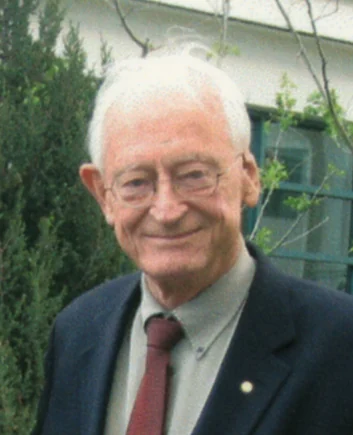
In this biography
Quick facts
- Born
- 22 September 1939
- Died
- 18 May 2026
- Birthplace
- Karachuonyo, Kenya
- Country
- Kenya
- Nationality
- Not independently established
- Known for
- Environmental chemistry, atmospheric research and Kenya’s scientific institutions
- Doctoral qualification
- Case Western Reserve University, 1972
- Nairobi career
- Joined the chemistry department in 1972
- KNAS leadership
- Chair listed for 1992–2002
- Termite paper
- Science, 1982; four coauthors
Why this life matters
His career shows how measurements, interdisciplinary research and institutional capacity develop together.
Timeline
Key moments
Birth
Born on 22 September; the academy locates his origins in Karachuonyo.
Doctorate and return
Completed doctoral study and joined the University of Nairobi.
Atmospheric collaboration
Coauthored the Science paper on termite gas emissions.
Academy leadership
Listed as chairman by the Kenya National Academy of Sciences.
Interdisciplinary research
A coauthored highland-malaria vulnerability study appeared in Climatic Change.
Death
The Royal Society of Chemistry records his death on 18 May.
Chemistry training across continents
Shem Oyoo Wandiga was born on 22 September 1939. The Kenya National Academy of Sciences locates his early life in Karachuonyo and records schooling at Kamagambo and Pine Forge Institute in Pennsylvania. He studied chemistry at Howard University, earned a master’s degree at the University of Maryland and completed a doctorate at Case Western Reserve University in 1972.
He returned to Kenya and joined the University of Nairobi’s chemistry department that year. His academic career included teaching, research and departmental leadership. Coordination and analytical chemistry supplied a laboratory foundation for later work on environmental questions.
Following chemicals through the environment
Wandiga investigated environmental contamination as well as chemical structures. The academy’s profile highlights trace-metal studies involving hair, fish, water and sediments. These different specimen types connected analytical chemistry with questions about how substances move through biological and environmental settings.
An international collaboration took him into atmospheric science. With Patrick Zimmerman, James Greenberg and Paul Crutzen, he coauthored a 1982 Science paper about gases emitted by termites. Its abstract presented possible global emissions calculated from laboratory measurements, with field checks at two nests in Guatemala. The scale of that estimate depended on extrapolation; it was not a direct count of emissions everywhere.
Climate research needed several disciplines
The same concern with connected environmental processes appears in a 2010 study of epidemic-malaria vulnerability in East African highlands. Wandiga worked with a large team including Maggie Opondo, Daniel Olago and Andrew Githeko. The author-repository abstract connects climate and hydrology with health records and household circumstances.
The coauthors considered coping and adaptive capacity alongside physical exposure. Linking climate, hydrology, health records and household circumstances required cooperation across specialisms. The project illustrates why a chemist’s research network could involve geology, meteorology, public health and social science.
Institutions carried the work forward
Wandiga’s responsibilities extended beyond individual papers. KNAS lists him as chairman for 1992–2002. At Nairobi he held senior academic and administrative roles and helped establish the Institute for Climate Change and Adaptation. These institutions provided settings in which researchers could teach, collaborate and develop further projects.
The Royal Society of Chemistry’s obituary also records his contribution to the Pan Africa Chemistry Network and his service in university governance. It dates his death to 18 May 2026. His legacy lies in identifiable research collaborations and institutions, as well as the students and scientific communities that continued their work.
Quick answers
Frequently asked questions about Shem Wandiga
- Who collaborated with Shem Wandiga on the 1982 termite paper?
- The listed authors are P. R. Zimmerman, J. P. Greenberg, S. O. Wandiga and P. J. Crutzen.
- Did that paper directly measure a worldwide termite total?
- Its abstract describes a global estimate calculated from laboratory measurements, with field checks at two nests. Extrapolated estimates and direct global measurement are different kinds of evidence.
- When did Shem Wandiga die?
- The Royal Society of Chemistry’s obituary records 18 May 2026.
Keep exploring
Lives connected to this story
- Thomas Odhiambo
Compare the building of African scientific institutions through chemistry and insect research.
- Calestous Juma
Explore a related career connecting scientific knowledge with institutions and development.
- Miriam Were
Compare environmental-health research with community participation in health services.
Sources and further reading
Explore the evidence
These references support the biography and offer further reading. Official records, first-person accounts and independent reporting provide different perspectives; image records document attribution and licensing.
- 1. Royal Society of ChemistryProfessor Shem Oyoo Wandiga: obituary
The RSC obituary supplies life dates and selected institutional history. The paper records cited separately establish specific research collaborations.
- 2. Kenya National Academy of SciencesProfiles of fellows: founding-fellow entry and office-bearer lists
Founding-fellow entry on PDF page 11 and the historical office-bearer lists were read. Undated publication totals are not used as current metrics.
- 3. P. R. Zimmerman, J. P. Greenberg, S. O. Wandiga and P. J. Crutzen; Science / NLMTermites: a potentially large source of atmospheric methane, carbon dioxide, and molecular hydrogen (1982), abstract
The original article’s indexed abstract and author record were read, not the complete Science paper.
- 4. National Science FoundationAnnual Report 1983, printed pages 10–11: atmospheric measurements and methane sources
Actual scanned report PDF pages 22–23, printed 10–11, were viewed. The historical estimate is not represented as a current methane inventory.
- 5. Shem O. Wandiga and coauthors; Clark UniversityVulnerability to epidemic malaria in the highlands of Lake Victoria basin (2010), author-repository record
The author-repository abstract and bibliographic record were read. A failed candidate PDF retrieval is not counted as full-text inspection.