In this biography
Quick facts
- Born
- 2 May 1921
- Died
- 23 April 1992
- Birthplace
- Calcutta, Bengal Presidency, British India (now Kolkata, India)
- Country
- India
- Nationality
- Indian
- Known for
- The Apu Trilogy, The Music Room, Charulata, The Chess Players, Feluda and Professor Shonku
- First feature
- Pather Panchali, released in 1955
- Film-society work
- Co-founded the Calcutta Film Society in 1947
- Literary creations
- Detective Feluda and scientist Professor Shonku
- Late recognition
- Honorary Academy Award and Bharat Ratna, 1992
Why this life matters
His films connected close observation of Bengali lives with deliberate visual and musical form, while his design and literary work reached audiences beyond the cinema.
Timeline
Key moments
Born in Calcutta
Born on 2 May into a family associated with Bengali writing, illustration and printing.
Art at Santiniketan
Studied at Tagore’s Visva-Bharati, expanding his knowledge of Indian and East Asian art.
Advertising and book design
Began professional commercial-art work and designed books for Signet Press.
Film society and international influences
Co-founded the Calcutta Film Society, met Jean Renoir and encountered European cinema, including Bicycle Thieves.
Pather Panchali
An interrupted production led to the 1955 release and the 1956 Cannes prize for Best Human Document.
The Apu Trilogy
Aparajito and Apur Sansar continued Apu’s story.
Sandesh revived
Resumed the family children’s magazine, contributing illustrations, stories and verse.
Recognition and death
Received an honorary Oscar and Bharat Ratna; died in Calcutta on 23 April.
A family of books, images and music
Satyajit Ray was born in Calcutta on 2 May 1921, when the city was part of British India. His grandfather Upendrakishore Ray worked in writing, illustration, music and printing; his father Sukumar Ray became celebrated for nonsense verse and illustration. Sukumar died when Satyajit was a small child. His mother, Suprabha, raised him within a household whose circumstances changed after the family printing business passed out of their hands.
Ray’s early interests included Hollywood films and Western classical records. He graduated from Presidency College in 1939, then went to Santiniketan in 1940. At Visva-Bharati he encountered Indian and East Asian visual traditions and studied with artists including Benode Behari Mukherjee. The later filmmaker’s education therefore involved both city cinema culture and sustained attention to other artistic traditions.
Commercial artist and student of cinema
In 1943 Ray entered advertising at D. J. Keymer as a junior visualiser. Work for Signet Press also brought him into book-cover design and illustration. Among the books he illustrated was a children’s version of Bibhutibhushan Bandyopadhyay’s Pather Panchali. Design was a profession with its own skills and audiences, not merely a waiting room before an inevitable film career.
He co-founded the Calcutta Film Society in 1947. Meeting Jean Renoir during preparations for The River and seeing films abroad enlarged his sense of what cinema could do. Bicycle Thieves offered a particularly important example of location-based filmmaking. These influences did not make his work a European transplant: his familiarity with Bengali literature and the visual education of Santiniketan remained equally important to the subjects and details he chose.
Pather Panchali was a collaborative first film
Ray began shooting Pather Panchali in 1952 while still associated with advertising. Money shortages interrupted production; support from the Government of West Bengal eventually helped complete it. The film reached audiences in 1955 and received the prize for Best Human Document at Cannes in 1956. That award should not be confused with the Palme d’Or.
His authorship involved collaboration. Subrata Mitra photographed the film, Bansi Chandragupta directed its art, Dulal Dutta edited it and Ravi Shankar supplied the music. The cast combined newcomers with experienced performers, including the veteran Chunibala Devi. Ray’s first-person account describes a small, inexperienced initial unit learning through practical work. It does not justify the often repeated claim that every actor and crew member was entirely untrained.
Beyond Apu: a changing range of films
Aparajito in 1956 and Apur Sansar in 1959 completed the Apu Trilogy. Ray also moved away from its family chronicle: The Music Room examined an aristocratic world, while The Philosopher’s Stone offered comedy. Charulata drew on Tagore, and The Chess Players joined a growing body of later work. A single label such as rural realism cannot describe that range.
He increasingly combined directing and writing with musical composition, design and detailed planning. His relation to poverty also became a subject of criticism. In the BFI’s account, critic Shubhra Gupta recalls accusations that Pather Panchali displayed Indian poverty for Western viewers. That is a debate about representation, not evidence of an intention to demean India. The film’s formal choices and the variety of his later work provide more substantial grounds for discussion.
Sandesh, Feluda and another reading public
Ray revived Sandesh in 1961, continuing a children’s magazine founded by his grandfather. He supplied pictures, stories and verse. His Bengali fiction includes the detective Feluda and the scientist Professor Shonku, alongside adventure, fantasy, horror and other short stories. The literary work reached readers who did not need to encounter him first through an international film festival.
He also wrote about filmmaking. Our Films, Their Films gathers critical essays, while My Years with Apu recounts the making of the trilogy. These are valuable accounts of craft and memory, but a filmmaker’s retrospective explanation is a perspective to assess alongside production records and other participants. His illustration and prose belong within his working life, rather than appearing as decorative hobbies added after the serious business of cinema.
Illness, recognition and the work that survived
Heart problems disrupted his later filmmaking. During work on The Home and the World, his son Sandip helped complete the production under his instructions. Ray returned with Ganashatru, followed by Shakha Prashakha and Agantuk. Their completion extended his career into the early 1990s despite the interruption caused by illness.
In 1992 he received an honorary Academy Award and India’s Bharat Ratna. The Academy’s official video description places the Oscar presentation at the 1992 ceremony; its award-year tables use the 1991 eligibility year. He died in Calcutta on 23 April 1992. His legacy includes the practical labour of collaborators, Bengali readers and film viewers, as well as international recognition. Keeping those audiences and forms together makes his career more legible than a list of festival prizes alone.
Quick answers
Frequently asked questions about Satyajit Ray
- Was Pather Panchali Satyajit Ray’s first film?
- It was his first feature film, released in 1955. Aparajito and Apur Sansar later continued Apu’s story.
- Did Ray write books as well as direct films?
- Yes. He wrote Bengali fiction, including Feluda and Professor Shonku stories, contributed to Sandesh and published writing about cinema.
- Did Ray compose the music for Pather Panchali?
- No. Ravi Shankar composed its music. Ray later composed music for many of his own films.
- When did Ray receive his honorary Oscar?
- The presentation took place at the Academy Awards ceremony in 1992. Academy tables label that 64th ceremony by the 1991 film year.
Keep exploring
Lives connected to this story
- Rabindranath Tagore
Explore the writer and educator behind Ray’s Santiniketan education, several literary adaptations and his 1961 documentary.
- Guru Dutt
Compare another Indian filmmaker’s studio practice and later international reception.
Sources and further reading
Explore the evidence
These references support the biography and offer further reading. Official records, first-person accounts and independent reporting provide different perspectives; image records document attribution and licensing.
- 1. SatyajitRay.orgBiography
- 2. SatyajitRay.orgGrowing up, 1921–1939
- 3. SatyajitRay.orgAt Shantiniketan
- 4. Society for the Preservation of Satyajit Ray ArchivesBiography (indexed passages)
The indexed Society biography supplied the advertising and Signet Press passages. Direct requests timed out; no full live-page or archival collection inspection is claimed.
- 5. SatyajitRay.orgMaking of Pather Panchali (indexed passages)
Indexed production passages distinguish inexperienced Subir and Karuna Banerjee from veteran Chunibala Devi. Direct page requests timed out.
- 6. SatyajitRay.orgA Film a Year
- 7. SatyajitRay.orgRay’s Literary Career
- 8. SatyajitRay.orgFinal Offerings
- 9. Academy of Motion Picture Arts and SciencesSatyajit Ray’s Honorary Award: 1992 Oscars (official video description)
- 10. Academy of Motion Picture Arts and SciencesThe Honorary Award: Ray listed under the 1991 film year
- 11. British Film InstitutePather Panchali: programme notes, Ray’s 1957 account and credits
Read BFI credits and its reproduced 1957 Ray essay. The first eight-person unit is not equated with every participant in the completed production. Ray’s screenplay and Dutta’s editing are corroborated by Criterion.
- 12. British Film InstitutePather Panchali: film record and attributed criticism
The poverty-representation criticism is explicitly attributed to Shubhra Gupta’s retrospective account; no motive is assigned to Ray or to every Indian viewer.
- 13. Criterion CollectionPather Panchali: synopsis and credits
- 14. Terrence Rafferty / Criterion CollectionThe Apu Trilogy: Every Common Sight
- 15. Girish Shambu / Criterion CollectionThe Apu Trilogy: Behind the Universal
- 16. Museum of Modern ArtCharles Silver: Satyajit Ray’s Pather Panchali
- 17. Festival de CannesPather Panchali: Prix du document humain 1956
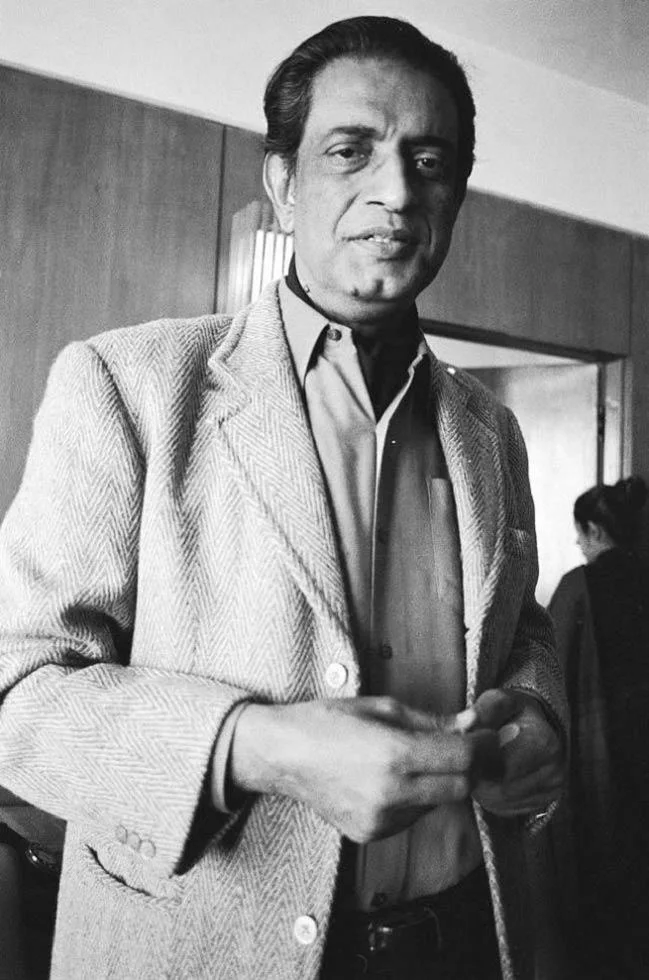
- 18. Dinu Alam / Wikimedia CommonsSatyajit Ray in New York: original photograph and CC BY-SA 4.0
Dinu Alam’s own-work, CC BY-SA 4.0 original full photograph. Description dates it 12 October 1981, while embedded metadata gives a 1987 date. Caption uses the photographer’s record with this disagreement disclosed, not an unqualified exact date. Cropped derivative files were rejected.