In this biography
Quick facts
- Born
- 8 February 1977
- Birthplace
- Winnipeg, Canada
- Country
- Australia
- Nationality
- Not independently established
- Known for
- Environmental law, women’s representation and Senate procedural reform
- Born
- 8 February 1977, Winnipeg, Canada
- Education
- Science and law at Griffith; graduate legal-practice diploma
- Earlier work
- Community environmental lawyer
- First Senate term
- Began 1 July 2011
- Return
- Chosen for a casual vacancy, 6 September 2018
- Federal party leadership
- May 2025–September 2026; remained a senator afterwards
Why this life matters
Her record combines advocacy for a more accessible Parliament with a serious constitutional eligibility failure. The distinction between party leadership and a continuing Senate seat also explains why her September 2026 resignation did not end her parliamentary career.
Timeline
Key moments
Law and environmental work
Born in Canada, she studies science and law in Queensland and works in legal research and practice.
First election and term
Elected in 2010, she becomes Queensland’s first Greens senator when the term begins in July 2011.
Infant-care rules and a first
The Senate broadens its rules in November 2016; Waters breastfeeds her daughter in the chamber in May 2017.
Citizenship disqualification
She resigns in July; the High Court rules the 2016 election void in October.
Return and further elections
A September 2018 appointment is followed by election in 2019 and re-election in 2025.
Federal leadership
She leads the Greens from May 2025 until stepping down because of illness in September 2026.
An environmental lawyer entered national politics
Waters was born in Winnipeg in 1977. She studied science and law at Griffith University and completed a graduate legal-practice diploma. Legal research, private practice and community environmental law preceded her election.
Her work at the Environmental Defender’s Office involved helping people use legal processes to protect the environment. That practical background connected law, public participation and environmental conflict before she represented Queensland nationally. The party’s current biography records the Law Council’s 2010 young environmental lawyer recognition, while the parliamentary handbook supplies the underlying qualifications and employment chronology.
Senate representation combined environmental and women’s issues
Elected in 2010, Waters began her first Senate term in July 2011 as Queensland’s first Greens senator. Her responsibilities developed across environmental policy, resources, democracy and women’s issues, alongside committee work.
The chamber itself became one focus of reform. In 2016 she proposed broadening an existing breastfeeding exception to accommodate infant care. The Procedure Committee recommended a more qualified form, and the Senate adopted it. When she breastfed her daughter in the chamber in May 2017, the visible milestone attracted attention well beyond the earlier procedural negotiations. It did not mean breastfeeding had first become lawful there that year.
Citizenship ended one period of service
Waters resigned on 18 July 2017 after discovering that she retained Canadian citizenship. She said she had misunderstood her status after leaving Canada as a baby and apologised to constituents. The failure concerned eligibility at nomination, not whether she identified with Australia.
The High Court later ruled her 2016 election void under section 44(i). Her lack of awareness did not prevent disqualification. The wider citizenship references exposed a constitutional problem affecting several political parties, but that context did not remove her responsibility to establish eligibility. Parliamentary summaries and contemporaneous reporting distinguish her July resignation from the Court’s October determination.
A return preceded the federal leadership
The Queensland Parliament chose Waters on 6 September 2018 to fill Andrew Bartlett’s casual vacancy. Further elections in 2019 and 2025 extended her representation. Her return followed the citizenship failure rather than reversing the finding about her earlier nomination.
She became federal Greens leader in May 2025 after Adam Bandt lost his lower-house seat. In an early interview she favoured constructive parliamentary work while defending the party’s willingness to negotiate firmly on housing and other issues. Environmental and women’s policy remained central. Her position was therefore not a promise to abandon disagreement with Labor, even when seeking cooperation.
Illness ended the leadership, not the Senate mandate
On 28 September 2026 Waters announced she was stepping down as leader because a chronic kidney condition had worsened. She planned medical leave and a return to Senate duties. The announcement separated the demands of party leadership from continued parliamentary representation.
Contemporary reporting described environmental-law negotiations and other parliamentary work during her leadership, while her own statement acknowledged that illness had shortened the role. A new team followed. At the review date her current party biography identifies her as a Queensland senator and explicitly dates the leadership to May 2025–September 2026. Older directories still carrying the leadership title are not used to override that dated account.
Quick answers
Frequently asked questions about Larissa Waters
- Was Waters born in Brisbane?
- No. Parliament records Winnipeg, Canada; some secondary biographical entries give a conflicting birthplace.
- Did breastfeeding first become permitted in the Senate in 2017?
- No. A 2003 exception preceded the 2016 infant-care expansion and her May 2017 first.
- Did the High Court restore her original seat?
- No. The 2016 election was ruled void; she later returned through a separate 2018 casual-vacancy appointment.
- Did she resign from Parliament in September 2026?
- No. She stepped down as party leader while remaining a senator and taking medical leave.
Keep exploring
Lives connected to this story
- Mehreen Faruqi
Read the deputy leader who served during her leadership and the subsequent party transition.
- Adam Bandt
Place her leadership after the electoral defeat of her predecessor.
- Julia Gillard
Compare a different generation’s experience of women’s representation and parliamentary debate.
Sources and further reading
Explore the evidence
These references support the biography and offer further reading. Official records, first-person accounts and independent reporting provide different perspectives; image records document attribution and licensing.
- 1. Parliament of AustraliaLarissa Waters: selected electoral service, return and qualifications
Selected indexed passages read; direct retrieval failed. Current party biography and dated September reporting supersede the stale leader heading.
- 2. Parliamentary LibraryForty-third Parliamentary Handbook: Larissa Joy Waters entry, page 243
Only the Waters entry consulted. Its Winnipeg birthplace is corroborated by her citizenship account; the conflicting Australian Women’s Register birthplace is not adopted.
- 3. Australian GreensLarissa Waters: current senator identification and May 2025–September 2026 leadership
- 4. ABC NewsWaters resigns over Canadian citizenship, 18 July 2017
- 5. Parliament of AustraliaSelected account of the 2017 citizenship references and disqualification issue
- 6. ABC NewsWaters’s May 2025 leadership priorities and negotiating approach
This report misdates the breastfeeding first as 2016. The parliamentary chronology supplies 9 May 2017; its interview is used for leadership priorities only.
- 7. ABC NewsWaters steps down as leader while remaining a senator, 28 September 2026
- 8. Senate Procedure CommitteeFirst report of 2016: selected infants-in-the-chamber discussion and recommendation
- 9. Parliamentary LibraryParliament House chronology: selected 2003, 2016, 2017 and 2018 entries
- 10. Australian GreensCurrent federal MPs: separate Senate and leadership roles
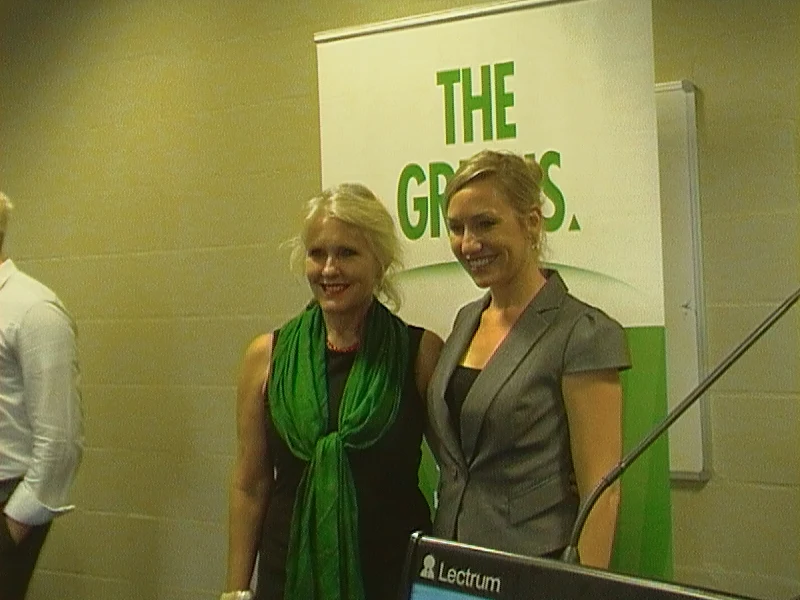
- 11. Patrick Gillett / Wikimedia CommonsRainee Skinner + Larissa Waters: photographer’s original own-work release, 27 January 2012