
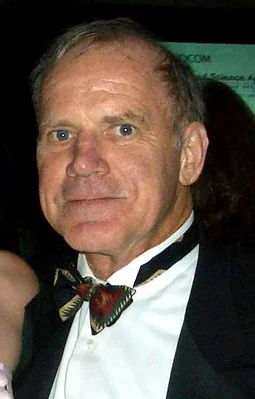
In this biography
Quick facts
- Born
- 28 December 1944
- Died
- 7 August 2019
- Birthplace
- Lenoir, NC, USA
- Country
- United States
- Nationality
- Not independently established
- Known for
- Conceiving the polymerase chain reaction and helping develop an amplification method
Why this life matters
Conceiving the polymerase chain reaction and helping develop an amplification method
Timeline
Key moments
Birth
Kary Mullis was born in Lenoir, NC, USA.
PCR team publication
Coauthored the original Cold Spring Harbor paper explaining repeated DNA amplification.
Nobel recognition
Received Nobel recognition for the work described in the official award record.
Chemistry from Georgia to Berkeley
Kary Banks Mullis was born in Lenoir, North Carolina, in 1944 and grew up in the American South. He studied chemistry at the Georgia Institute of Technology before moving to Berkeley for graduate work. At the University of California, Berkeley, he worked with biochemist J. B. Neilands and completed his doctorate in 1973. His Nobel autobiography is an unusually personal account of this formation; it should be read as his recollection rather than as an independent validation of his later opinions.
An idea inside an industrial laboratory
At Cetus, Mullis worked on oligonucleotide synthesis. He conceived the repeated amplification idea in 1983, with short DNA primers marking the region to be copied. Turning that idea into a dependable method involved a larger company research programme. Berkeley’s alumni history, drawing on interviews with colleagues including Tom White, describes advocacy, testing and implementation by other researchers. The 1986 paper’s coauthors included Fred Faloona, Stephen Scharf, Randall Saiki, Glenn Horn and Henry Erlich. Their names matter to the practical history.
What the amplification method changed
The polymerase chain reaction made repeated primer-directed copying into a way of increasing a selected DNA region. The 1986 paper explained the approach, and Mullis and Faloona’s 1987 methods account presented it in greater detail. These early records should not be silently rewritten as descriptions of every later automated PCR system. Their achievement was the amplification strategy and its experimental development. Mullis received half of the 1993 Nobel Prize in Chemistry for PCR; Michael Smith received the other half for a separate method.
A contribution distinct from public authority
Mullis left Cetus in 1986. His later public profile also included scientifically disputed claims, including AIDS denial, discussed critically in Berkeley’s alumni magazine. Those positions do not follow from his molecular-biology achievement and should not acquire authority through his Nobel Prize. Mullis died in Newport Beach, California, in 2019. A useful assessment therefore credits the amplification idea, includes the team that made it workable, and evaluates unrelated assertions on their own evidence rather than treating scientific fame as a universal credential.
Quick answers
Frequently asked questions about Kary Mullis
- Did Mullis develop PCR alone?
- He conceived the central amplification idea, while the published and institutional records identify a wider Cetus team in its practical development.
- What does his Nobel Prize recognise?
- The 1993 Chemistry award recognised his invention of the polymerase chain reaction.
Keep exploring
Lives connected to this story
- Frederick Sanger
Compare amplifying a DNA segment with determining the order of its bases.
Sources and further reading
Explore the evidence
These references support the biography and offer further reading. Official records, first-person accounts and independent reporting provide different perspectives; image records document attribution and licensing.
- 1. Cold Spring Harbor Symposia on Quantitative Biology, 1986Specific Enzymatic Amplification of DNA In Vitro: The Polymerase Chain Reaction
Conception in 1983, practical development, the 1986 team paper and later automation are different stages.
- 2. Mullis and Faloona, 1987Specific synthesis of DNA in vitro via a polymerase-catalyzed chain reaction
- 3. Coby McDonald, California magazine, 2019Intolerable Genius: Berkeley’s Most Controversial Nobel Laureate
The article records controversial public positions critically; a Nobel award is not evidence for unrelated claims.
- 4. Nobel Prize OutreachKary Mullis — Facts
- 5. Nobel Prize OutreachKary Mullis — Biographical