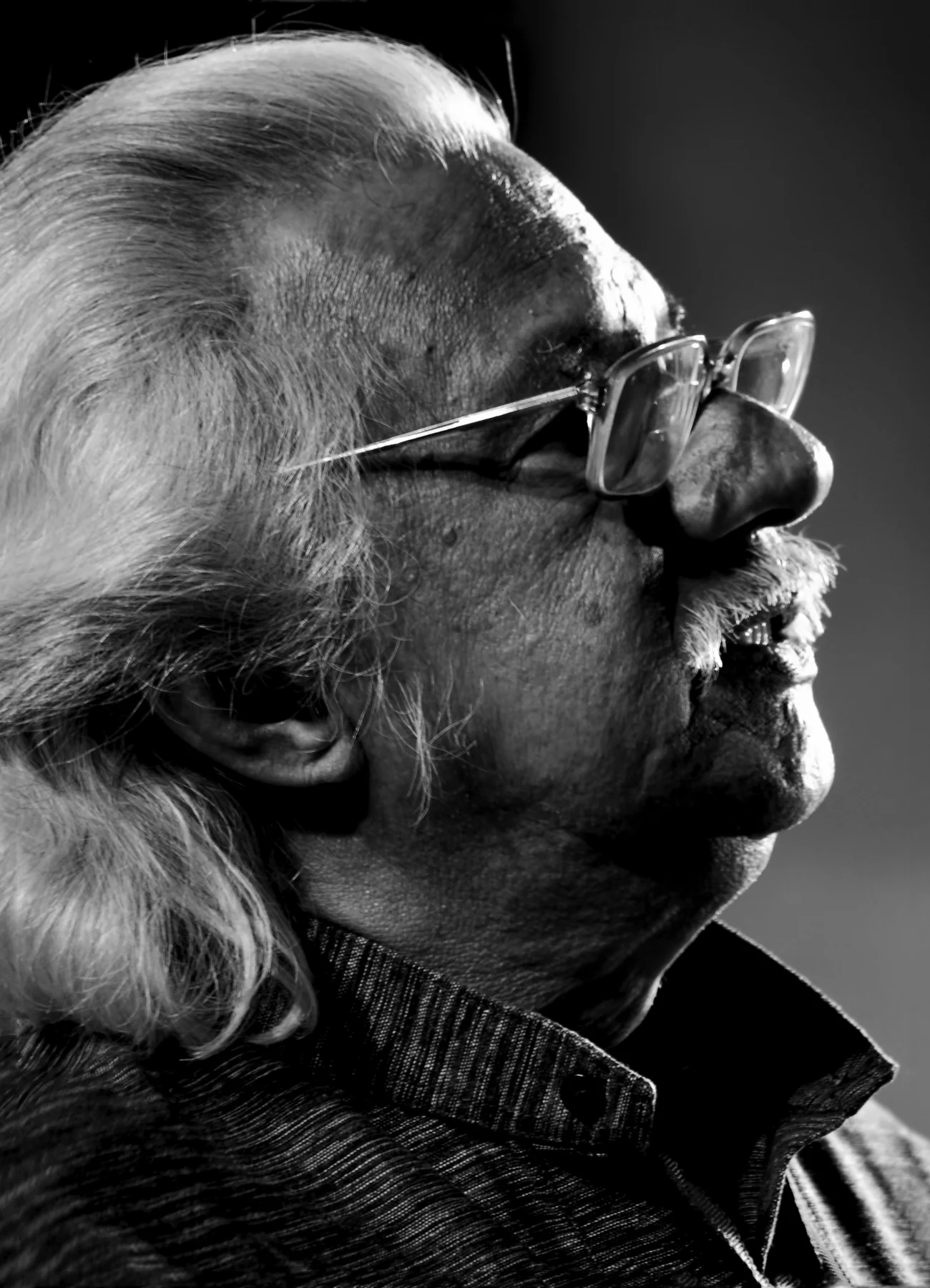
In this biography
Quick facts
- Born
- 1924
- Died
- 2016
- Birthplace
- Kuthuparamba, present-day Kerala, India
- Country
- India
- Nationality
- Not independently established
- Known for
- Work across materials
Why this life matters
He connected painting with craft, public art, writing and education, working with artisans and students as well as established artists.
Timeline
Key moments
Teaching in Baroda
Faculty of Fine Arts.
A return to teaching
Santiniketan.
A large mural
An architectural surface at Santiniketan.
Politics and an artistic education
Born in Kuthuparamba in 1924, Subramanyan studied economics at Presidency College in Madras. He later recalled imprisonment during the Quit India movement and being unable to return to the college. Art offered a different direction.
At Santiniketan he studied with Nandalal Bose, Benode Behari Mukherjee and Ramkinkar Baij. He joined the teaching staff at the Faculty of Fine Arts in Baroda in 1951 and later studied at the Slade School in London. His career developed through both institutional education and sustained contact with craft practices.
Making with colleagues and artisans
Work with weavers’ service centres deepened his understanding of craft and its educational problems. At Baroda, the Fine Arts fair encouraged artists to make affordable toys, calendars and puppets. Gyarasilal Mistry, a skilled mason and departmental colleague, helped turn his models into further pieces.
Toy-making led into terracotta. Public commissions brought other relationships: architect Charles Correa invited him to the Gandhi Darshan project, and later reliefs at Jyoti Limited developed architectural work on another scale. Such projects connect the image-maker with the labour and knowledge of other makers.
Transparent supports and new possibilities
Glass paintings collected by his student Ushakant Mehta encouraged him to experiment with reverse painting. He recalled using gouache backed with oils, later working on transparent plastic. The change of support offered new relationships among line, colour and surface.
His work also included murals, drawings, prints and children’s books. A later colleague’s account describes the large mural he made at Santiniketan in 1990, bringing figures and movement onto a building rather than limiting an image to a portable canvas.
Teaching through an environment
He returned to teach at Santiniketan in 1980 and retired in 1989. In his reflections, an art school should sustain a varied environment in which students develop judgment, rather than merely repeat a teacher’s formula. He later returned to Baroda, where former students remained part of his circle.
Subramanyan died in 2016. His legacy includes writing about art and modernism as well as objects in many media. The playful movement between those media was a working method, not a rejection of the skill each required.
Quick answers
Frequently asked questions about K. G. Subramanyan
- Did he work only in paint?
- No. His work used several media.
Keep exploring
Lives connected to this story
- Nandalal Bose
How did another artist connect teaching with making?
- Iskandar Jalil
What decisions can a material require from its maker?
Sources and further reading
Explore the evidence
These references support the biography and offer further reading. Official records, first-person accounts and independent reporting provide different perspectives; image records document attribution and licensing.
- 1. Manjula Narayan, 2005 interview republished 8 October 2024, The PunchConversations with K.G. Subramanyan
- 2. Jehangir Nicholson Art FoundationK.G. Subramanyan
Year-only life dates are retained. Economics study is not treated as proof of a completed degree.
- 3. DAGK. G. Subramanyan
- 4. Gulammohammed Sheikh, 2015 catalogue essay excerpt; Indian Express, 2016The Man Who Painted Passages from India