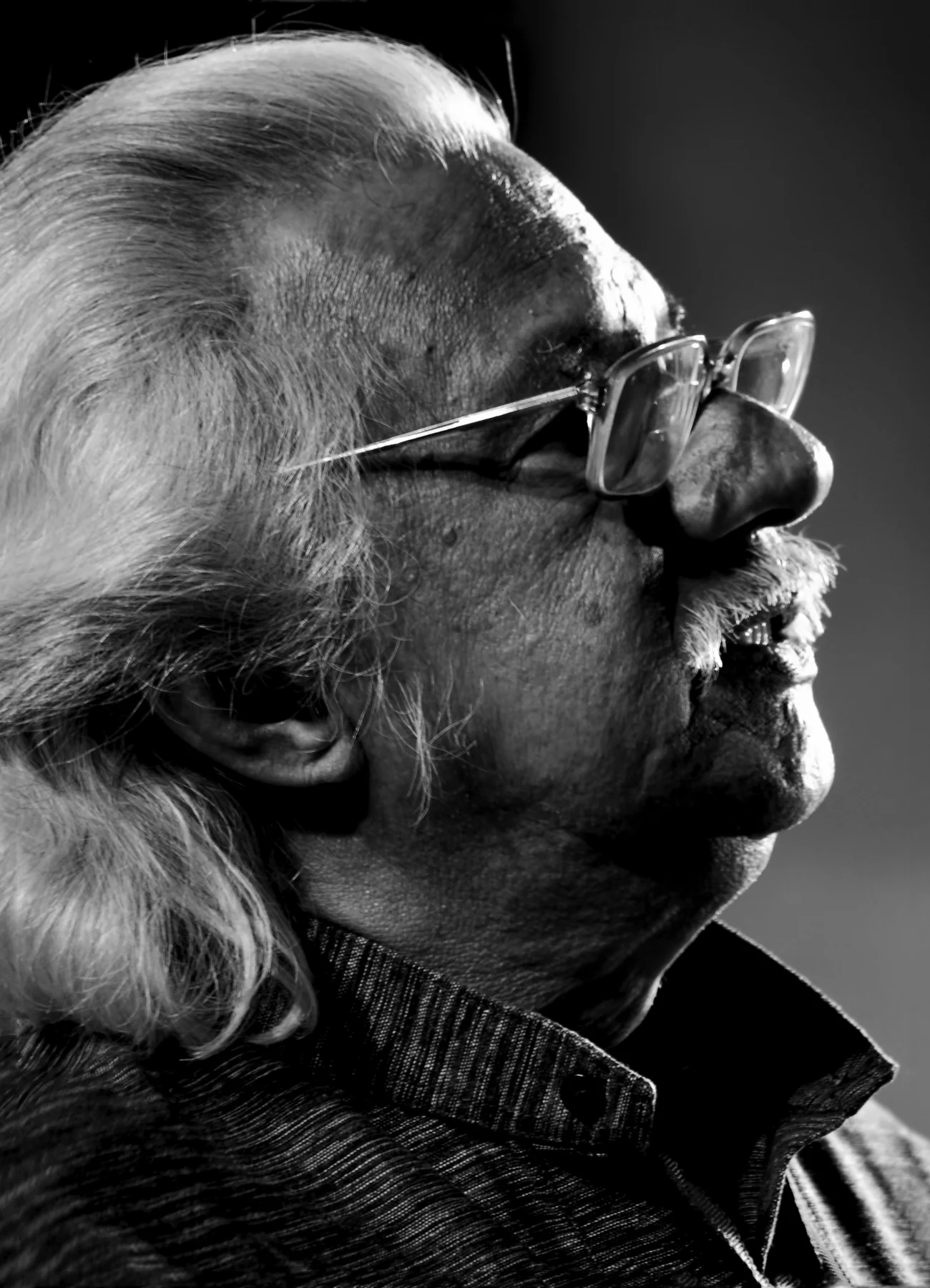
In this biography
Quick facts
- Born
- 1940
- Birthplace
- Singapore
- Country
- Singapore
- Nationality
- Not independently established
- Known for
- Ceramics and teaching
Why this life matters
He joined material experiment with teaching, drawing on several craft traditions while developing a recognisable sculptural practice.
Timeline
Key moments
Textiles abroad
Study in India.
Ceramic engineering
Study in Japan.
A survey exhibition
Kembara Tanah Liat.
From teacher training to two scholarships
Born in Singapore in 1940, Iskandar Jalil trained as a mathematics and science teacher. Pottery entered his life through the Teachers’ Training College, where Sng Cheng Kiat taught him. His early practice involved experimenting with materials and kilns rather than beginning with an established studio system.
A textile scholarship took him to India in 1966; a second Colombo Plan scholarship brought him to Tajimi, Japan, in 1972 to study ceramic engineering. Weaving and pottery remained connected in his thinking: basket impressions, layered colour and the tactile qualities of a surface could become part of a vessel’s design.
Teaching through practice
On returning from Japan, he worked in the pottery department at Baharuddin Vocational Institute. His retrospective account describes wanting to pass on everything he had learned before recognising the need for patient, practical teaching. Material choices mattered: the same form or technique could not simply be imposed on every clay.
His methods included handbuilding, slabs and coils as well as throwing. He sometimes retained visible construction traces and attached found branches as handles. Everyday objects, regional architecture and travel supplied ideas, while the resulting pieces could move beyond household utility.
A public practice and a large survey
He received the Cultural Medallion in 1988 and Japan’s Order of the Rising Sun, Gold Rays with Rosette, in 2015. National Gallery Singapore’s 2016 survey brought together nearly 180 ceramics. Seng Yu Jin and Syed Muhammad Hafiz curated the exhibition, presenting both travel and education as central to his work.
One annex description recounts a teapot altered by clay falling during firing. He kept the piece for its accidental quality. That particular decision sits beside his demanding standards; it does not mean that every damaged pot was acceptable.
Sources for this section: [3]
An educational legacy
Nanyang Technological University conferred an honorary Doctor of Letters in 2016. NIE’s collection emphasises his educator-mentor role and the textured surfaces and distinctive handles of his ceramics. The surviving work and teaching accounts show a practice in which making, travel and passing knowledge to others remained intertwined.
Quick answers
Frequently asked questions about Iskandar Jalil
- Was his doctorate earned through research?
- No. The cited institution identifies an honorary degree.
Keep exploring
Lives connected to this story
- Arthur Boyd
How did another ceramic practice distribute work among collaborators?
- Agnes Martin
How can a planned structure retain traces of making?
Sources and further reading
Explore the evidence
These references support the biography and offer further reading. Official records, first-person accounts and independent reporting provide different perspectives; image records document attribution and licensing.
- 1. NIE; researched text by Silver Rue Art Consulting, 2016A Master Potter’s Philosophy and Process
Edited practitioner reflections; the honorary degree is not an earned doctorate.
- 2. Asian Art Newspaper interview, 1 September 2016Iskandar Jalil
- 3. National Gallery Singapore, 29 August 201650 Years of Master Potter Iskandar Jalil’s Work
- 4. NIE LibraryDr Iskandar Jalil Collection