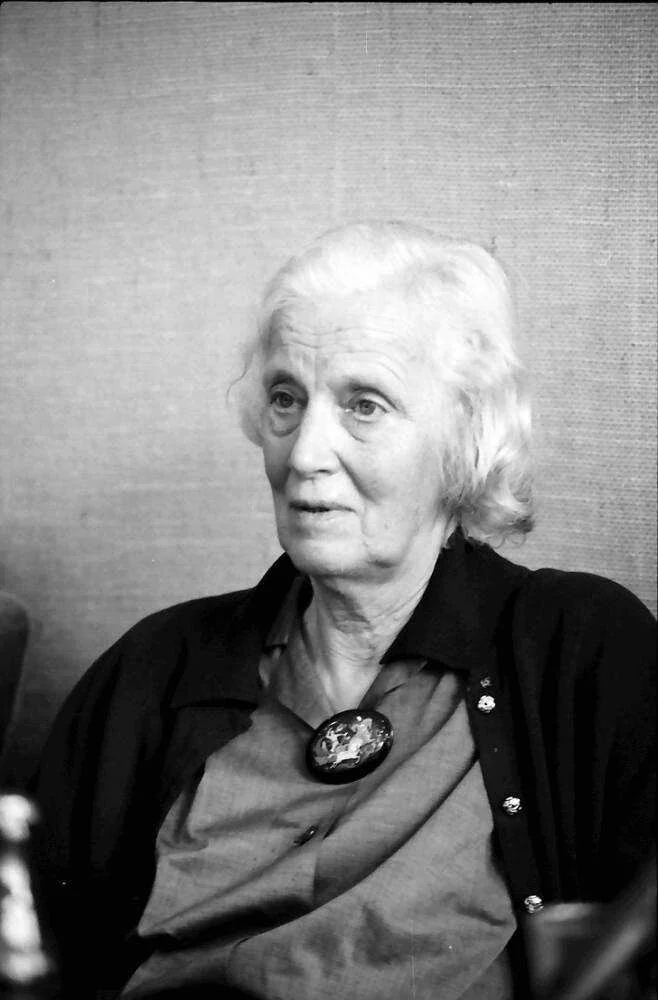
In this biography
Quick facts
- Born
- 10 May 1901
- Died
- 15 September 1971
- Birthplace
- Nenagh, County Tipperary, Ireland
- Country
- Ireland
- Nationality
- Not independently established
- Known for
- Structural research, Birkbeck laboratories and science-policy debate
- Early research
- Royal Institution, from 1923
- Pepsin report
- With D. Crowfoot, 26 May 1934
- Royal Society
- Elected 1937
- Birkbeck
- Professor of Physics from 1938; Crystallography chair, 1963
Why this life matters
His contribution is clearer when experiments, collaborators, laboratory leadership and political arguments are credited separately.
Timeline
Key moments
Birth
Born in Nenagh, County Tipperary.
Cambridge and London
Studied at Cambridge and began research with Bragg at the Royal Institution.
Cambridge lecturer
Returned to Cambridge as a lecturer.
Pepsin collaboration
Published X-ray Photographs of Crystalline Pepsin with Dorothy Crowfoot.
Birkbeck and public writing
Moved into laboratory leadership and published The Social Function of Science in 1939.
Rebuilt laboratory
Birkbeck’s account dates the new Torrington Square laboratory opening to 1 July.
Later years
Held the Crystallography chair; health declined after a stroke, and he died in 1971.
An Irish beginning led into Cambridge science
Bernal was born on 10 May 1901 in Nenagh, County Tipperary. He entered Cambridge in 1919, studying mathematics and the natural sciences before concentrating on physics. Independent work on symmetry and space groups helped draw William Henry Bragg’s attention. In 1923 he joined research at the Royal Institution. The route mattered: mathematical interests became tools for studying physical arrangements in materials. His early investigations included graphite, alloys and instrument methods. They preceded the biological research most often associated with his name and provided experience of how a diffraction record could constrain a structural explanation.
Sources for this section: [1]
Molecules brought new questions to a physical method
Bernal returned to Cambridge as a lecturer in 1927 and investigated substances including sterols and proteins. Dorothy Crowfoot, later Dorothy Hodgkin, worked with him from 1932. Their joint report X-Ray Photographs of Crystalline Pepsin appeared in Nature on 26 May 1934. The accessible opening credits crystals prepared by Dr Philpot in Svedberg’s Uppsala laboratory and brought by G. Millikan. This is a network of preparation, transfer and investigation, not an isolated two-person discovery. The preview also describes crystals changing in air, making specimen condition part of the experimental question.
Diffraction was a beginning, not a complete protein structure
The 1934 report is important to the history of protein diffraction, but a pattern is not itself a finished atomic model. Hodgkin’s 1964 Nobel lecture explains the further problem: measured intensities supply amplitudes, while phase information is needed to calculate electron density. Methods for obtaining and testing that information required continuing work. Her retrospective account places the Cambridge collaboration within her own developing career. It does not make Bernal the author of all her later structures. Nor should the accessible opening of their paper be presented as a newly verified reading of every page of the original report.
Birkbeck made research leadership a practical responsibility
Birkbeck’s current institutional account places Bernal’s professorship of physics from 1938; an older departmental summary gives 1937. The move belongs to the late 1930s without concealing that discrepancy. Wartime disruption interrupted laboratory building. After his return, a new crystallography laboratory at Torrington Square opened on 1 July 1948, according to the department’s history. Rosalind Franklin and later Aaron Klug were among researchers connected with this setting. Their particular work must retain its own institutional location and credit: Franklin’s earlier King’s College DNA photographs should not be reassigned to Bernal’s laboratory.
War redirected scientific organisation
During the Second World War Bernal worked on civil-defence and operational problems, including protection from bombing and planning associated with Combined Operations. His contribution to breakwater and landing research belonged to teams supporting practical military decisions. Calling him the sole inventor of the Mulberry harbours would replace that collaborative history with a slogan. The work also reinforced his interest in how scientific knowledge could be organised for social purposes. His 1939 The Social Function of Science and later Science in History, published in 1954, addressed science as an activity shaped by institutions and material circumstances.
Public commitments require critical treatment too
Bernal’s communist politics and peace campaigning gave his arguments an international audience; he led the World Peace Council from 1958 to 1965. The Dictionary of Irish Biography also records his support for Lysenko’s discredited biological views. That is a substantive failure of judgment, not something erased by achievement in crystallography. Elected a Fellow of the Royal Society in 1937, he received its Royal Medal in 1945. He held Birkbeck’s crystallography chair from 1963, the year of a disabling stroke, and died in London on 15 September 1971. His legacy includes both a productive research community and difficult questions about the relation between evidence and political loyalty.
Quick answers
Frequently asked questions about John Desmond Bernal
- Did Bernal alone discover the structure of pepsin in 1934?
- No. The report was co-authored with Dorothy Crowfoot and belongs to the development of protein diffraction, not a completed atomic structure determination.
- Was J. D. Bernal a Nobel laureate?
- No. Hodgkin’s later Nobel recognition was her own; collaboration does not transfer an award.
Keep exploring
Lives connected to this story
- Dorothy Hodgkin
Read the pepsin co-author’s independent career and her explanation of structure determination.
- Rosalind Franklin
Follow Franklin’s distinct research at King’s and later Birkbeck without transferring credit between laboratories.
- Kathleen Lonsdale
Compare mathematical reference work and structural research in another Bragg-associated career.
Sources and further reading
Explore the evidence
These references support the biography and offer further reading. Official records, first-person accounts and independent reporting provide different perspectives; image records document attribution and licensing.
- 1. Dictionary of Irish BiographyBernal, John Desmond: scholarly biography
- 2. Birkbeck, University of LondonBernal Lecture: institutional career and commemoration
The current Birkbeck account gives 1938 for the Physics professorship; the older departmental history gives 1937. The discrepancy is retained rather than converted into an invented appointment sequence.
- 3. Birkbeck, University of LondonBirkbeck crystallography: departmental history
- 4. J. D. Bernal and D. Crowfoot; NatureX-Ray Photographs of Crystalline Pepsin, Nature 133, 794–795, 26 May 1934: opening preview
Read the accessible original opening preview and publication metadata, not the complete subscription article. Its authors are J. D. Bernal and D. Crowfoot.
- 5. Dorothy Crowfoot Hodgkin; Nobel FoundationThe X-ray Analysis of Complicated Molecules, Nobel Lecture, 11 December 1964
Selected opening pages and references of Hodgkin’s 1964 lecture were read for her Cambridge recollection and the amplitude–phase distinction. This is a later participant account, not the full 1934 experimental protocol.