In this biography
Quick facts
- Born
- 6 July 1946
- Birthplace
- New Haven, Connecticut, United States
- Country
- United States
- Nationality
- American
- Known for
- The post-September 11 presidency, the Afghanistan and Iraq wars, education legislation and PEPFAR
- College degrees
- Yale, 1968; Harvard MBA, 1975
- Governor of Texas
- 1995–2000
- U.S. president
- 2001–2009
- Father
- George H. W. Bush, 41st U.S. president
Why this life matters
Bush’s decisions after September 11 reshaped American security policy and the lives of people in Afghanistan and Iraq. His record also includes major domestic legislation and international HIV programs, alongside failures of intelligence, disaster coordination and economic stability.
Timeline
Key moments
Born in Connecticut
George Walker Bush was born in New Haven on 6 July and grew up principally in Texas.
Military training, business and baseball
After Yale he served in the Air National Guard, completed a Harvard MBA and worked in energy before joining the Texas Rangers ownership group.
Governed Texas
He took office on 17 January 1995 and won reelection in 1998 before his presidential campaign.
Became president; September 11 changed the agenda
Inaugurated on 20 January, he later ordered military strikes in Afghanistan following the al-Qaeda attacks.
Iraq invasion and PEPFAR
The administration launched the Iraq War and announced the President’s Emergency Plan for AIDS Relief, separate initiatives with very different purposes and outcomes.
Confronted a financial crisis and left office
He signed emergency financial stabilization legislation in October 2008 and completed his second term on 20 January 2009.
A Texas upbringing connected education, military service and business
George Walker Bush was born in New Haven, Connecticut, on 6 July 1946, the son of George Herbert Walker Bush and Barbara Bush. His father later became the 41st president; George W. Bush would become the 43rd. Although born in Connecticut, he grew up principally in Texas and attended Phillips Academy before entering Yale.
He graduated in history in 1968, trained as a pilot in the Air National Guard and completed an MBA at Harvard in 1975. Work in the oil industry preceded a more visible role in baseball. In 1989 he assembled an investor group that purchased the Texas Rangers. He had married Laura Welch in 1977; their twin daughters were born in 1981.
The Texas governorship led to a disputed presidential election
Bush lost a congressional race in 1978, but won election as governor of Texas in 1994. Taking office in January 1995, he promoted tax reductions, changes to welfare and criminal-justice policy, and an education agenda that emphasized testing and accountability. His 1998 reelection strengthened his position within the national Republican Party.
The 2000 presidential election against Al Gore turned on a contested Florida count and a prolonged legal dispute. The final Electoral College tally gave Bush 271 votes to Gore’s 266, although Gore received more votes nationwide. Bush entered the presidency on 20 January 2001. The distinction between the popular vote and electoral votes is essential to understanding that result without treating a court ruling as the formal certification of all votes.
Education, taxes and international health formed a separate policy agenda
Bush’s early domestic program included tax reductions and federal education legislation. He signed the No Child Left Behind Act on 8 January 2002, bringing a stronger national emphasis on school testing and accountability. Enacting those requirements was distinct from demonstrating that every school benefited; the administration’s favorable account should not substitute for evaluation of the law’s results.
In 2003 he announced the President’s Emergency Plan for AIDS Relief, known as PEPFAR. The program expanded support for HIV prevention, treatment and health systems through American agencies and international partners. Its later achievements depended on congressional funding, health workers, partner governments and people living with HIV, not the president alone. The health initiative remains an important part of a record often dominated by war.
September 11 transformed national security priorities
The al-Qaeda attacks of 11 September 2001 transformed Bush’s presidency. Civilian airliners struck the World Trade Center and the Pentagon, while a fourth crashed in Pennsylvania. His administration made counterterrorism the central organizing principle of foreign and security policy, expanding the scale and reach of the American response.
On 7 October Bush announced military strikes against al-Qaeda camps and Taliban installations in Afghanistan. He described the campaign as a response to the Taliban’s protection of the terrorist network. The initial removal of the Taliban from major cities did not resolve the country’s political future or end the conflict. Military action, humanitarian claims and the practical demands of rebuilding had to be judged by their consequences, not only the administration’s stated intentions.
The Iraq invasion made intelligence and accountability central questions
Bush ordered the invasion of Iraq in March 2003 after securing congressional authorization and arguing that Saddam Hussein’s government posed an unacceptable threat. This was a different war from the 1991 coalition campaign conducted during his father’s presidency. The new operation removed Hussein’s government, but American forces remained amid a prolonged conflict.
Central prewar claims about Iraqi weapons stockpiles and active programs were not substantiated by postwar investigation. The 2005 WMD Commission documented serious failures in collection, analysis and communication. Those findings matter to assessing the case for war, alongside the president’s responsibility for choosing military action. Intelligence agencies, senior advisers and Congress had their own roles; their involvement does not erase presidential decision-making or justify unsupported claims about any individual’s private knowledge.
Disaster response and financial collapse tested the second term
Bush won reelection in 2004, but his second term brought major failures and emergencies at home. Hurricane Katrina in 2005 exposed weaknesses in disaster preparation, leadership and coordination across federal, state and local government. The Government Accountability Office subsequently identified deficiencies in capabilities and accountability, rather than a single problem that could be solved by one official’s replacement.
The financial crisis intensified in 2008. Bush signed the Emergency Economic Stabilization Act on 3 October, authorizing extraordinary federal action aimed at stabilizing the financial system. That emergency response did not mean the economic damage had ended. He left office in January 2009 during a severe downturn. His presidency thus closed with contested wars abroad and urgent questions about governmental competence and economic security at home.
Quick answers
Frequently asked questions about George W. Bush
- Which President Bush served in 2001–2009?
- George W. Bush, the 43rd president, served those two terms. His father, George H. W. Bush, was the 41st president in 1989–1993.
- Did Bush win the national popular vote in 2000?
- No. Al Gore received more votes nationwide, while Bush won the Electoral College. The final recorded tally was 271 electoral votes for Bush and 266 for Gore.
- What happened to the Iraq weapons claims?
- Postwar investigations did not substantiate central claims about Iraqi stockpiles and active weapons programs. The official WMD Commission identified major intelligence failures, which must be distinguished from the separate decision to invade.
- What was PEPFAR?
- Announced in 2003, the President’s Emergency Plan for AIDS Relief expanded American support for international HIV prevention, treatment and health systems through government agencies and partner institutions.
Keep exploring
Lives connected to this story
- George H. W. Bush
Distinguish his father’s 1989–1993 presidency and the 1991 Gulf War from the later Bush administration.
- Condoleezza Rice
Examine the career of his national security adviser and later secretary of state, including diplomacy and the public Iraq arguments.
Sources and further reading
Explore the evidence
These references support the biography and offer further reading. Official records, first-person accounts and independent reporting provide different perspectives; image records document attribution and licensing.
- 1. George W. Bush Presidential Library, National ArchivesGeorge W. Bush
Used critically for biography and chronology. Its inconsistent age for Bush at his sister’s 1953 death is omitted, and its shorthand about Bush v. Gore is not repeated as a claim that the Court certified electoral votes. Favorable policy assessments are not adopted as established outcomes.
- 2. Texas State Library and Archives CommissionPortraits of Texas Governors: George W. Bush
- 3. National Archives2000 Electoral College Results
- 4. U.S. Government Publishing OfficePublic Law 107-110: No Child Left Behind, approved 8 January 2002
- 5. Centers for Disease Control and PreventionEliminating HIV as a Global Public Health Threat, March 2023
A dated March 2023 historical assessment supports PEPFAR’s origins and collaborative work. No numerical outcome is presented as a current 2026 total.
- 6. George W. Bush White House ArchivesPresidential Address to the Nation, 7 October 2001
- 7. George W. Bush White House ArchivesWar Powers Report Letter, 15 June 2007
- 8. George W. Bush White House ArchivesPresident Bush Addresses the Nation, 19 March 2003
- 9. Commission on the Intelligence Capabilities of the United States Regarding Weapons of Mass DestructionReport to the President, 31 March 2005: selected overview and Iraq findings
Selected official overview and Iraq findings, not a claim to have read the full report or to know an individual’s private intent.
- 10. U.S. Government Accountability OfficeEmergency Management: Post-Katrina Reform Act Implementation, GAO-09-433T
- 11. U.S. Government Publishing OfficePublic Law 110-343: Emergency Economic Stabilization Act of 2008
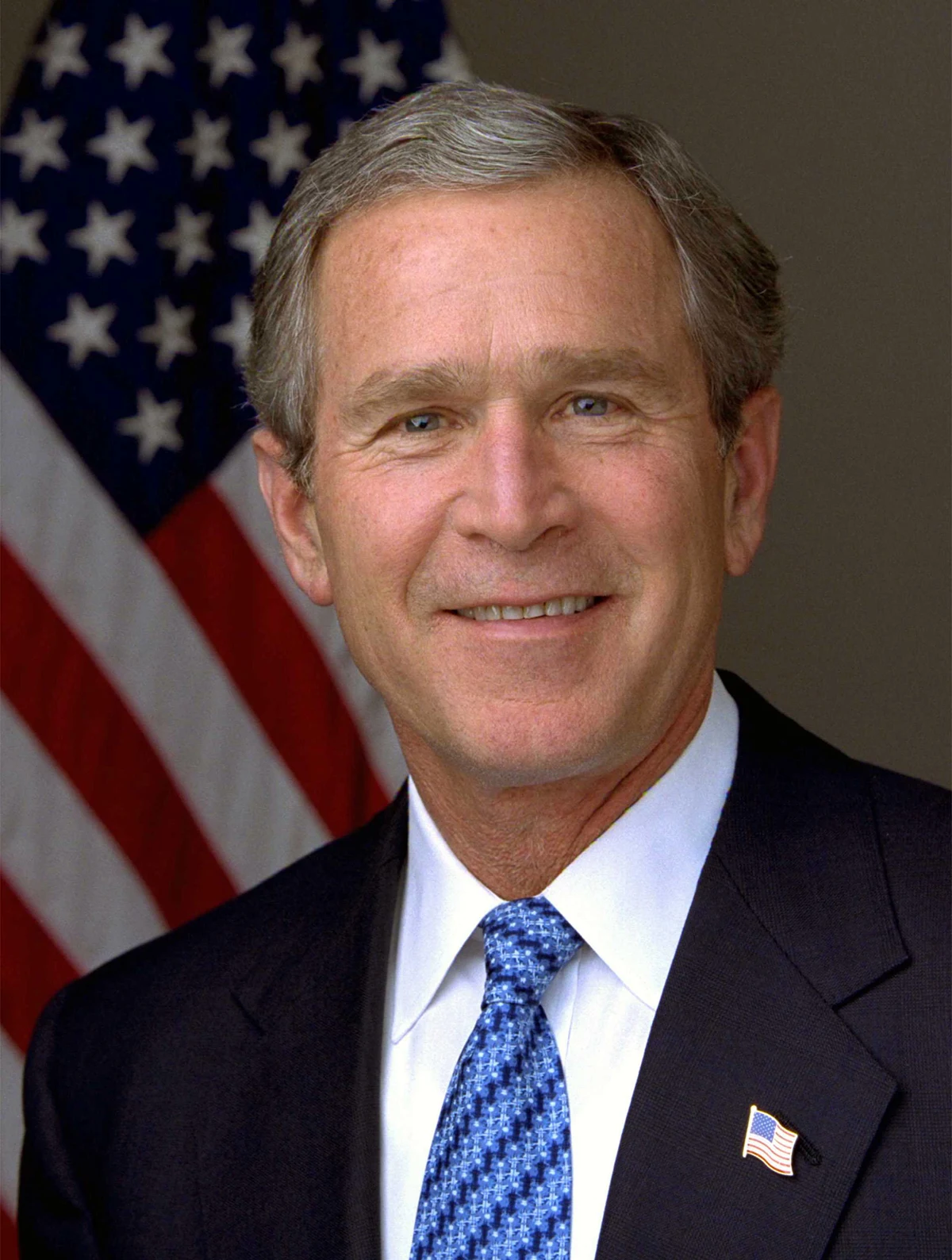
- 12. U.S. Department of Defense photograph via Wikimedia CommonsOfficial George W. Bush portrait, 030114-O-0000D-001