In this biography
Quick facts
- Born
- 1826
- Died
- 1911
- Birthplace
- Oakley Park, near Birr, County Offaly, Ireland
- Country
- Ireland
- Nationality
- Not independently established
- Known for
- Electrical units, the electron name and Irish scientific institutions
- Education
- Trinity College Dublin BA, 1848
- Galway teaching
- Professor of Natural Philosophy, 1852–1857
- University administration
- Queen’s University of Ireland, 1857–1882
- Scientific recognition
- Royal Society, 1861; Boyle Medal, 1899
Why this life matters
Distinguishing a proposed unit and name from a later particle experiment makes his contribution precise without diminishing it.
Timeline
Key moments
Birth
Born near Birr, County Offaly.
Degree and astronomy
Completed a Trinity BA and worked with the Earl of Rosse.
Galway professor
Taught natural philosophy at Queen’s College Galway.
University administration
Worked for the Queen’s University of Ireland.
Natural units
Presented the Belfast argument in 1874, with later presentation and publication in 1881.
Electron terminology
Used electron for the elementary electrical quantity before Thomson’s 1897 particle work.
Death
Died after later years in London.
Astronomy and teaching came before the familiar name
Stoney was born in 1826 at Oakley Park near Birr, County Offaly. Educated initially at home, he completed a BA at Trinity College Dublin in 1848. Work as an assistant to the Earl of Rosse connected him with observational astronomy at Birr Castle. An unsuccessful fellowship competition at Trinity did not end his scientific career. He became Professor of Natural Philosophy at Queen’s College Galway in 1852, holding the post until 1857. These appointments show a career developing through instruments, teaching and institutions before the electrical terminology for which he is now remembered.
An administrator worked across three colleges
In 1857 he moved into administration for the Queen’s University of Ireland, remaining until 1882. This degree-awarding body served the colleges in Belfast, Cork and Galway; it was not simply another name for the Galway college where he had taught. Administrative work occupied a substantial part of his professional life alongside continuing research. He later moved to London in 1893 to support his daughters’ university studies. That family move should not be used as the ending date of the earlier university office. Institutional titles and dates help prevent several distinct stages from being compressed into one appointment.
Sources for this section: [1]
Standards made an electrical quantity a research problem
Stoney participated for decades in the British Association’s work on electrical standards, alongside scientists including William Thomson and James Clerk Maxwell. A shared unit made measurements portable between laboratories, but selecting a unit also raised questions about relations among physical quantities. In a Belfast paper presented in 1874, and presented and published again in 1881, Stoney discussed natural units based on light, gravity and an elementary electrical quantity. Electrolysis and estimates of molecular numbers helped motivate an estimate of that quantity. This was an argument from existing physical relationships, not a cathode-ray experiment observing a new particle.
Sources for this section: [1]
The electron name preceded particle identification
By his 1894 discussion Of the Electron, or Atom of Electricity, Stoney was defending the priority of his elementary electrical concept. University of Galway’s history explicitly distinguishes his terminology from J. J. Thomson’s experimental identification in 1897. Naming a unit, estimating a quantity and investigating the properties of a carrier are related but separate contributions. Describing Stoney as the sole experimental discoverer would confuse them. Equally, beginning the history only with a later laboratory result would conceal the measurement and conceptual problems that made an elementary charge worth investigating.
A wider scientific life survives in institutional records
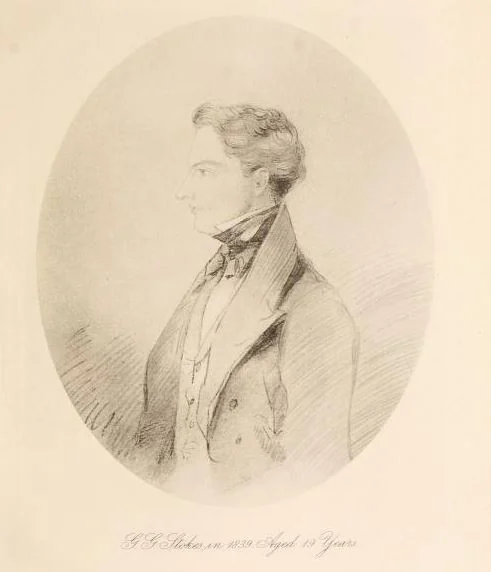
His interests also included spectroscopy, optics, gases and astronomy. Some explanations relied on the ether models of his period; historical importance does not make those models current physical theory. He became a Fellow of the Royal Society in 1861 and the first recipient of the Royal Dublin Society’s Boyle Medal in 1899. He died in 1911. Trinity’s exhibition, Galway’s institutional history and the RDS portrait catalogue preserve complementary parts of that life. The portrait’s existence establishes commemoration, while the written accounts explain appointments and research. No likeness is reproduced here without a verified commercial-use basis.
Quick answers
Frequently asked questions about George Johnstone Stoney
- Did Stoney discover the electron in a cathode-ray experiment?
- No. His elementary-charge concept and electron terminology preceded Thomson’s 1897 experimental work.
- Which university employed him after Galway?
- He worked in administration for the Queen’s University of Ireland, the body serving three constituent colleges, rather than remaining professor at Galway.
Keep exploring
Lives connected to this story
- John Tyndall
Compare another Irish physicist’s instrument-based work and different path through British scientific institutions.
- Ernest Walton
Distinguish elementary electrical concepts from the much later experimental work on atomic nuclei.
Sources and further reading
Explore the evidence
These references support the biography and offer further reading. Official records, first-person accounts and independent reporting provide different perspectives; image records document attribution and licensing.
- 1. Trinity College DublinGeorge Stoney: Physics 300 exhibition
The university exhibition supplies the career chronology, standards work and 1874/1881 publication sequence. It is an institutional historical account; the original nineteenth-century papers were not independently acquired.
- 2. University of GalwayElectricity and University of Galway: George Johnstone Stoney
The institutional account distinguishes Stoney’s electron terminology from Thomson’s 1897 experimental identification. Exact-day birth and death fields are withheld; only supported years are used.
- 3. Royal Dublin Society Digital ArchiveGeorge Johnstone Stoney, portrait by Thomas Alfred Jones, 1883: item 3865
The dated portrait catalogue was used as an institutional record, not as a licence to reproduce its image.