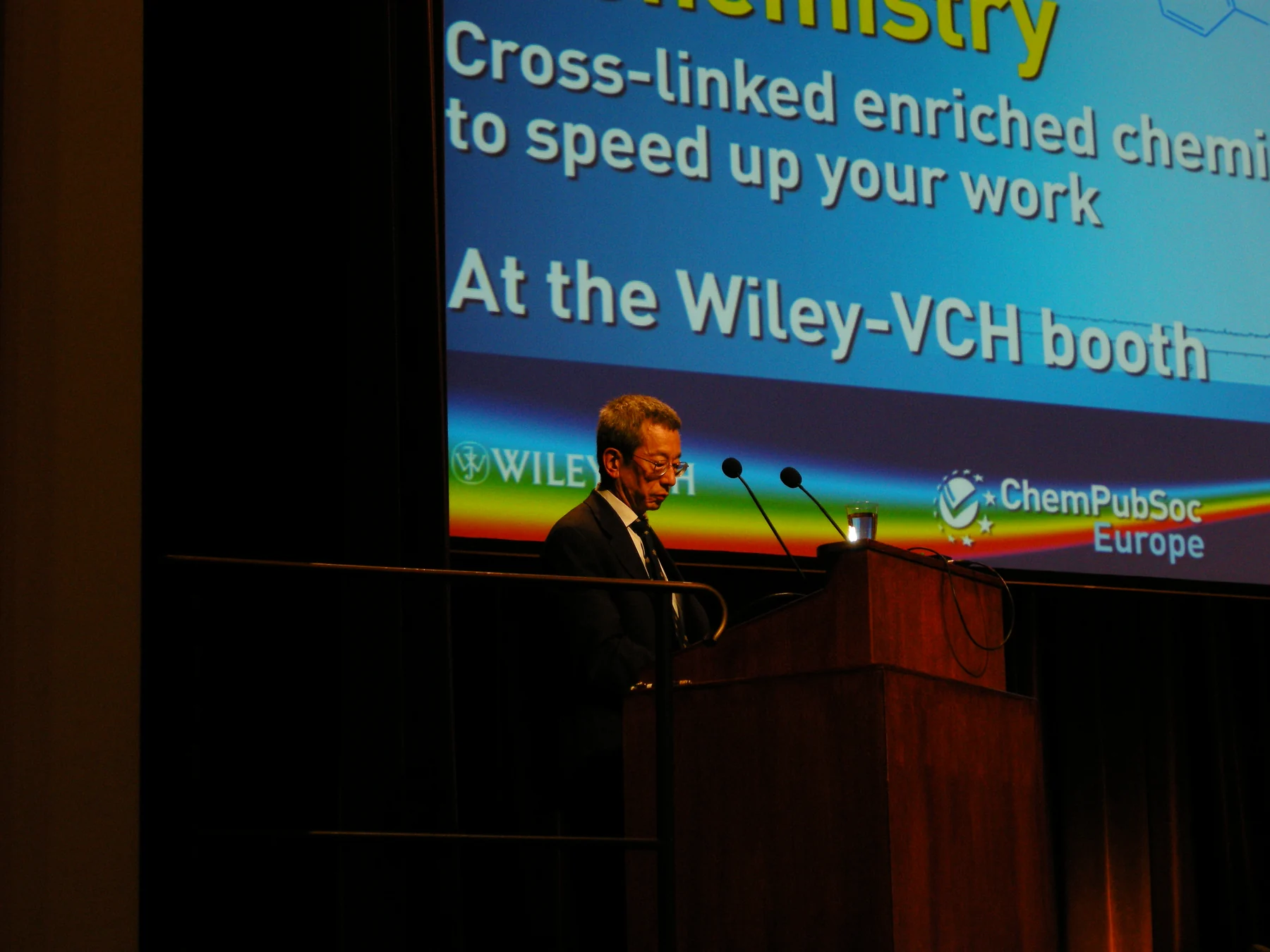
In this biography
Quick facts
- Born
- 13 January 1960
- Birthplace
- Ann Arbor, Michigan, United States
- Country
- United States
- Nationality
- Not independently established
- Known for
- Co-developing photoactivated localisation microscopy and other methods for high-resolution biological imaging
Why this life matters
His work connects precise single-emitter measurements with the dense sampling needed to reconstruct a meaningful biological structure.
Timeline
Key moments
Born in Ann Arbor
Betzig was born on 13 January.
PALM paper
Published the single-molecule localisation method witha wider team.
Chemistry Nobel
Shared the award with Stefan Hell and William Moerner.
An instrument builder’s education
Eric Betzig was born in Ann Arbor, Michigan, in 1960. He studied physics at Caltech and continued doctoral research at Cornell before joining Bell Laboratories. His early work concerned microscopy and the challenge of obtaining optical information at very small scales. His autobiography describes the intellectual stimulus of Bell Labs and his friendship with Harald Hess. Those encounters mattered to the later story, but the career was not a straightforward progression from graduate school to the method that eventually earned a Nobel Prize.
Leaving and returning to laboratory research
After Bell Labs, Betzig worked in his father’s machine business before returning to scientific problems. He and Hess developed a new route to high-resolution imaging using sparse activation of fluorescent labels. Betzig’s account also names collaborators such as Jennifer Lippincott-Schwartz and George Patterson, whose biological and labelling expertise helped make the idea useful for cellular structures. He joined HHMI’s developing Janelia research campus in 2005. The collaboration therefore combined optical reasoning, experimental construction and biological material rather than treating microscopy as an exclusively theoretical trick.
The 2006 PALM result
The 2006 paper reported activating small subsets of photoactivatable fluorescent protein molecules, localising them and then bleaching them before activating further subsets. Combining the positions produced a super-resolution image. The paper’s author list includes researchers from several contributing groups. A later Janelia commentary stresses a distinction central to interpreting the method: precisely locating one emitter is not the same as resolving every feature of a complex structure. The density and distribution of labels also matter to the image that can be reconstructed.
Recognition for a method and its conditions
Betzig shared the 2014 Nobel Prize in Chemistry with Stefan Hell and William Moerner. The award brought together different developments that overcame conventional optical-resolution limits. His contribution is most clearly understood by keeping its stages visible: make emitters distinguishable in time, estimate their positions and combine sufficiently dense observations into a structural image. This explains both the method’s power and why a very precise coordinate from one molecule cannot guarantee a complete map of the surrounding cell. Scientific credit belongs to the method and the collaboration that demonstrated it.
Quick answers
Frequently asked questions about Eric Betzig
- Who was Eric Betzig’s key PALM collaborator?
- Harald Hess was a central co-developer, and the 2006 paper also names the wider optical and biological-imaging team.
- Is localisation precision the same as image resolution?
- No. Precisely estimating one emitter’s position does not guarantee that a complex structure has been sampled densely enough to resolve its features.
Keep exploring
Lives connected to this story
- Martin Chalfie
Read fluorescent-protein research that helped make molecular labelling useful for biological imaging; the tools and the imaging method have different roles.
Sources and further reading
Explore the evidence
These references support the biography and offer further reading. Official records, first-person accounts and independent reporting provide different perspectives; image records document attribution and licensing.
- 1. Betzig and colleagues / Science; UC Irvine teaching copyImaging Intracellular Fluorescent Proteins at Nanometer Resolution
- 2. Janelia Research Campus, HHMIImaging intracellular fluorescent proteins atnanometer resolution, with commentary
The retrospective commentary’s methodological distinction is used; its claims of priority or superiority over other 2006 groups are not adopted as an independent verdict.
- 3. Nobel Prize OutreachEric Betzig — Facts
- 4. Nobel Prize OutreachEric Betzig — Biographical