
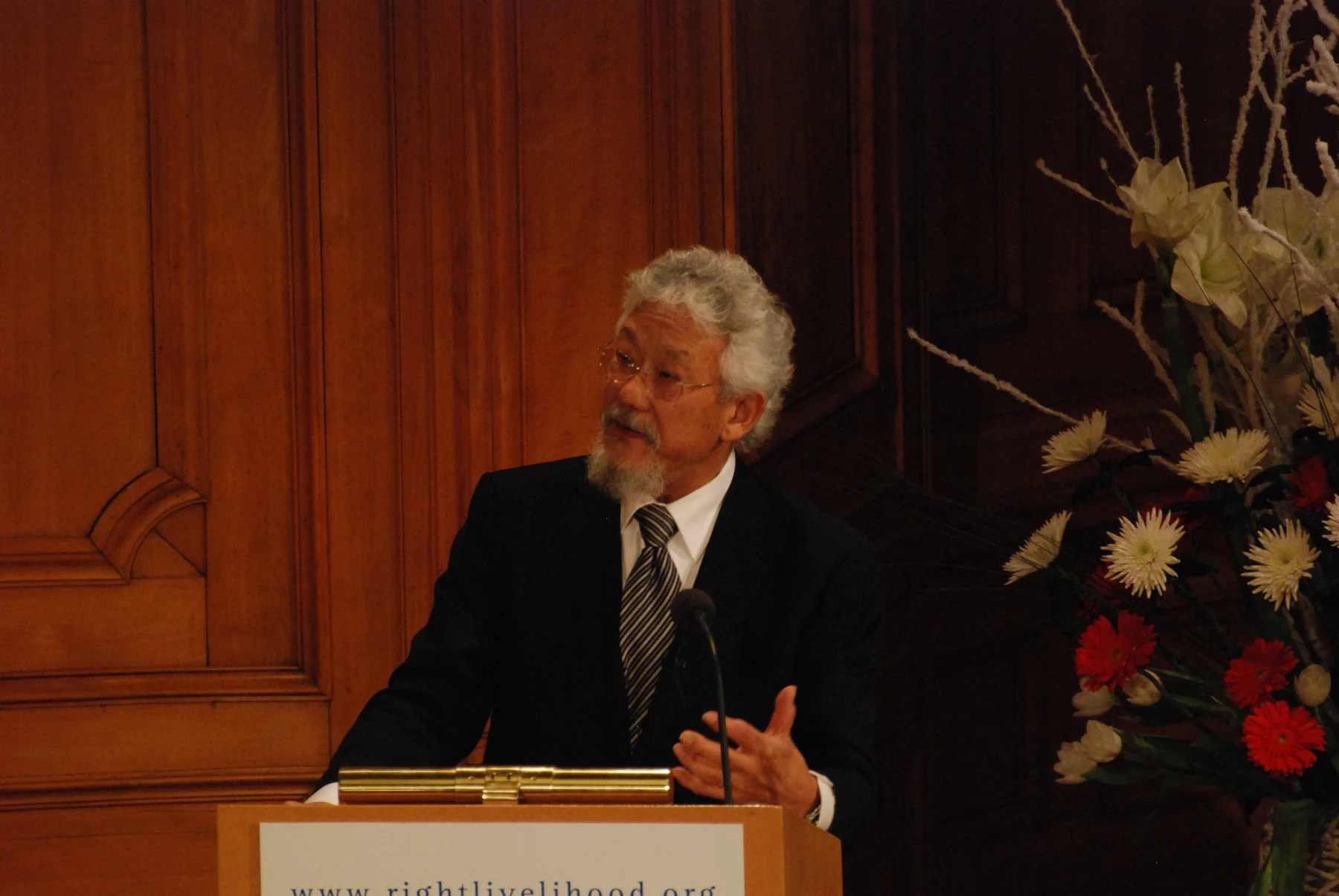
In this biography
Quick facts
- Born
- 24 March 1936
- Birthplace
- Vancouver, British Columbia
- Country
- Canada
- Nationality
- Not independently established
- Known for
- Science communication and environmental advocacy
- Academic transition
- UBC retirement, 2001
Why this life matters
His career connects scientific teaching with public communication and collective environmental organising.
Timeline
Key moments
Doctoral training
Zoology at Chicago.
Joins UBC
Begins his university appointment.
A broadcasting transition
Describes his final hosting year.
Childhood before a scientific career
Suzuki was born in Vancouver in 1936. During the Second World War, his family was sent to an internment camp in British Columbia. After the war they moved to Ontario. A Foundation education guide recalls his exploration near Leamington as an influence on his later concern for the environment.
Sources for this section: [1]
Genetics and university teaching
He earned a zoology doctorate at the University of Chicago in 1961 and joined UBC in 1963. His university career continued until retirement in 2001. A 2024 UBC account identifies him as professor emeritus and records the honorary doctorate awarded in 2011.
With T. Grigliatti and R. Williamson, he published a 1971 study of a temperature-sensitive mutation in Drosophila. Its abstract reports reversible paralysis in mutant adults shifted from 22°C to 29°C. The work examined how a genetic difference could be expressed under particular conditions.
Science moves into public broadcasting
UBC’s 2011 honorary citation recognises both research and broadcasting. It identifies Suzuki with The Nature of Things and as a former host of Quirks and Quarks. Explaining science to a public audience became a substantial part of his working life alongside the university career.
Sources for this section: [3]
An organisation and another transition
He co-founded the David Suzuki Foundation, whose work includes education, advocacy and policy.
In his signed Spring 2023 newsletter contribution, Suzuki described that year as his last hosting The Nature of Things while saying he intended to continue advocacy.
Quick answers
Frequently asked questions about David Suzuki
- Did university retirement end all of his work?
- He retired from UBC in 2001; later institutional accounts document continuing public science work.
Keep exploring
Lives connected to this story
- Roberta Bondar
Compare another scientific career that developed a public environmental dimension.
Sources and further reading
Explore the evidence
These references support the biography and offer further reading. Official records, first-person accounts and independent reporting provide different perspectives; image records document attribution and licensing.
- 1. David Suzuki FoundationWho is David Suzuki? Appendix C1
Read the selected educational appendix, not the complete teaching guide.
- 2. UBC OkanaganSuzuki at UBC
- 3. University of British ColumbiaDavid Suzuki: 2011 honorary citation
- 4. David Suzuki FoundationNever Retiring: Spring 2023 last word
Read the signed newsletter passage. No broadcast episode was viewed; a stated intention is not proof of every subsequent activity.
- 5. D. T. Suzuki, T. Grigliatti and R. Williamson, PNAS, 1971Temperature-sensitive mutations VII: reversible adult paralysis
Read the publication record and abstract only; no complete research paper or fly experiment was inspected.