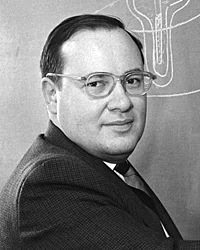
In this biography
Quick facts
- Born
- 7 June 1877
- Died
- 23 October 1944
- Birthplace
- Widnes, United Kingdom
- Country
- United Kingdom
- Nationality
- Not independently established
- Known for
- Distinguished characteristic secondary X-rays from scattered radiation and investigated polarization and the K and L families.
Why this life matters
Distinguished characteristic secondary X-rays from scattered radiation and investigated polarization and the K and L families.
Timeline
Key moments
Birth
Born in Widnes, Lancashire.
Return to Liverpool
Began the X-ray investigations that shaped his career.
Fluorescence paper
Published an account of the spectra of fluorescent Röntgen radiation.
Nobel Prize
Recognised for characteristic X-rays of elements.
From Widnes to the Cavendish Laboratory
Charles Glover Barkla was born in Widnes, Lancashire, in 1877. He studied mathematics and physics at University College, Liverpool, where Oliver Lodge taught him. After an undergraduate degree in 1898 and a master’s degree the following year, a research scholarship took him to Cambridge. He worked in the Cavendish Laboratory with J. J. Thomson and returned to Liverpool in 1902. His earliest research dealt with electrical waves along wires. His subsequent choice of X-rays gave him another way to ask how radiation behaves when it encounters matter.
Reading secondary radiation
When X-rays reached a target, Barkla investigated what emerged from it. His experiments distinguished radiation scattered from the incoming beam from another contribution with properties associated with the emitting element. The latter was characteristic fluorescence. Comparison of different targets and excitation conditions provided evidence for this distinction. His 1911 paper on fluorescent Röntgen radiations recorded the investigation in the terminology of its time. What mattered was whether a radiation feature followed a property of the incident beam or remained associated with the particular material under a change in excitation.
Polarization and the groups of lines
Barkla also investigated X-ray polarization. His work on the characteristic radiation used absorption behaviour to sort observations into families. K and L became names for groups that could be further distinguished when later instruments had sufficient resolving power. Barkla’s lecture credits crystal interference work by Bragg, Moseley and others with showing multiple nearby lines in each family. The shift from one apparent line to a resolved group illustrates how a useful early classification can survive a change in measurement detail. The family label can still identify which features belong together.
London, Edinburgh and the prize
Barkla held a physics chair in London from 1909 and became professor of natural philosophy at Edinburgh in 1913. He remained there for the rest of his career. The 1917 Nobel Prize in Physics honoured his discovery of characteristic X-radiation of the elements. He died in Edinburgh in 1944. His investigations gave researchers a practical reason to vary both the illuminating beam and the target. The response of a feature to those changes can identify its origin even when several kinds of outgoing radiation appear together in a single experiment.
Quick answers
Frequently asked questions about Charles Glover Barkla
- What did Barkla discover?
- His prize recognised characteristic X-rays emitted by different elements.
- Why are K and L called series?
- Later experiments resolved multiple neighbouring lines within each group.
Keep exploring
Lives connected to this story
- Arthur Compton
Compare a later angle-dependent shift in scattered radiation.
- William Henry Bragg
Follow how crystal-based interference improved X-ray spectral analysis.
Sources and further reading
Explore the evidence
These references support the biography and offer further reading. Official records, first-person accounts and independent reporting provide different perspectives; image records document attribution and licensing.