In this biography
Quick facts
- Born
- 8 January 1956
- Died
- 30 July 2022
- Birthplace
- Mooroopna, Victoria, Australia
- Country
- Australia
- Nationality
- Australian
- Known for
- Took the Children Away, Charcoal Lane and Tell Me Why
- Born
- 8 January 1956, Mooroopna, Victoria
- Died
- 30 July 2022
- Peoples
- Gunditjmara and Bundjalung
- Musical partner
- Ruby Hunter, an artist and songwriter in her own right
- Breakthrough album
- Charcoal Lane, 1990
- Memoir and companion album
- Tell Me Why, 2019
Why this life matters
Took the Children Away brought an intimate account of forced child removal to wider audiences. His longer career also depended on Ruby Hunter, fellow musicians and a continuing relationship between songs, family and community.
Timeline
Key moments
Born in Mooroopna
Roach’s family connections include Gunditjmara and Bundjalung peoples.
Forced removal
He is taken from his family and placed in foster care.
A song takes shape
Banjo Clarke’s recollections help him write Took the Children Away.
Charcoal Lane and recognition
The album is released in 1990 and receives two ARIA awards in 1991.
Ruby Hunter dies
Their long personal and musical partnership remains central to his work.
Memoir and public honours
Tell Me Why is followed by the Victorian Australian of the Year recognition and ARIA Hall of Fame induction.
Death and continuing legacy
His sons announce his death on 30 July; recordings and family projects carry the work forward.
Family separation shaped a life, not only a famous song
Archie Roach was born in Mooroopna, Victoria, on 8 January 1956. The NFSA identifies him as a Gunditjmara and Bundjalung Elder. As a young child he was forcibly removed from his family, placed in foster care and told that his parents had died.
His childhood also contained formative musical relationships. The Cox foster family introduced him to gospel and other recorded music; Mary Cox helped him learn instruments. The NFSA’s exhibition account describes a teenager confronting the truth of removal and later periods of homelessness and alcohol dependence. Those experiences belong to a wider life, not a ready-made explanation for every song he wrote.
Ruby Hunter was a creative partner with her own voice
Roach met Ruby Hunter, a Ngarrindjeri, Kokatha and Pitjantjatjara woman who had also been removed from her family. Their relationship connected raising a family, performing and songwriting. The NFSA’s joint collection follows more than 35 years together before her death in 2010.
Hunter encouraged Roach to make his first album, and her composition Down City Streets appeared on Charcoal Lane. Her own recordings included Thoughts Within and Feeling Good. Describing her only as the supportive partner of a celebrated man misses the separate authorship and performing career that the archive preserves alongside their shared work.
Charcoal Lane reached listeners through a network of musicians
Took the Children Away drew the attention of Paul Kelly and Steve Connolly in 1989. They produced Charcoal Lane, released in 1990. The title referred to a Fitzroy laneway associated with Melbourne’s Aboriginal community and with Roach’s earlier life.
The album received Best New Talent and Best Indigenous Release recognition at the 1991 ARIAs. Its reception opened a professional recording career, but Roach remained the songwriter telling the removal story: a production credit for Kelly and Connolly is not authorship of that song. Hunter’s contribution also makes the album a meeting of different creative voices rather than a lone discovery by an established star.
Later records and a memoir extended the story
Charcoal Lane was a beginning rather than the whole catalogue. NFSA recording entries document Jamu Dreaming in 1993 and Looking for Butterboy in 1997. These later works expanded a career in which community, relationships and survival continued to matter.
In 2019 Roach published Tell Me Why with a companion album. The NFSA interviewed him that October for a collection drawing together recordings, photographs and personal materials. A memoir and newly recorded songs offered related but different forms of looking back: readers could encounter the chronology of a life, while recordings continued the work of performance. Neither requires treating every lyric as a literal diary entry.
Recognition and legacy remained rooted in relationships
The National Museum’s 2020 exhibition identified Roach as Victorian Australian of the Year, not the national award winner. Its objects included a songbook illustrated by Hunter, connecting public recognition with their shared practice. ARIA inducted him into its Hall of Fame in 2020.
Roach died on 30 July 2022; his sons Amos and Eban released the family statement. His official website’s later Songs from the Kitchen Table project brings his and Hunter’s songs together, curated by long-time manager Jill Shelton. This legacy is not confined to an award list: it includes preserving collaborators’ names and enabling new audiences to encounter the work without erasing the histories behind it.
Quick answers
Frequently asked questions about Archie Roach
- What is Archie Roach best known for?
- Took the Children Away and the 1990 album Charcoal Lane, alongside a longer songwriting career and the 2019 memoir and companion album Tell Me Why.
- Did Paul Kelly write Took the Children Away?
- No. It is Roach’s song. Kelly and Steve Connolly produced Charcoal Lane; production and songwriting are different credits.
- Who was Ruby Hunter?
- A singer-songwriter and Roach’s long-time partner. Her Down City Streets appears on Charcoal Lane, and she released her own albums as well as collaborating with him.
- Was he the national Australian of the Year in 2020?
- He was the 2020 Victorian Australian of the Year. That state recognition should not be confused with winning the national award.
Keep exploring
Lives connected to this story
- Paul Kelly
Kelly co-produced Charcoal Lane with Steve Connolly; follow the distinct songwriting and production careers.
- Pat Dodson
The Victorian Honour Roll connects Roach and Patrick Dodson through Liyarn Ngarn; follow Dodson’s separate public and reconciliation work.
- Kim Scott
Compare a different Aboriginal artist’s work with family history, language and community, without assuming one uniform First Nations experience.
Sources and further reading
Explore the evidence
These references support the biography and offer further reading. Official records, first-person accounts and independent reporting provide different perspectives; image records document attribution and licensing.
- 1. National Film and Sound ArchiveArchie Roach and Ruby Hunter: two artists and their shared life
- 2. National Film and Sound ArchiveArchie Roach’s story told in a new online exhibition, 2019
- 3. National Film and Sound ArchiveArchie Roach: exclusive October 2019 interview, published July 2022
- 4. National Film and Sound ArchiveVale Archie Roach: family, Banjo Clarke and the making of the song
Birth date follows NFSA and ARIA, not the Victorian Honour Roll’s conflicting 1955 year. Removal is described here as early childhood; published age accounts differ. Linked interview recordings were not watched in full.
- 5. National Film and Sound ArchiveTook the Children Away: 1990 recording and 1991 recognition
- 6. National Film and Sound ArchiveIndigenous recordings catalogue: selected Roach entries, printed page 79
Selected printed-page-79 catalogue entries only. Jamu Dreaming’s 1993 catalogue date is not replaced with a later video page’s 1994 wording.
- 7. First Peoples–State Relations, VictoriaArchie Roach: Victorian Aboriginal Honour Roll, 2011 induction
- 8. National Museum of AustraliaArchie Roach: 2020 Victorian Australian of the Year exhibition
- 9. ABC NewsArchie Roach dies aged 66, 30 July 2022: family statement
- 10. Archie Roach official websiteSongs from the Kitchen Table: the songs of Ruby Hunter and Archie Roach
- 11. ABC NewsArchie Roach remembered, 30 July 2022: family permission for his name and image
This biography includes a deceased Aboriginal person’s name and image. ABC reported the family’s permission for public use; that cultural permission is distinct from the photographer’s copyright grant.
- 12. Australian Recording Industry AssociationARIA Hall of Fame: Paul Kelly, 1997, and Archie Roach, 2020
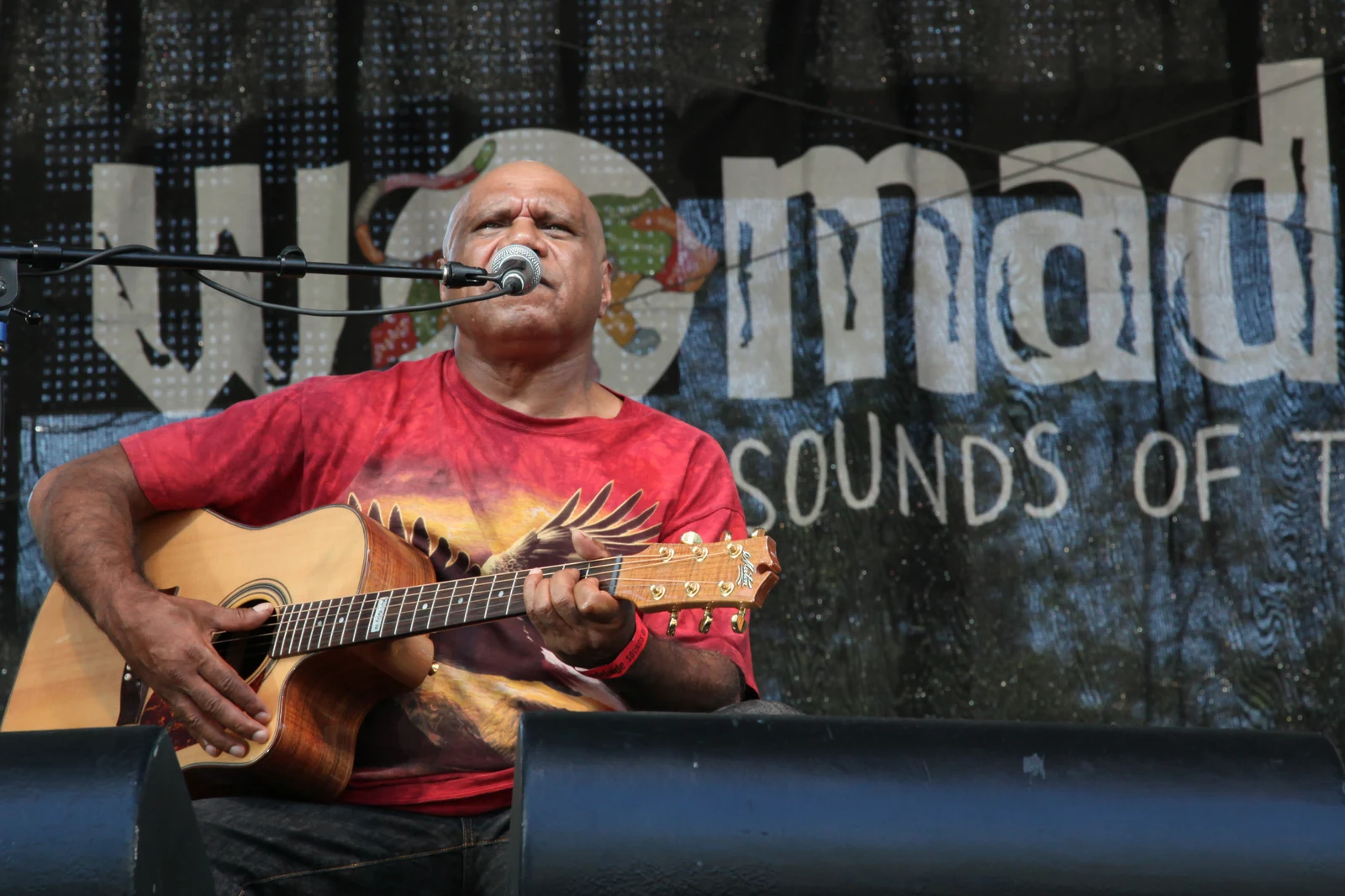
- 13. Nichollas Harrison / Wikimedia CommonsArchie Roach at WOMADelaide, 12 March 2011: exact original and CC BY-SA 3.0 grant
The exact photographer-supplied WOMADelaide 2011 original carries an own-work CC BY-SA 3.0 grant. It is not the 1990 music video or an image of the later memoir launch.