
The short answer
A training programme has several promises to inspect: what learning is organised, when workplace experience begins and which payment or employment statements are conditional. The selected school pages make these questions concrete—and do not give an identical answer about second-year pay.
The records answer different questions
Keep the measures separate
The question changes when the object, unit or reporting period changes.
| Record or measure | What it establishes | What it does not establish |
|---|---|---|
| Technology page | Classroom learning followed by team internship. | Every learner’s eventual outcome. |
| Home page | Second-year monthly amount ₹15,000. | A reconciliation with the FAQ. |
| FAQ | Up to ₹20,000, performance-dependent. | Guaranteed payment at the ceiling. |
Chronology
A timeline of the turning points
Experiment
The school dates its beginning to 2005.
Published conditions
The FAQ retains performance-dependent wording.
Learning and workplace participation are stages
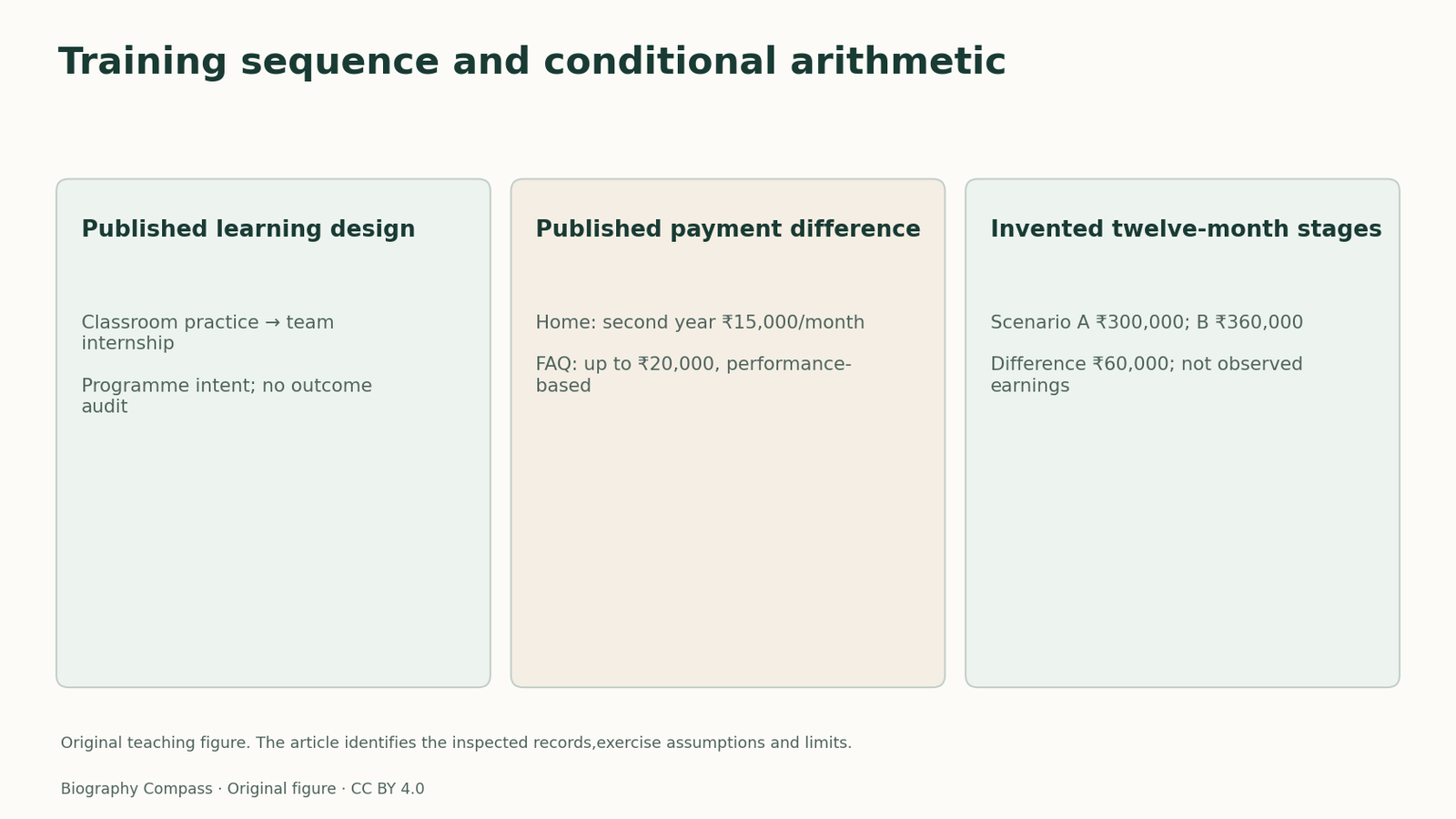
The Technology programme describes a first year of problem-solving, programming, mathematics and communication, followed by a second year interning with teams.
The school dates its initial experiment to 2005 and emphasises skills over conventional credentials. This is a designed route into work, not merely a scholarship attached to an ordinary degree. To evaluate its structure, ask how classroom practice connects with the work learners are later expected to undertake. The institutional description establishes the intended sequence; it does not supply a comparison group or an outcome for every entrant.
Two pages, different payment wording
The home page states ₹10,000 per month in the first year and ₹15,000 in the second.
The FAQ instead states a second-year amount up to ₹20,000 based on performance. It describes one classroom year and one internship year, with employment offered to successful graduates; it also says the curriculum is not published and changes with team needs.
These are genuinely different statements. A careful reader should preserve the difference and seek the applicable offer before planning an actual budget. “Up to” sets a conditional ceiling, not a universal payment. A programme year also does not by itself establish twelve paid months.
Exercise: price only the assumptions supplied
For this invented planning exercise, assume exactly twelve paid months in each of two stages, no gaps or deductions and a first-stage monthly stipend of ₹10,000. Scenario A uses ₹15,000 throughout stage two. Scenario B assumes the learner qualifies for ₹20,000 throughout that stage. Compute both two-stage totals and the difference. Which assumption makes B a ceiling scenario rather than a promise?
Reference answer: A is 12 ×₹10,000 + 12 ×₹15,000 = ₹300,000. B is 12 ×₹10,000 + 12 ×₹20,000 = ₹360,000. The difference is ₹60,000. B assumes qualification for the higher amount in every second-stage month. Neither total is an observed student payment. The twelve-month assumption is supplied by the exercise and must not be attributed to the programme calendar.
What evidence would evaluate the learning design?
A useful follow-up study would separate entrants, stage completers and employees rather than mixing their denominators. It could compare the tasks taught with the tasks actually performed during internship, and record when feedback changes the curriculum. For a learner’s planning task, payment conditions and assessment conditions belong in different columns.
The sources here give a programme description and FAQ, not a public syllabus, signed contract or independent employment evaluation. The substantive finding is both the staged practical design and the unresolved difference in its published payment wording.
Continue the chronology
Related history guides
Biography context
Explore India through connected lives
Connected biographies
The connected careers
born 1968
Sridhar Vembu
Zoho cofounder and Chief ScientistVembu cofounded Zoho and became Chief Scientist.Read biographyQuick answers
Common questions
- Can the two totals be treated as published student earnings?
- No. Both depend on the exercise’s supplied paid months and qualification assumptions.
Primary and institutional sources
How this history was checked
Compare the dated company records with the independent or regulatory context. Original task inputs are labelled separately from reported historical measures. This article was reviewed on 31 October 2026.