
The short answer
A credit list identifies responsibilities, while a participant account can show ideas moving between those responsibilities. The useful question is how to combine both records without reducing collaboration to a list of names.
Evidence and interpretation
What each record adds
Compare the production task and the authority behind its description.
| Record | Supported finding | Further question |
|---|---|---|
| Studio credits | Several production roles are separately named. | What does each label actually establish? |
| Director’s account | Script and music were revised in exchange. | Which dependent decisions need revisiting? |
Chronology
A timeline of the turning points
Film release
Your Name was released.
Production conversation
Published interview describes the collaboration.
Role labels and iterative work
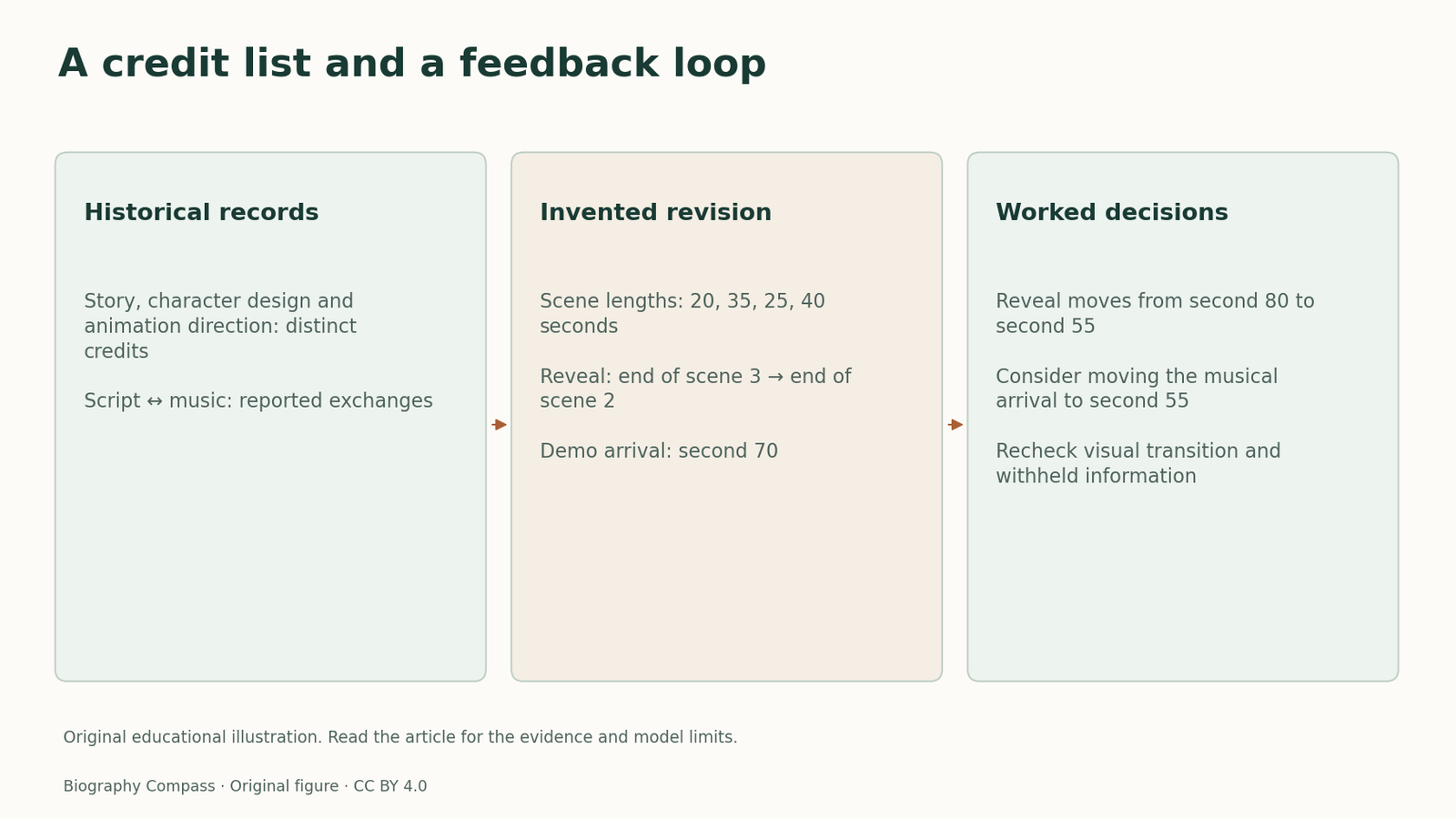
CoMix Wave Films assigns original story, screenplay and direction to Shinkai, character design to Masayoshi Tanaka and animation direction to Masashi Ando. Shinkai’s published interview adds a process: he gave RADWIMPS a script, changed it in response to songs, and returned with requests connected to revised scenes. He describes eighteen months of exchange.
The credit record gives a stable set of labels. The interview complicates an assumed one-way pipeline in which writing ends before music begins. Neither record makes the other redundant.
A bounded production comparison
The same interview describes meetings with Genki Kawamura and distinguishes Shinkai’s storyboard from Yoshitoshi Shinomiya’s art direction for a sequence. This is evidence of particular exchanges and responsibilities, not a complete record of every worker’s contribution.
For a practical revision, identify both the changed element and the downstream decisions it affects. A redesigned gesture may alter drawing and timing; a changed scene duration may require a new musical transition. These are proposed production consequences, not claims that a named collaborator made an undocumented decision on the film.
Original dependency exercise
Fictional inputs: a storyboard has four scenes lasting 20, 35, 25 and 40 seconds. A composer supplies a 120-second demo with a strong arrival at second 70. The director moves a reveal from the end of scene 3 to the end of scene 2, while keeping total duration unchanged. Calculate the old and new reveal times. Propose one revision request to music and one to visual planning. Do not assign an individual from a credit list to a task the record does not specify.
Reference answer: the old reveal is at 20 + 35 + 25 = 80 seconds; the new one is at 20 + 35 = 55 seconds. Ask whether the demo’s arrival can move from 70 to 55 seconds, or whether its present timing should become deliberate anticipation of a later event. Ask visual planning to check the new transition and what information is withheld in scene 3. The total remains 120 seconds. A role credit alone does not tell us who approved this invented revision, and the model supplies no actual Your Name timing.
Continue the chronology
Related history guides
Biography context
Explore Japan through connected lives
Connected biographies
Creative lives behind the records
born 1973
Makoto Shinkai
Director and writerShinkai directs animation rooted in familiar landscapes.Read biographyQuick answers
Common questions
- Does iteration mean that the screenplay had no author?
- No. A writing credit and an account of revision through collaboration answer different questions. The comparison preserves both responsibility and exchange.
Primary and institutional sources
How this history was checked
Read the linked credits and participant accounts alongside the original task. Dates identify the stated object or event; the exercise inputs are invented. This article was reviewed on 31 October 2026.