
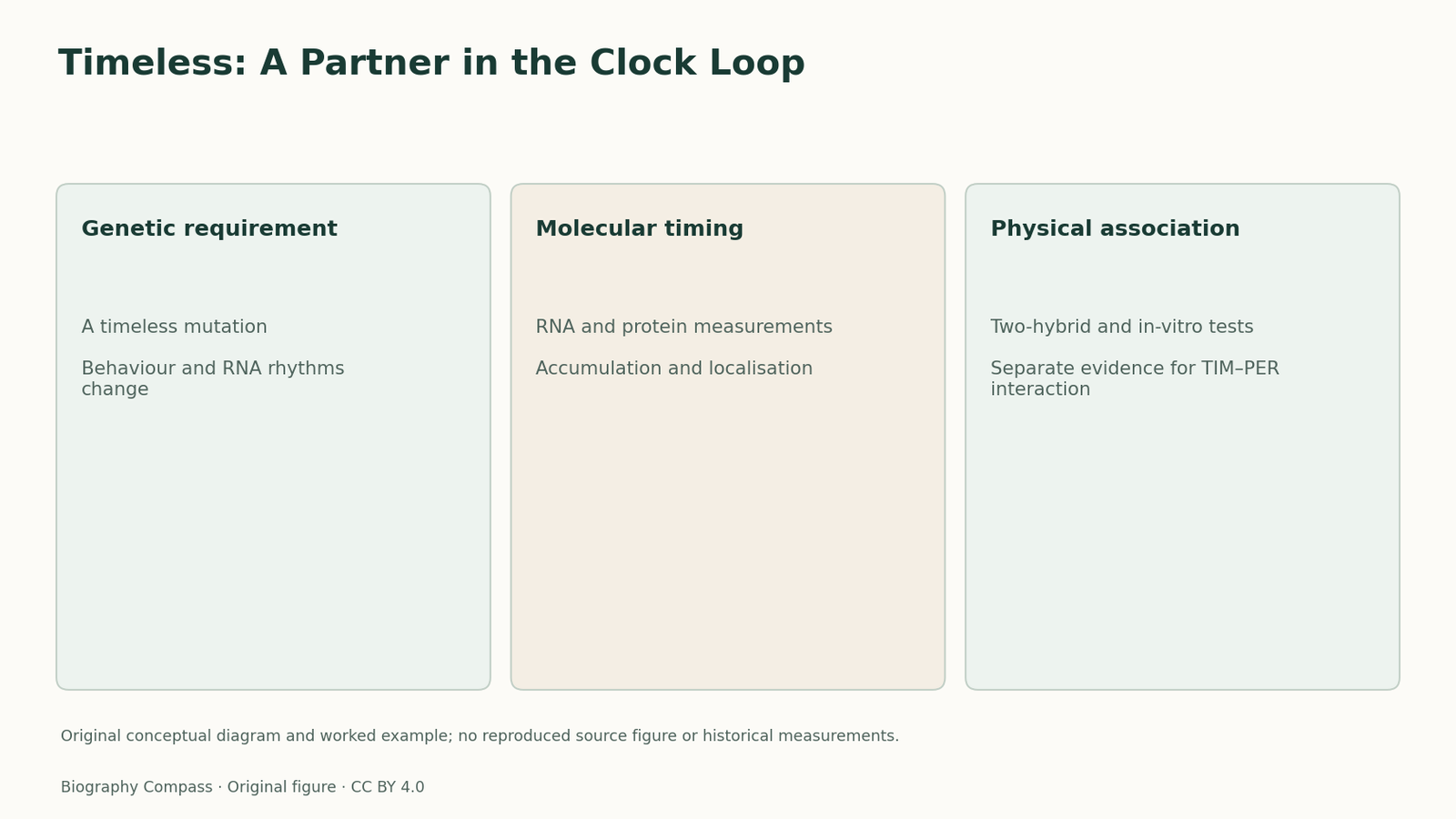
The short answer
How did timeless mutants and protein-interaction studies extend the period feedback model?
Read the evidence
From a mutant to interacting proteins
A sequence of studies connected different scales without making one assay stand for all of them.
| Record or test | What it establishes | What remains different |
|---|---|---|
| 1994 mutation | Linked timeless with behaviour and period RNA cycling. | Did not directly measure TIM–PER binding. |
| 1995 rhythmic expression | Connected RNA and protein timing within the clock system. | Did not alone identify every physical interaction. |
| 1995 interaction study | Provided direct experimental evidence for TIM–PER association. | Was not itself a whole-animal behavioural test. |
Start with the mutant’s phenotype
The 1994 timeless paper described a fruit-fly mutation associated with loss of normal rhythms in adult emergence and locomotor activity. It also altered the cycling of period RNA. Those observations connected a second genetic locus with a molecular feature of the clock. They did not by themselves show the molecular product binding PER. The immediate result was a dependency: normal behavioural and RNA rhythms required something affected by the timeless mutation.
Sources for this section: [1]
Measure an additional rhythmic component
A 1995 study examined timeless RNA and found a cycle related to the period RNA rhythm. Its results linked that cycling to PER and TIM proteins and associated timeless expression with the timing of PER accumulation and nuclear localisation. This extended the feedback model from one gene’s output to a system with interacting components. It also clarified why abundance and cellular location were separate useful measurements. A protein being present in a cell is different from its arrival at the location where it participates in regulation.
Sources for this section: [2]
Ask directly about protein interaction
A separate 1995 paper used a two-hybrid screen and in-vitro assays to investigate TIM and PER interaction. It reported binding between restricted protein regions and a temperature-sensitive interaction defect involving the long-period PERL mutant. This was a different experimental route from observing an arrhythmic fly. Together, the studies connected behaviour, changing RNA abundance and physical interaction, but their strength lies in the combination. The binding assay did not alone measure a whole animal’s daily rhythm, just as the mutant phenotype did not alone identify a physical contact.
Sources for this section: [3]
An original evidence-ordering exercise
Arrange three fictional notebook cards: a mutant changes a daily activity pattern; a partner protein affects the timing or localisation of another component; purified protein fragments interact. Which card would support a genetic requirement, which a molecular dependency, and which a direct physical association? The answer follows that order. Now remove the third card: a researcher can still argue that the components participate in the same system, but should not claim that this experiment directly demonstrated their binding. These cards are original teaching examples. They help explain why the 1994 and 1995 reports belong in one history while remaining separate experiments with different endpoints. A mechanistic history is clearer when the reader can identify which observation supports each arrow in the proposed pathway.
Continue the chronology
Related history guides
The Clock Loop: RNA Versus Protein Timing
Read the 1990 period RNA study alongside the later clock model, with a worked exercise separating daily correlation, feedback and direct molecular binding.
Read the timeline1992Clock Location: Which Cells Keep Time?
Explore the 1992 period-expression and mosaic study, distinguishing labelled brain cells, functional evidence and the limits of locating a fly’s clock.
Read the timelineBiography context
Explore United States through connected lives
Connected biographies
Researchers and related approaches
1949–
Michael Young
Geneticist and molecular-clock researcherMichael Young built a Rockefeller University programme that used fruit-fly genetics to explain how molecular interactions organise a daily biological rhythm.Read biography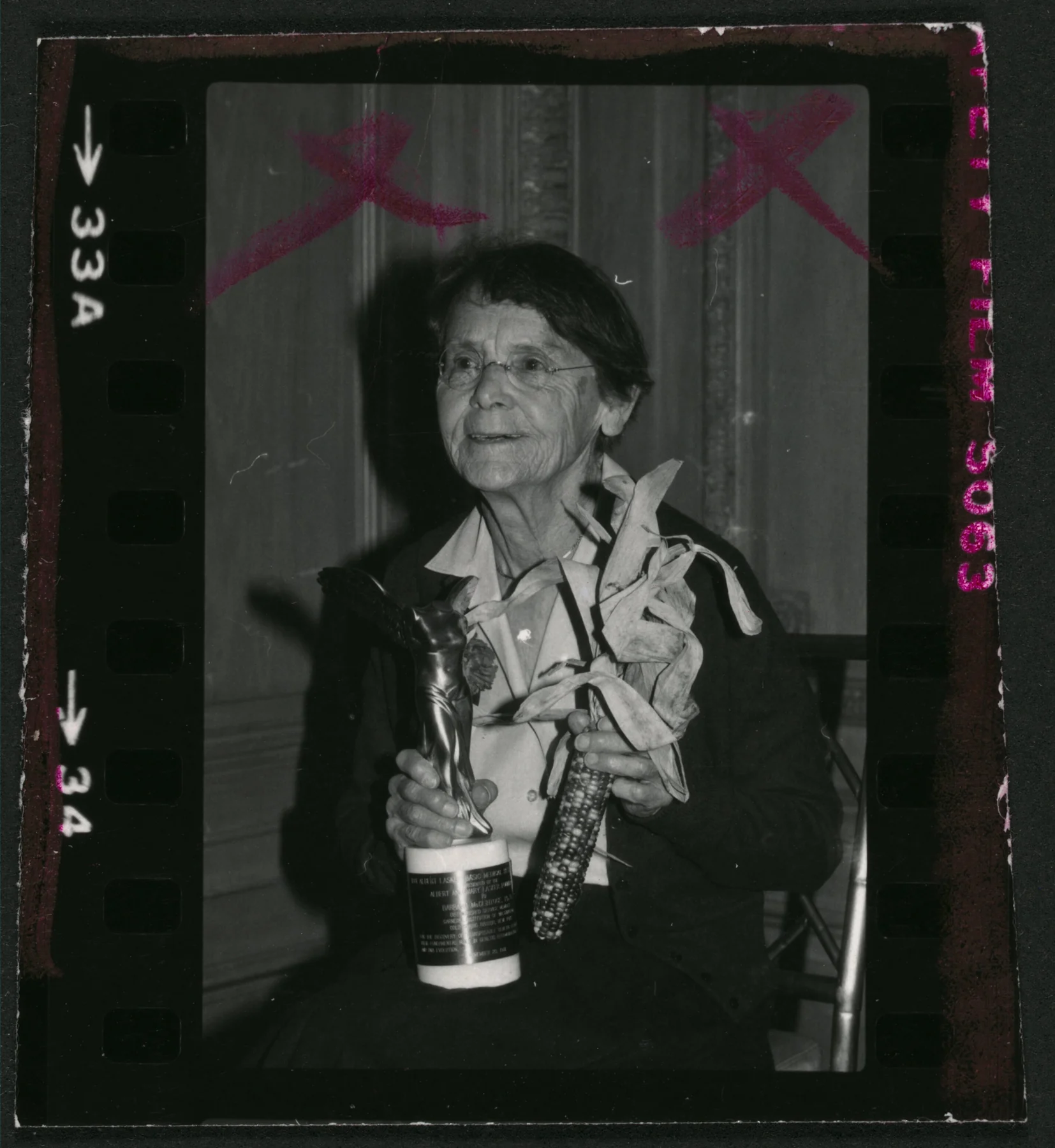
1902–1992
Barbara McClintock
Cytogeneticist and maize researcherBarbara McClintock connected chromosome observation with the inheritance of visible traits in maize. Her long research career made mobile genetic elements central to genetics and shows why an experiment’s observations, interpretation and later recognition need separate histories.Read biographyQuick answers
Common questions
- Why use more than the 1994 paper?
- The later studies addressed RNA timing and physical interaction, questions that were not answered by the mutant phenotype alone.
- Does a genetic interaction always mean direct binding?
- No. Genes can affect the same biological process through indirect pathways; direct association needs additional evidence.
Primary and institutional sources
How this history was checked
The primary 1994 and two distinct 1995 papers answer different questions. The exercise preserves their separate experimental endpoints. This article was reviewed on 7 November 2026.
- Sehgal, Price, Man and Young / ScienceLoss of circadian behavioral rhythms and per RNA oscillations in the Drosophila mutant timeless
- Sehgal and colleagues / ScienceRhythmic expression of timeless: a basis for promoting circadian cycles in period gene autoregulation
- Gekakis and colleagues / ScienceIsolation of timeless by PER protein interaction: defective interaction between timeless protein and long-period mutant PERL
- Nobel Prize OutreachMichael Young — Facts
- Nobel Prize OutreachMichael Young — Biographical