
The short answer
How does the story’s private writing expose conflict between a patient’s experience and authority?
Read the evidence
Sources, interpretation and production roles
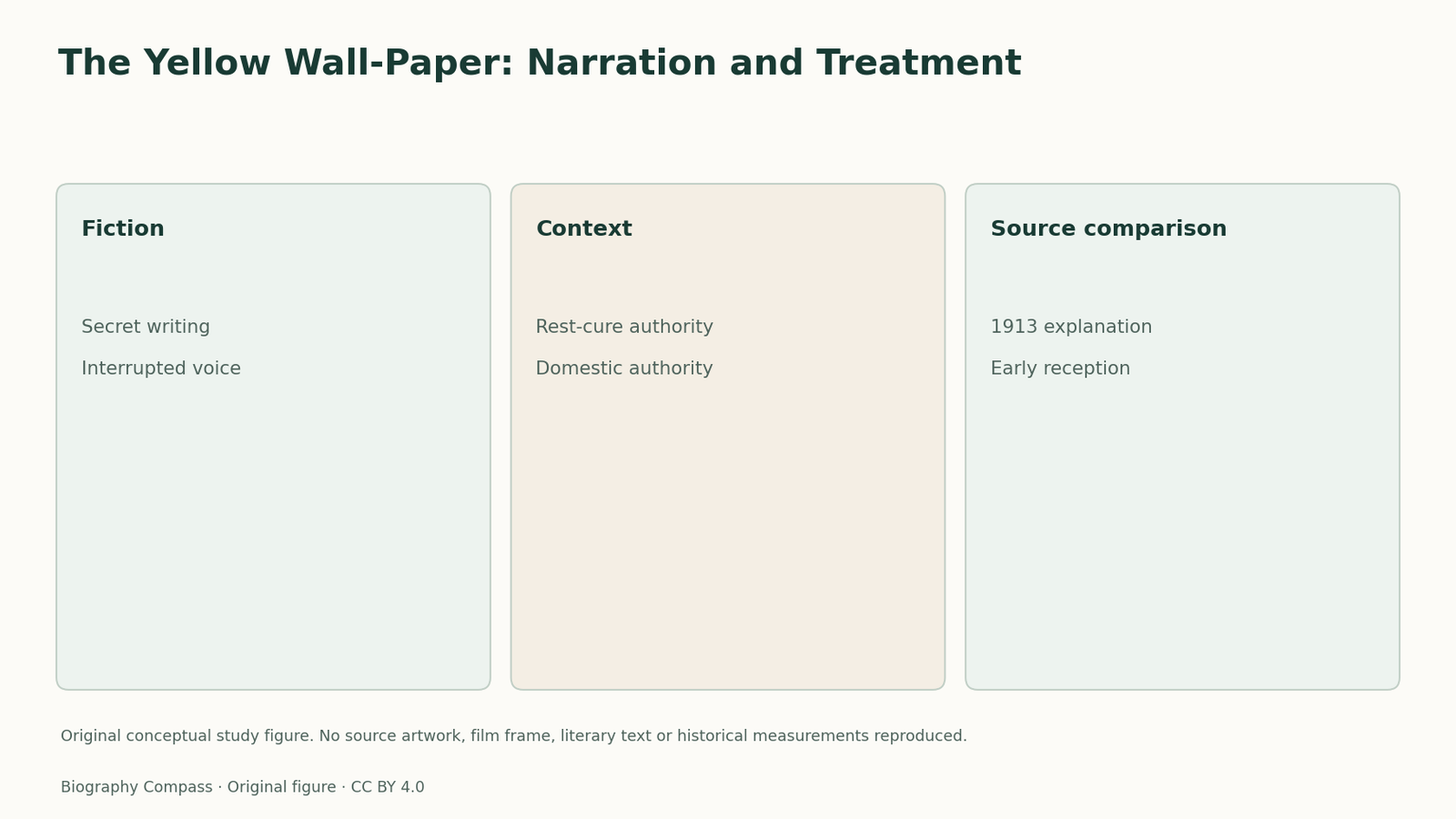
The records answer different questions about this work. The final exercise is an original teaching model.
| Record or question | Supported reading | Boundary or contrast |
|---|---|---|
| Fictional journal | Concealed writing makes restricted expression part of the form. | The narrator is not identical with the historical author. |
| 1913 explanation | Gilman later described a purpose for writing the story. | Intention does not by itself measure medical impact. |
| Original cards | Match fiction, retrospective testimony and reception to distinct questions. | One respondent does not stand for every reader. |
A voice kept on paper
The Yellow Wall-Paper was published in January 1892. Its unnamed fictional narrator writes about a summer residence and a treatment controlled by her physician husband, John. She disagrees with his judgement yet feels unable to make that disagreement authoritative. The story’s written form matters: the reader receives thoughts she cannot easily sustain in open conversation. Writing is both the means of narration and one of the activities being restricted.
Sources for this section: [5]
Treatment and the authority to describe
The selected opening sets medical standing beside the narrator’s account of her own needs. She believes congenial activity might help, while John treats intellectual stimulation as something to control. Because he is also her husband, professional and domestic authority overlap. The story does not need a separate lecture to make this arrangement visible; its interruptions and concealed writing embody it. This article analyses a historical fiction and does not diagnose the narrator or recommend treatment for present-day readers.
Sources for this section: [5]
The author’s later statement is another source
The National Library of Medicine places the story beside Gilman’s later explanation, Why I Wrote The Yellow Wallpaper, published in 1913. Gilman described her own rest-cure experience and the purpose she attached to the tale. That statement is retrospective authorial testimony. It is not the fictional journal itself, and an intention to affect medical thinking is not the same as independently measured change in clinical practice. The exhibition also records early rejection and disturbed reactions, showing that reception was not one uniform response.
An original evidence comparison
Create three cards labelled fictional experience, later authorial explanation and contemporary reception. Which card supports the claim that the narrator must conceal writing? The supported answer is the fictional text. Which supports what Gilman later said she wanted the story to do? The later explanation. An early response supports a claim about that respondent, rather than every reader. This exercise keeps each source useful by giving it a question it can actually answer.
Reading form alongside context
Return to an interruption in the journal and ask what changes when John or his sister approaches. A reasonable reading is that the act of narration must adapt to the same authority the narrator describes. Historical context helps explain why restrictions on work could be framed as care, but the formal insight comes from the story’s arrangement of writing and interruption. The result connects voice with power without turning fiction, autobiography and medical evidence into interchangeable accounts.
Continue the chronology
Related history guides
Biography context
Explore United States through connected lives
Connected biographies
People and related creative practices
1860–1935
Charlotte Perkins Gilman
Writer, lecturer and social criticCharlotte Perkins Gilman wrote fiction and social criticism about work and women’s dependence, while also advancing racist and eugenic ideas that limit her legacy.Read biography1860–1935
Jane Addams
Settlement organiser and peace campaignerAddams helped establish Hull-House in 1889, connecting neighbourhood services, social investigation and later national and international peace work.Read biography1850–1904
Kate Chopin
Novelist and short-story writerKate Chopin built a professional writing career in stories and novels that examined women’s choices, social expectations and the conditions of independence.Read biographyQuick answers
Common questions
- Is the journal autobiographical evidence?
- It is fictional narration. Gilman’s later explanation provides a separate autobiographical source.
- Did the story’s intended purpose prove its impact?
- No. Purpose, individual reception and a measured change in medical practice are different claims.
Primary and institutional sources
How this history was checked
Sources include production records, institutional collections and the specifically identified passages discussed here. Interpretations and teaching models are distinguished from credits and publication facts. This article was reviewed on 7 November 2026.
- Harvard Schlesinger LibraryPapers of Charlotte Perkins Gilman
- Harvard Radcliffe InstituteCharlotte Perkins Gilman
- National Library of MedicineThe Literature of Prescription
- National Endowment for the HumanitiesGilman did more than write one classic short story
- Charlotte Perkins Gilman / Project GutenbergThe Yellow Wallpaper
- National Library of MedicineReading The Yellow Wall-Paper