
The short answer
What can a 1908 legal handbook tell us about married women’s earnings, and why can neither its national title nor a later Senate victory supply one universal rule?
Read the documents together
Different records, different conclusions
Keep the scope of each record visible when making a historical claim.
| Record | What it shows | Limit |
|---|---|---|
| 1908 handbook | A dated comparison and references for further research. | Not an individual legal opinion or a new statute. |
| Provincial enactment | The underlying legal wording at the relevant date. | Not automatically applicable in another province. |
| 1929 judgment and 2000 monument | A Senate-eligibility ruling and its later commemoration. | Not a nationwide 1908 earnings rule. |
Chronology
A timeline of the turning points
Historical records
Read the dated documents before comparing their implications.
Read the preface before treating a summary as law
Edwards’s 1908 preface describes a condensed legislative compilation, supplies references and warns against using it as an individual legal guide. This arrangement makes the book a starting point for comparison.
The selected material for this study is the preface and Chapter III, “Married Woman Earnings,” in the accessible transcription. We have not checked every underlying provincial statute or read the entire book. Where an extract is compressed, the next step is to consult its cited enactment and relevant case law.
Sources for this section: [1]
The same topic produces different provincial summaries
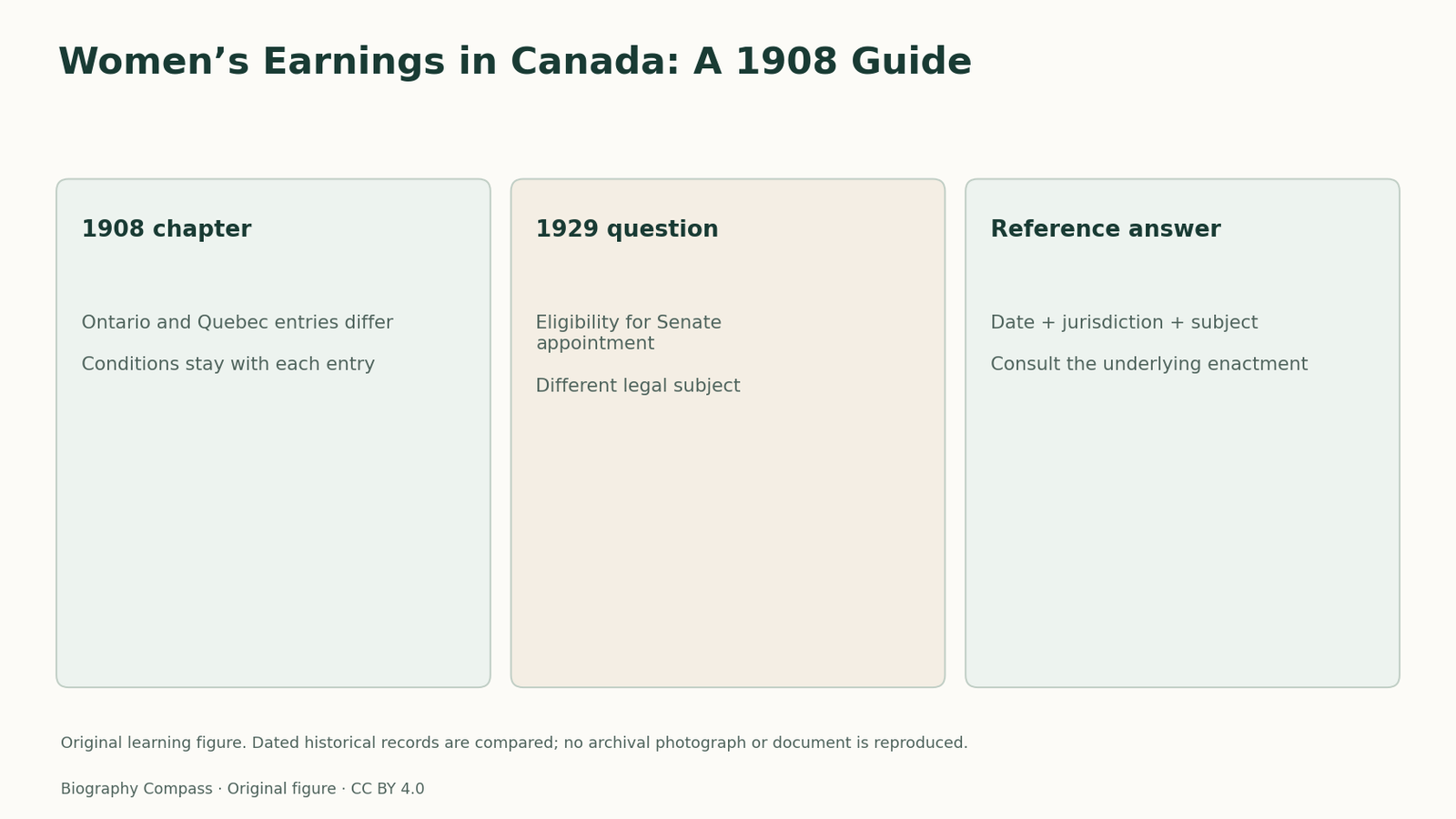
The Ontario entry states a right to a married woman’s earnings and points to RSO 1897, chapter 163, section 6. The Quebec entry describes a restriction in the absence of a marriage contract and refers to special court permission. Read each as Edwards’s 1908 summary, with its conditions attached, rather than as present law.
The comparison defeats two sweeping claims: that every married woman in Canada had the same earnings rights, and that women had no legal rights at all until 1929. It does not establish a particular woman’s contractual position or resolve a dispute from a short handbook entry.
Sources for this section: [1]
Original exercise: edit an inaccurate museum label
Draft label: “Before the Persons Case, women could not legally own their wages anywhere in Canada. In 1929, the courts introduced the same earnings rule nationwide.” Rewrite it in no more than 60 words. Your answer must identify the earlier date, retain jurisdictional difference and state what the Persons Case actually concerned.
One reference answer is: “In 1908, provincial earnings rules differed. The 1929 judgment concerned Senate eligibility, not a new nationwide earnings rule.” Other wording is acceptable if it preserves the date, jurisdiction and subject.
Notice the separate errors in the draft: an absolute claim about all women, an absolute claim about every province, and the substitution of one legal question for another. Merely changing “anywhere” to “usually” would leave the misleading chronology and subject matter intact.
Keep evidence of law separate from public remembrance
Canadian Heritage explains that the Privy Council reversed the earlier Senate-eligibility decision on 18 October 1929. Its account of Barbara Paterson’s 2000 monument is evidence of later commemoration. It is useful for understanding how a collective victory is remembered, rather than for reconstructing the text of a 1908 property provision.
For a stronger research response, create a source note with four fields: date, jurisdiction, legal subject and record type. A handbook, statute, judicial decision and commemorative sculpture can all contribute, but answer different questions. This approach allows the earlier work of legal organisers to remain visible alongside the later constitutional milestone.
Continue the chronology
Related history guides
Biography context
Explore Canada through connected lives
Connected biographies
The career behind the documents
1849–1931
Henrietta Muir Edwards
Artist and reformerResearch gave collective campaigning a practical resource.Read biographyQuick answers
Common questions
- Did publishing the handbook enact its rules?
- No. It is a summary, not an enactment.
- Does the title settle a jurisdictional question?
- No. Check the particular entry and its cited law.
Primary and institutional sources
How this history was checked
The identified passages support the historical comparison. Exercises and reference answers are original learning material, not recovered individual files. Only the specified records or selected passages were read. This article was reviewed on 31 October 2026.