
The short answer
How does an apparently empty place connect weather, memory and a designed surface?
Read the evidence
Sources, interpretation and production roles
The records answer different questions about this work. The final exercise is an original teaching model.
| Record or question | Supported reading | Boundary or contrast |
|---|---|---|
| 1950 | Completion and first exhibition | Not necessarily a depicted day |
| Composite | Real chapel used within a constructed setting | Not an exact survey view |
| 1954 | Collection acquisition | Not the painting’s creation date |
A dated painting with a longer series behind it
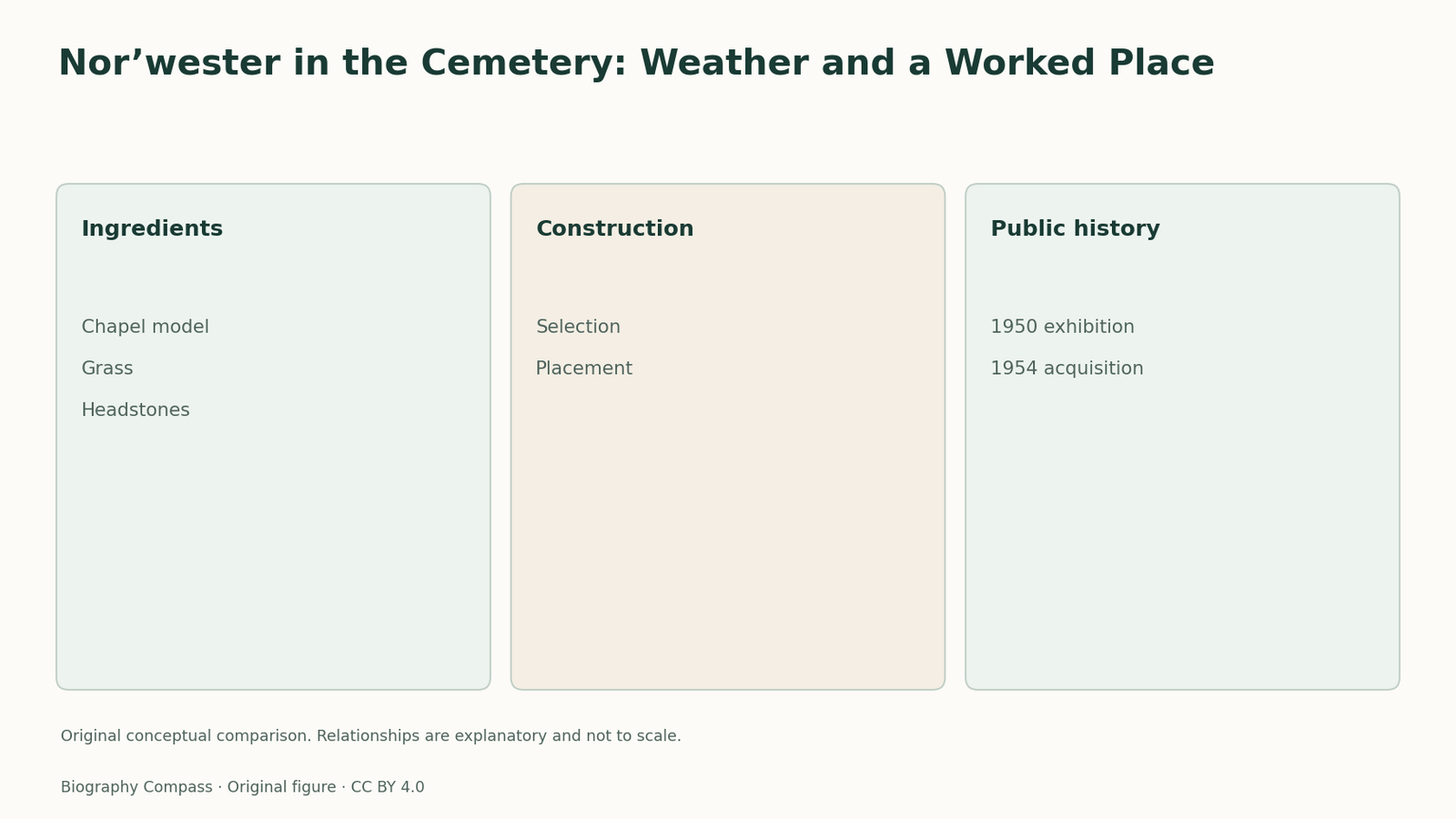
Nor’wester in the Cemetery is a 1950 oil on canvas. Christchurch’s retrospective catalogue identifies it as the first painting in Sutton’s Country Church series and records its first exhibition that year, followed by purchase for Auckland’s collection in 1954. These are separate events: making, exhibiting and entering a collection. Keeping them distinct helps answer a more interesting question about the painting itself. How does a work associated with Canterbury make a landscape that is recognizable without simply reproducing one fixed viewpoint? The documented construction of its setting gives a concrete starting point for that question.
Sources for this section: [3]
A composite is not an error in observation
The University of Canterbury account describes the painting as a composite. Its small church was modelled on a chapel in the Barbadoes Street cemetery, then placed within a country churchyard with grass and old headstones. Our interpretation is that Sutton joins elements to build a particular relationship between human structures and the environment around them. A painter can remember, select and relocate, rather than remain tied to the geometry of one spot. Calling the image composite therefore identifies a working decision; it does not make the landscape less deliberate or reduce it to a failed attempt at topographical accuracy.
Sources for this section: [4]
The title brings weather into a worked place
The title identifies a nor’wester and a cemetery. Those terms place atmospheric movement beside structures intended to mark and preserve human lives. Our reading question is how that relationship can become pictorial: forms associated with endurance occupy a landscape subject to change. The documented churchyard ingredients support the question without requiring an invented account of Sutton’s private intentions. Nor should the work be treated as a direct weather observation from a known day in 1950. The catalogue establishes an exhibition year, while the composite account explains how the place was made. Together they allow a formal and thematic discussion more precise than a generic label such as regional scenery. The comparison gives selection an active role in making place legible.
Exercise: a place can be built from real elements
Draw three original cards: a small building, a cluster of markers and a band of moving grass. Arrange them first as a street-side site and then as a more isolated landscape. A possible answer explains that the same ingredients can create different spatial and emotional relationships through placement alone. Identify which parts of your model came from the documented categories and which arrangement you invented. Now assign three dates to a hypothetical picture: completion, exhibition and acquisition. Explain why none automatically gives the date of its depicted weather. This comparison connects Sutton’s documented composite method with the work’s public history, while keeping a designed image distinct from a surveyed map or a diary of one afternoon.
Continue the chronology
Related history guides
Biography context
Explore New Zealand through connected lives
Connected biographies
People and related creative practices
1917–2000
William Sutton
Painter, portraitist and art teacherWilliam Alexander Sutton, usually known as Bill Sutton, developed a sustained Canterbury practice in painting, teaching, calligraphy and arts organizations.Read biography1908–1970
Rita Angus
PainterA New Zealand painter whose precise compositions make ordinary signs of human presence unusually visible.Read biography1912–1986
Leo Bensemann
Painter, printer, typographer and editorLeo Bensemann joined imaginative drawing and painting with the practical work of printing, typography and literary publishing in Christchurch.Read biographyQuick answers
Common questions
- Was the cemetery painted as a single exact view?
- The university account describes a composite, including a church modelled on a Christchurch chapel.
- When did the painting enter Auckland’s collection?
- The retrospective catalogue records its purchase in 1954, after its completion and exhibition in 1950.
Primary and institutional sources
How this history was checked
The work discussion uses the retrospective’s object entry and the university’s published account of its composite setting, not a direct examination of the painting. The reading exercises and comparisons are original analytical models. This article was reviewed on 8 November 2026.
- Christchurch City LibrariesWilliam (Bill) Alexander Sutton
- Sutton Heritage House and Garden Charitable TrustSutton Heritage House and Garden
- Christchurch Art GalleryNor’wester in the Cemetery, catalogue no.1
- University of CanterburyUniversity of Canterbury Chronicle, volume 14 no.21
- Govett-Brewster Art GallerySeveral Degrees of Attention: Sutton passage
- Getty ULANSutton, W. A.