
The short answer
A failed examination starts The Whiteheaded Boy, but the decisive action belongs to the family that tries to manage the consequences. The Abbey Theatre’s production record shows how that premise returned to stages with different performers.
Evidence comparison
The play and the performances
Keep the role stable while comparing changing records.
| Evidence | Best use |
|---|---|
| Edition description | Identify Denis’s problem and the competing family response. |
| Premiere record | Confirm the first opening and venue. |
| Character record | Compare casting in different runs. |
A premise with several incompatible plans
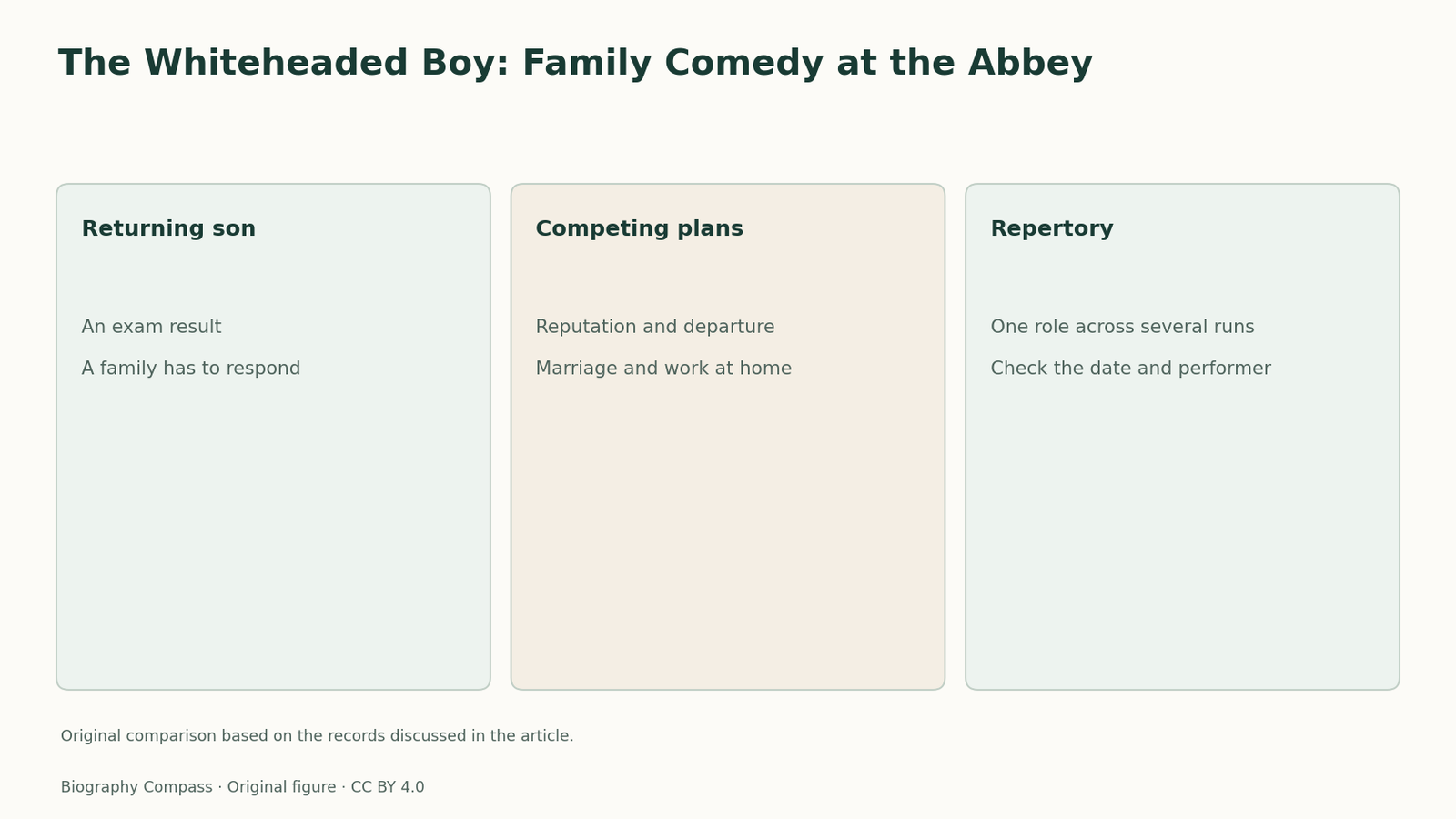
The published edition record describes Denis returning from Trinity College after failing his examinations. His family wants to avert the disgrace it anticipates and considers sending him to Canada. Denis has plans of his own involving marriage and work. Those desires give the playwright a set of decisions that can be made in public. A family member may try to act on behalf of someone whose own understanding of the problem differs from theirs. The failure matters because it gives several people a reason to interfere, rather than because an examination result is intrinsically comic.
Why the return is useful onstage
The story can begin with a young man arriving among people who already assign him a privileged place in the family. Each person’s expectation determines which part of the news demands action. The premises of three different proposals can then become visible through action. Protecting the family reputation may require leaving. Denis’s plan requires remaining. A relative may see the turmoil as an opportunity to pursue a separate aim. A scene built around those differences needs no narrator to announce who is most reasonable. It can keep the audience occupied with who has learned which part of the situation.
Sources for this section: [4]
Read opening dates as separate runs
The Abbey lists a first run beginning on 13 December 1916, followed by another December opening and further entries in subsequent years. These are records for productions or runs, so they should not be collapsed into a single premiere followed by an unbroken engagement. A character record is useful for checking the distinction. Maureen Delany is listed as Baby in the first run, with Christine Hayden appearing in that role in a later 1917 record. The character connects those entries, while the performer and opening date identify specific instances of stage work.
Build a record that can survive a revival
A useful rehearsal or reading record has three fields: the dramatic role, the person cast in that role, and the production being described. Add a fourth field only when the evidence supports it, such as the scene or a staging decision. This makes it possible to compare a new production without treating its performance choices as the author’s instructions. It also makes the limits of the archive productive. One can reconstruct which role appears, who is named and when a run opened, while leaving timing, gestures and delivery to sources that actually record them.
Track the premise through the programme
The family conflict makes sense in print, where a reader can return to a proposal and check who made it. In performance, understanding depends more immediately on entrance, timing and response. A production credit can begin the work of identifying who was responsible for realising those differences. A promptbook or rehearsal note would be needed to describe a particular solution.
Continue the chronology
Related history guides
Biography context
Explore Ireland through connected lives
Connected biographies
People connected to the work
1886–1958
Lennox Robinson
Playwright, director and theatre managerLennox Robinson combined writing with theatre management, production and the editing of literary records. The Abbey Theatre was central to all three strands of his work.Read biography1880–1964
Seán O’Casey
Playwright, autobiographer and correspondentSeán O’Casey was an Irish dramatist whose writing brought work, poverty, political conflict and family life into the theatre. The early Abbey successes were followed by later plays, autobiography and an extensive international correspondence.Read biographyQuick answers
Common questions
- When did The Whiteheaded Boy premiere?
- The Abbey Theatre Archives record 13 December 1916.
- Does every Abbey listing show the original cast?
- Each listing has its own date and casting information. The record for Baby identifies different performers across runs.
Primary and institutional sources
How this history was checked
Dates, legal milestones and historical claims are checked against the official and institutional records below. This article was reviewed on 13 November 2026.