
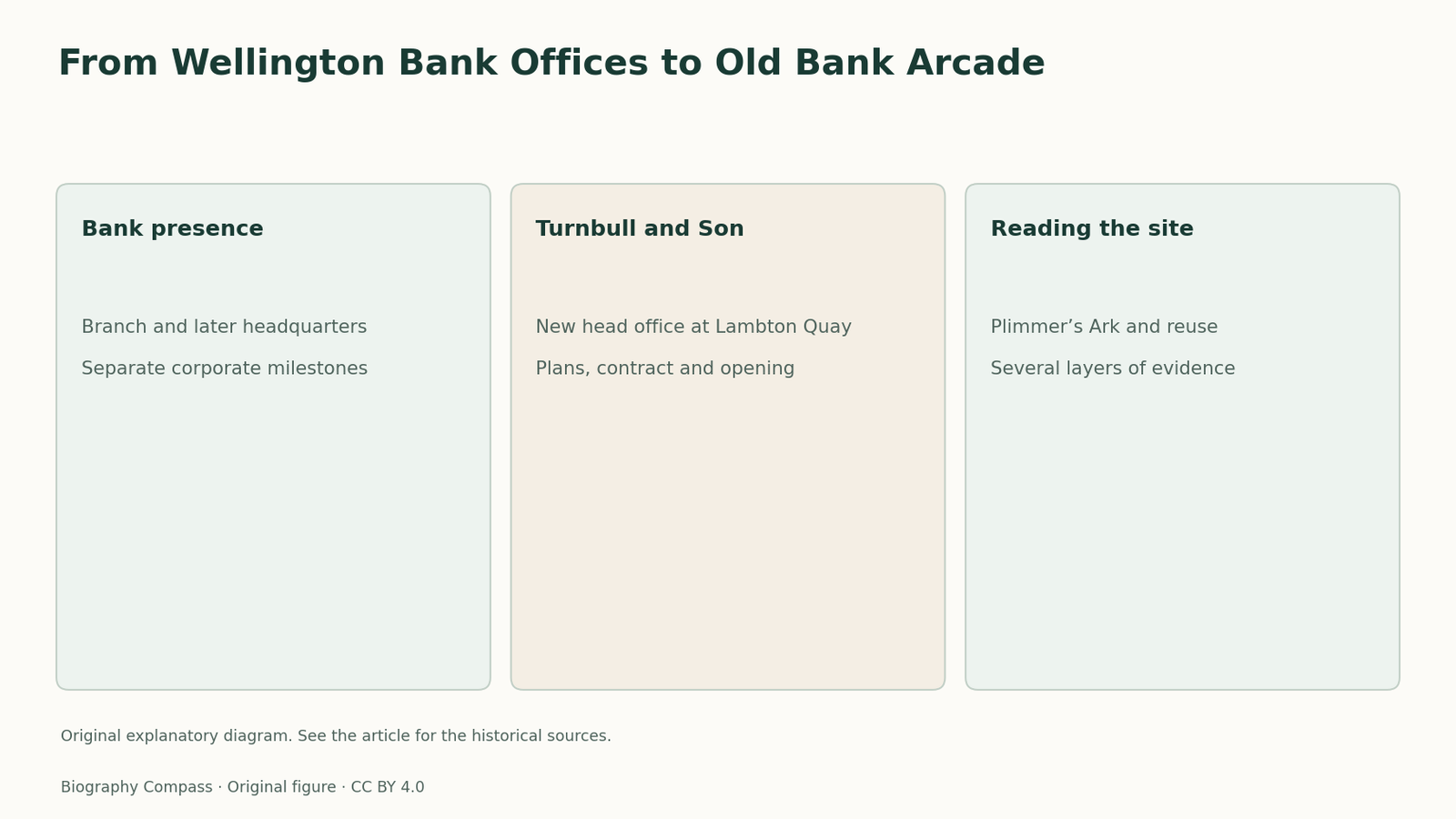
The short answer
Old Bank Arcade joins former bank and commercial properties with separate construction histories. Identifying individual heritage entries clarifies what belonged to Turnbull and Son’s head office scheme.
Compare the evidence
Decisions and their effects
The records describe different stages of the work.
| Country | Documented decision | What it explains |
|---|---|---|
| Branch and headquarters | Wellington branch in 1862 and headquarters transfer in 1894 | Institutional chronology precedes new construction |
| Head office building | Turnbull and Son plans, Carmichael contract, 1901 opening | Identify the building before applying credits |
| Retail arcade | Conversion began in 1997 | Related historic properties acquired a common use |
One arcade contains several building histories
Old Bank Arcade combines former commercial and banking buildings near Lambton Quay and Customhouse Quay. Heritage New Zealand’s entries identify them by number and by address, with a distinct record for the head office at 239–247 Lambton Quay. A single modern destination can therefore refer to more than one earlier building. Begin by matching the historic entry to the part of the complex being described. This is especially helpful when trying to follow an architect’s work, because a name found in one entry cannot automatically be attached to every former property in the group.
The bank moved its headquarters before it commissioned the building
The Bank of New Zealand was established in Auckland in 1861 and opened a Wellington branch the following year. The heritage record places the first permanent Wellington building in 1863 and the move of the head office to Wellington in 1894. It dates the new headquarters plans to 1899. These events mark different changes in the organisation. A branch can open before it owns purpose-built accommodation. A headquarters can move before it has a new building. Reading those dates with their events explains why the bank’s presence and the current structure have different origins.
Sources for this section: [2]
The surviving head office has a firm and contractor credit
The head office entry names Thomas Turnbull and Son as the designers, a contract awarded to T. Carmichael on 4 April 1899 and an opening on 1 July 1901. The contract date supplies evidence of a construction arrangement, while the opening dates the bank’s use of its new accommodation. Keeping the two events separate also protects the attribution. The firm was responsible for preparing plans and the contractor for construction. A search for individual work by Thomas or William can begin from that firm attribution and proceed to more specific records.
Reclamation left physical evidence below the bank
The head office occupies a site associated with an early harbour reclamation and John Plimmer’s use of the salvaged barque Inconstant as a warehouse. Heritage New Zealand identifies timbers uncovered in 1899 and connects some of the recovered wood to a chair in the boardroom. That evidence gives the parcel a history preceding the bank. The timber in the boardroom also has a history after recovery. A study of the site can follow the original waterfront use, the discovery during new building work and the later treatment of the salvaged material as distinct events.
Sources for this section: [2]
The 1990s conversion made new routes through the old properties
Heritage New Zealand records conversion work beginning in 1997, joining former bank buildings into a retail arcade. That later project created a new way to experience the group. Compare its boundaries with the separate heritage entries when following a particular facade or room. The arcade tells a story of coordinated reuse, while each entry can document earlier owners, architects, occupation and construction. Using both levels lets visitors understand the complex as a modern project and preserves the evidence of several different nineteenth-century and early twentieth-century properties within it.
Biography context
Explore Wellington, New Zealand through connected lives
Connected biographies
People behind the work
1824–1907
Thomas Turnbull
ArchitectThomas Turnbull practised in Australia and California before settling in Wellington. His New Zealand buildings used timber, masonry and different historic styles.Read biographyQuick answers
Common questions
- Who designed the 1901 head office?
- The heritage entry credits Thomas Turnbull and Son with the plans.
- Is the arcade a single original bank building?
- The later arcade conversion combined neighbouring properties with their own heritage entries.
Primary and institutional sources
How this history was checked
Dates, legal milestones and historical claims are checked against the official and institutional records below. This article was reviewed on 13 November 2026.