
The short answer
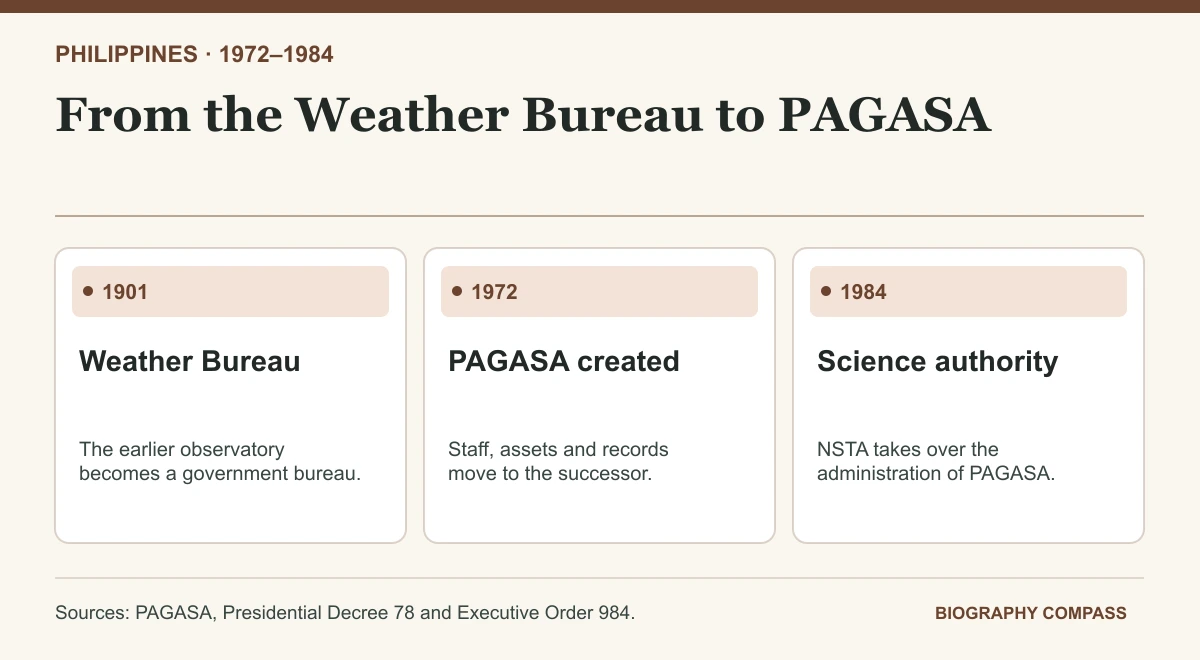
Presidential Decree No. 78 created PAGASA on 8 December 1972. It abolished the Philippine Weather Bureau and transferred its people, assets and records to the new administration. That legal change explains why PAGASA has a 1972 founding date while its weather history reaches back much further.
Compare the records
How to date the Philippine weather service
Service history, legal identity and supervising agency can each change on a different date.
| Milestone | Year | Meaning |
|---|---|---|
| Weather Bureau | 1901 | The government weather service takes the bureau name |
| Creation of PAGASA | 1972 | A successor agency receives the bureau’s people, records and assets |
| Transfer to NSTA | 1984 | The national science authority takes administrative responsibility under a reorganisation |
Chronology
A timeline of the turning points
Weather Bureau
The Philippine Commission reorganises the earlier observatory under civil government.
Network development
The bureau starts radar observations and later links more radar stations.
PAGASA created
The decree transfers staff, records and assets from the bureau.
Science authority takes administrative responsibility
PAGASA transfers to NSTA, and seismology goes to the volcanology institute.
What the old bureau already had
The Philippine Commission reorganised the earlier Manila observatory as the Weather Bureau in 1901. PAGASA’s institutional chronology records a surveillance radar at Manila in 1963 and five additional stations linked with it in 1971. The new administration therefore inherited a working service with staff and instruments. It also inherited records that help establish weather patterns over periods longer than the life of any one agency.
What the decree carried forward
The founding decree places PAGASA under the Department of National Defense and transfers the bureau’s personnel, property, files and remaining funds. It also keeps the previous director in place as administrator. These provisions preserved operational continuity as the legal identity changed. The decree explicitly funded equipment and operations, linking a new administrative structure to the practical needs of maintaining observations and issuing warnings.
How the 1984 transfer clarified responsibilities
Executive Order No. 984 moved PAGASA to the National Science and Technology Authority. It also merged its National Geophysical and Astronomical Office with the Philippine Institute of Volcanology and transferred applicable personnel, equipment and records. The transfer of seismology explains why earlier earthquake documentation may appear under PAGASA while later records identify PHIVOLCS. Forecasting and weather records continue under the PAGASA institutional line.
Continue the chronology
Related history guides
How the Hibok-Hibok Eruption Led to PHIVOLCS
Read how the volcanology institute gained responsibility for seismology.
Read the timeline1958–1987How the Philippine Science Board Became DOST
Follow the science authority that took over administrative responsibility in 1984.
Read the timeline1865–1901How Manila Observatory Began Warning of Typhoons
Trace earlier typhoon warnings issued by the Manila observatory.
Read the timelineConnected biographies
People connected to this history
Quick answers
Common questions
- When was PAGASA established?
- Presidential Decree No. 78 established PAGASA on 8 December 1972.
- What was the Philippine weather agency before PAGASA?
- Its immediate predecessor was the Weather Bureau. The decree transferred the bureau’s staff, records and assets to PAGASA.
Primary and institutional sources
How this history was checked
Dates, legal milestones and historical claims are checked against the official and institutional records below. This article was reviewed on 19 November 2026.