
The short answer
Charles Vignoles directed a major chain suspension bridge project at Kyiv. Contemporary visual records reveal particular views of a changing work site and help distinguish evidence of construction from evidence of commissioning.
Compare the evidence
Decisions and their effects
The records describe different stages of the work.
| Country | Documented decision | What it explains |
|---|---|---|
| Engineering commission | Vignoles directed the bridge project at Kyiv | Establishes the work and site |
| Drawings | Bourne drew the road bridge for Vignoles | Identifies an additional documentary role |
| Photographic trip | Fenton also photographed places away from Kyiv | The subject must be established for each item |
A commission, an engineer and a river crossing
The Kyiv Chain Bridge linked a major engineering commission with a specific geographical problem: carrying road traffic across the Dnipro. The Dictionary of Irish Biography attributes the design and construction direction to Charles Blacker Vignoles and describes four principal suspension spans. The scholarly name register dates the bridge work to 1847–53. These records explain the engineering responsibility and approximate duration of the commission. They also give the context needed to interpret the drawings and photographs made during the project, each of which represents only a moment or portion of a much longer enterprise.
Separate the crossing into parts before reading an image
A chain suspension bridge carries its deck from the suspended system, and successive supports divide the crossing into spans. The term span describes the portion between supports rather than the whole river crossing. That distinction matters when an illustration cuts off the far side of the structure or emphasises one part of the site. A viewer can count visible supports and compare the image’s date with the overall project range. Missing parts in a view may belong outside the frame or to a later stage of work.
Bourne made drawings for the engineer
The Government Art Collection records that John Cooke Bourne made drawings of the crossing for Vignoles. The drawings belong to the visual documentation of a civil engineering project. Their purpose can be considered separately from the calculations and working instructions needed to build the bridge. A finished drawing can make a site intelligible to a reader at a distance by selecting a viewpoint and showing the relationship of banks, supports and structures. Its evidential value depends on what it depicts, when it was produced and whether it records a proposal or a stage of construction.
Sources for this section: [6]
Fenton’s itinerary produced a different record
The Metropolitan Museum of Art identifies Vignoles’s invitation to Roger Fenton to photograph the suspension bridge. The museum’s example for this account is an 1852 view of the Kremlin in Moscow. That image belongs to the wider trip and represents a different bridge and location from the Kyiv construction site. The object record is especially useful because it links the photographer to the engineering commission without making every picture from the journey a construction photograph. A caption should therefore begin with the individual image’s subject before adding the reasons for the trip.
Sources for this section: [5]
Compare attribution and chronology across sources
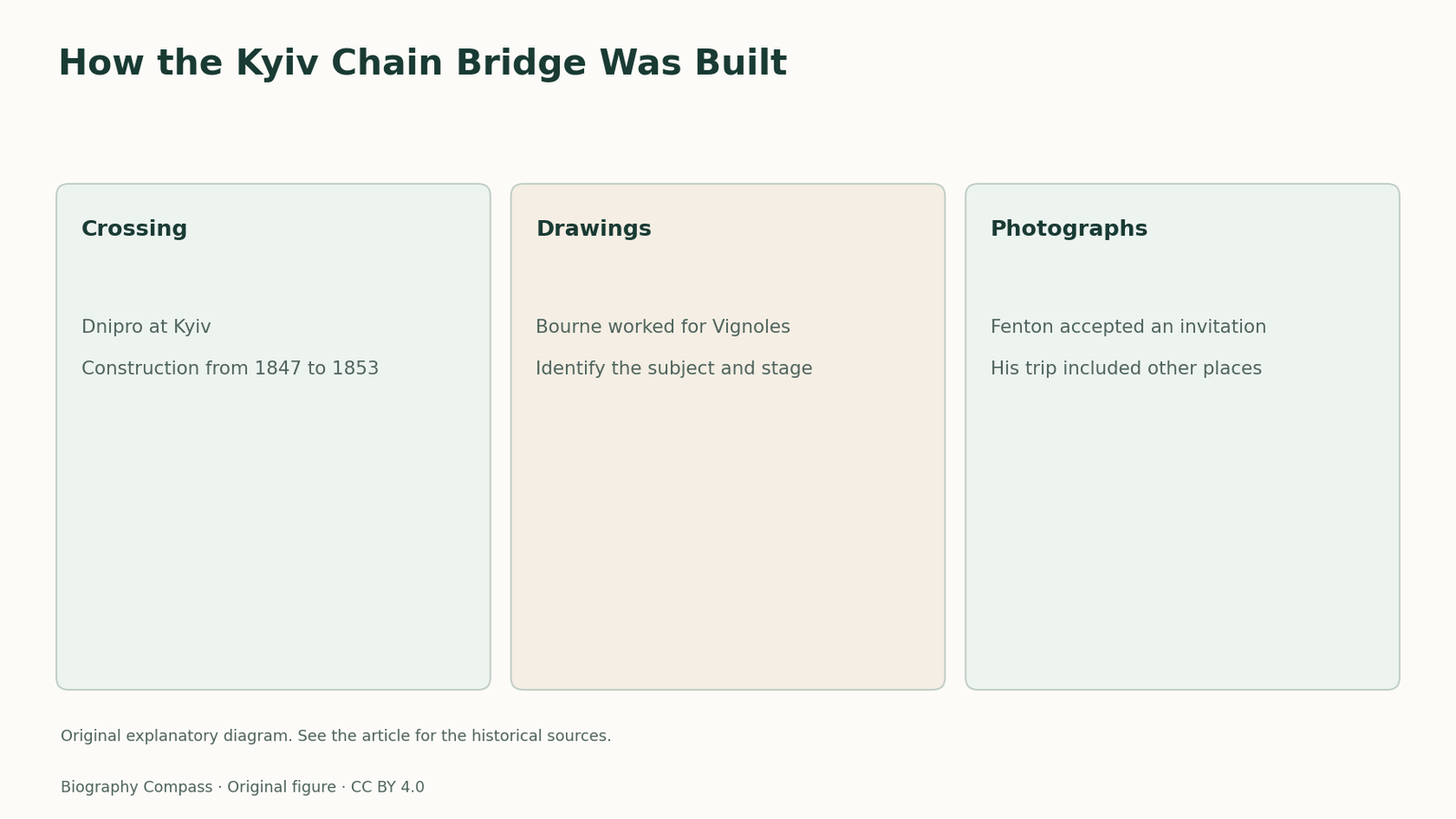
Use three columns for the engineering work, Bourne’s commission and Fenton’s journey. In the first, record the bridge site and construction range. In the second, record drawings specifically attributed to Bourne for Vignoles. In the third, distinguish the assignment at Kyiv from independently identified views elsewhere. Such a comparison helps a reader avoid using one photograph to stand for an entire project. It also gives the engineer, drawing maker and photographer separate credit for the records they left and keeps the visual archive tied to the specific evidence each item supplies.
Biography context
Explore Kyiv, present-day Ukraine through connected lives
Connected biographies
People behind the work
1793–1875
Charles Blacker Vignoles
Civil and railway engineerCharles Blacker Vignoles surveyed early railways in Britain and Ireland and directed the construction of the Kyiv Chain Bridge across the Dnipro.Read biographyQuick answers
Common questions
- What river did the bridge cross?
- It crossed the Dnipro, also called the Dnieper, at Kyiv.
- Is the Met’s Kremlin view a picture of the Kyiv bridge?
- The object is a view in Moscow. Its catalogue links Fenton’s trip to Vignoles’s invitation but identifies this individual subject separately.
Primary and institutional sources
How this history was checked
Dates, legal milestones and historical claims are checked against the official and institutional records below. This article was reviewed on 13 November 2026.
- Science Museum Group CollectionCharles Blacker Vignoles
- Dictionary of Irish BiographyVignoles, Charles Blacker
- Darwin Correspondence ProjectCharles Blacker Vignoles
- Dictionary of Irish Architects, Irish Architectural ArchiveCharles Blacker Vignoles
- Metropolitan Museum of ArtSouth Front of the Kremlin from the Old Bridge
- Government Art CollectionJohn Cooke Bourne