
The short answer
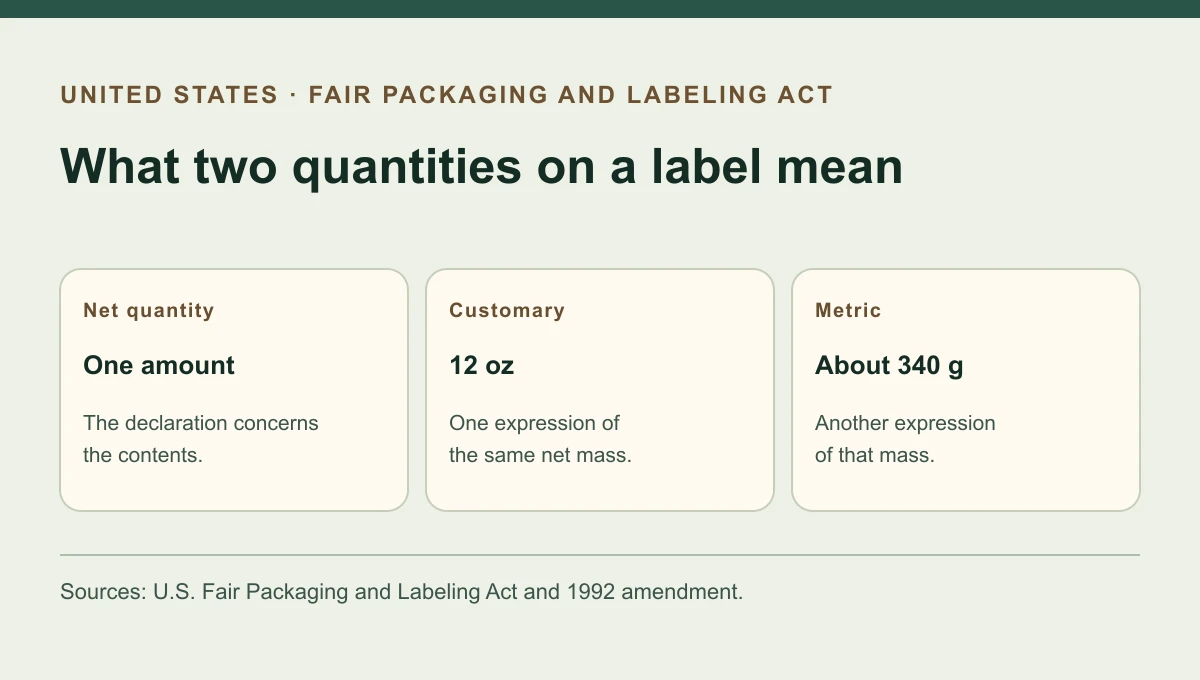
The U.S. Fair Packaging and Labeling Act made net quantity a central part of the label for covered consumer commodities. A 1992 amendment spelled out the use of both customary and metric units, subject to exceptions, with the changes taking effect in 1994. Two numbers such as 12 ounces and about 340 grams can describe one amount of product.
A worked net quantity example
One product, two equivalent amounts
Twelve avoirdupois ounces is approximately 340 grams. The values below are illustrative.
| Reading | Example | Meaning |
|---|---|---|
| Customary mass | 12 oz | Describes the contents in a customary unit. |
| Metric mass | About 340 g | Describes the same contents in a metric unit. |
| Net quantity | Mass of the product contents | The units are alternative expressions of that quantity. |
Chronology
A timeline of the turning points
Congress adopts the packaging statute
Covered packages carry specified information, including a net quantity statement.
Congress adopts metric labelling changes
The amended text calls for the appropriate customary and SI metric units within its scope.
The changes take effect
The law includes transitional treatment for labels already printed.
What the 1966 Act tried to make comparable
The original statute addressed consumer commodities distributed in packages. It required information about product identity, the business connected with the package and the net quantity of contents. The label can therefore communicate how much product a buyer is getting even if the containers of two brands have different shapes.
Net quantity and the physical size of a package answer different questions. A larger-looking package can contain the same amount as a smaller one. The quantity declaration gives a basis for comparison.
Where the metric statement came from
Public Law 102–329 made the dual-unit requirement explicit for the applicable net quantity statements. Congress exempted food packaged at the retail-store level from the metric statement under that provision. The law also explains that the amendments did not require a package to change its physical size.
The 1992 approval date and the 1994 effective date both matter. Congress made provision for packages bearing labels printed before the effective date.
What two numbers do for the shopper
A label can express one quantity in customary units and SI units. Multiplying 12 avoirdupois ounces by the exact conversion and rounding gives about 340 grams. A buyer can compare it directly with another package stated in grams. The amendment therefore changes the way the amount is communicated and leaves the amount itself to the seller’s product choice.
Continue the chronology
Related history guides
What the Philippines’ Consumer Act Put on Retail Labels
Compare the Philippine Consumer Act’s separation of package contents and retail price.
Read the timeline2010–2011How Australia Introduced a Single Consumer Law
Read another federal example of coordinating consumer protections across jurisdictions.
Read the timeline1975–1988What the U.S. Metric Conversion Act Actually Required
Read the broader U.S. policy history of voluntary metric conversion and federal procurement.
Read the timelineConnected biographies
People connected to this history
Quick answers
Common questions
- When did the 1992 U.S. package labelling changes take effect?
- Public Law 102–329 set 14 February 1994 as the effective date.
- Do two quantities in ounces and grams describe two amounts of product?
- They are two units expressing the same net quantity.
Primary and institutional sources
How this history was checked
Dates, legal milestones and historical claims are checked against the official and institutional records below. This article was reviewed on 19 November 2026.