
The short answer
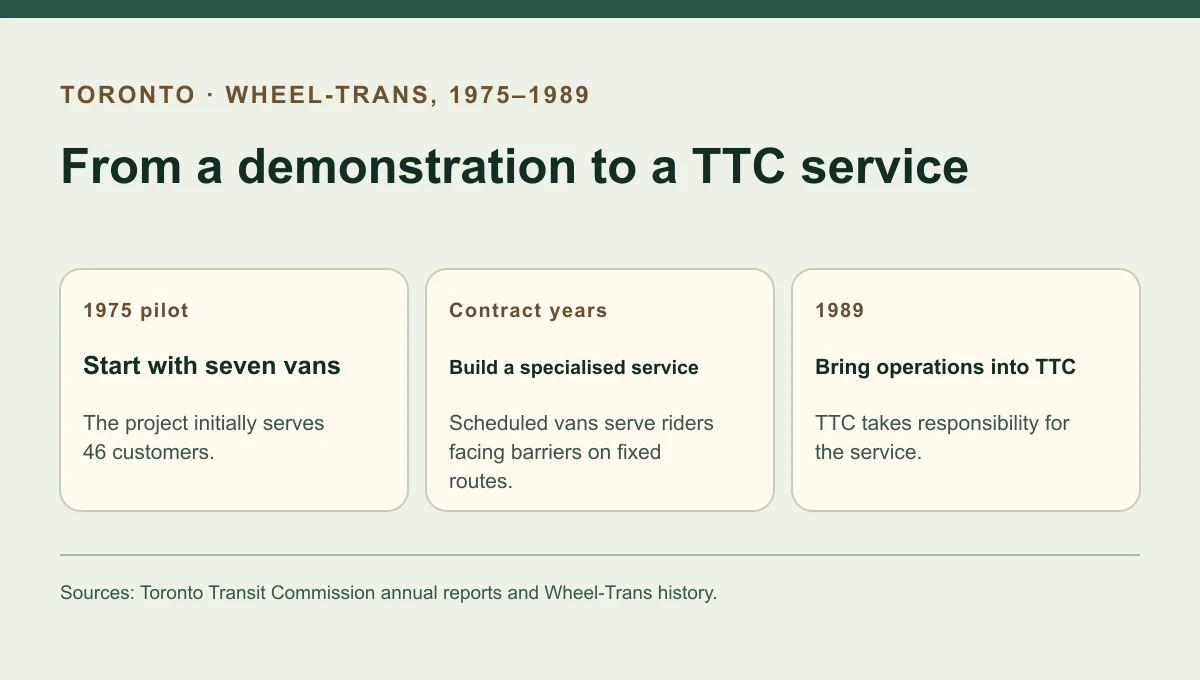
Toronto’s Wheel-Trans began on 3 February 1975 with seven vans serving 46 customers. Its original demonstration focused on rides to and from work for people unable to use regular transit. After years of contract operation, the Toronto Transit Commission assumed responsibility for Wheel-Trans operations in 1989.
A different service model
How early Wheel-Trans worked
Scheduled accessible trips addressed a gap in Toronto’s conventional network.
| Stage | Service arrangement | Why it matters |
|---|---|---|
| Demonstration | Seven vans and an initial group of 46 customers. | The early service has a defined scale and purpose. |
| Contract operation | The service is delivered under contract. | The specialised operation develops outside the regular fixed-route fleet. |
| TTC operations | The commission takes responsibility in 1989. | Public transit management includes a separate accessible service. |
Chronology
A timeline of the turning points
Wheel-Trans begins as a demonstration
A small fleet serves customers who cannot use conventional public transit for the relevant trips.
The TTC reports the project’s second year
The annual report describes the original employment-focused service.
The TTC assumes responsibility for operations
The agency begins directly operating the specialised service alongside its conventional network.
Who the demonstration aimed to serve
The commission’s 1976 annual report describes the early project as work transport for people unable to use regular services, including wheelchair users. The starting fleet and customer figures come from Wheel-Trans’s later anniversary history. Together the sources show a small, defined programme. Its earliest purpose was narrower than the range of journeys riders would later associate with paratransit.
Which barriers a dedicated service could address
A fixed-route vehicle may serve a broad area while still presenting barriers at the stop, steps or door. Wheel-Trans offered a different way to arrange a ride for someone who could not use that service. The vans, bookings and trips were organised around users and destinations while much of the conventional system still operated as before.
The distinction also explains why a city can change buses and stations while continuing to run a specialised service. The two kinds of improvement address different needs.
What the 1989 record adds
The TTC’s annual report dates its assumption of responsibility to 1 January 1989. It notes that the service had previously been operated entirely under contract. Under the new arrangement, TTC employees would deliver most of the service directly. The date belongs to the institution operating the programme. The opening date belongs to the riders who could first use it. Both are part of the history of Wheel-Trans.
Sources for this section: [3]
Continue the chronology
Related history guides
How Low-Floor Streetcars Reached Toronto’s Spadina Route
Compare the later effort to make a conventional Toronto streetcar route accessible.
Read the timeline2002–2006What Boston’s Daniels-Finegold Transit Settlement Changed
Read how Boston’s later accessibility settlement addressed mainstream bus and station operations.
Read the timelineConnected biographies
People connected to this history
Quick answers
Common questions
- When did Wheel-Trans start?
- The TTC dates the start to 3 February 1975.
- When did the TTC assume operations?
- Its 1989 annual report gives 1 January 1989.
Primary and institutional sources
How this history was checked
Dates, legal milestones and historical claims are checked against the official and institutional records below. This article was reviewed on 19 November 2026.