
The short answer
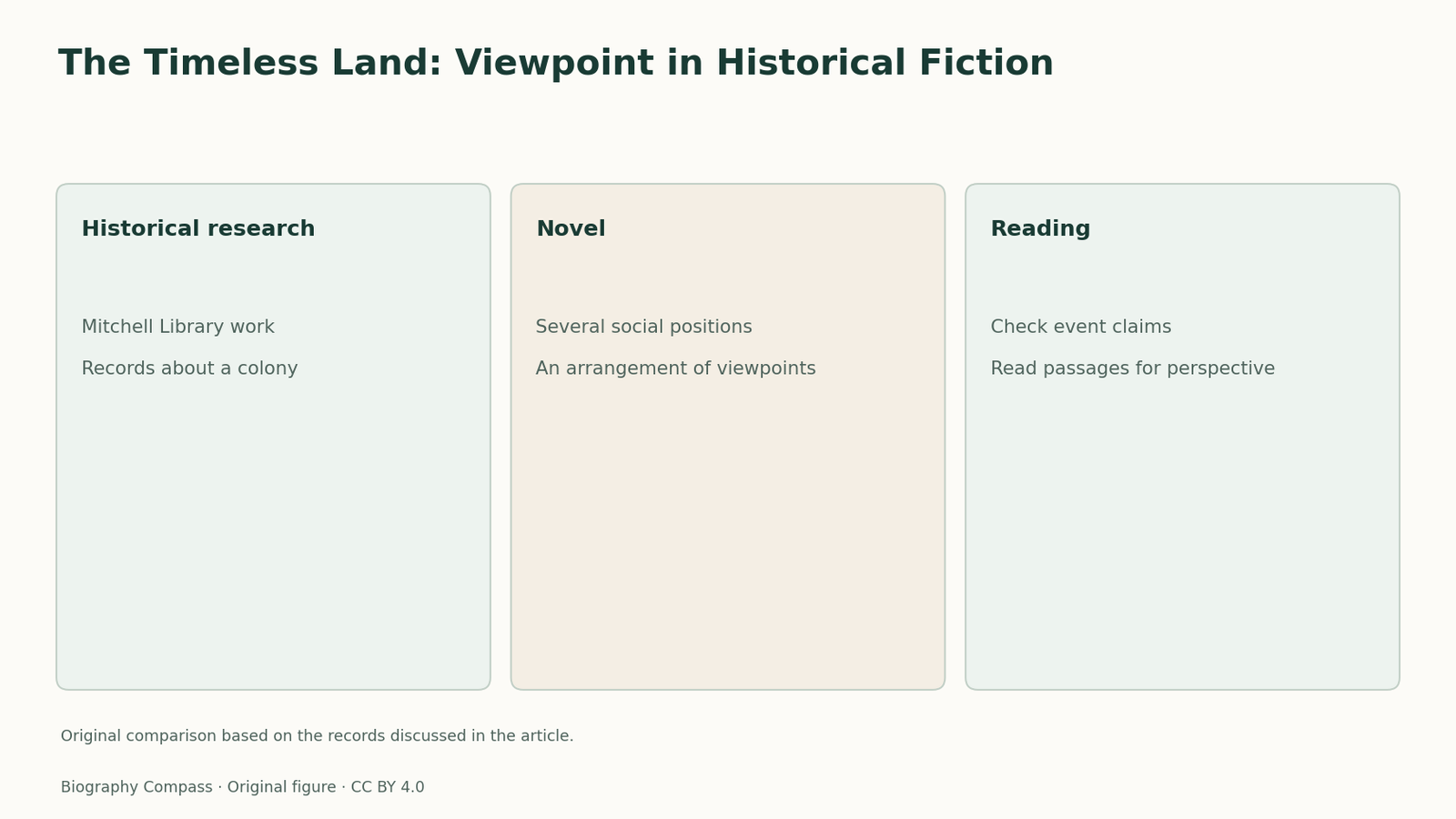
The Timeless Land is built around the opening years of the British colony in New South Wales. Dark researched those years and represented them through several kinds of participant. A record of her research can establish what she sought to know. The novel’s arrangement of viewpoints requires a separate kind of reading.
Evidence comparison
Three kinds of evidence for historical fiction
Select the record appropriate to the question.
| Evidence | Best question |
|---|---|
| Publication record | When and in what form did the book reach readers? |
| Working papers | How was research used or changed during drafting? |
| Specific scene | What can the reader know from the available viewpoint? |
Start with the project’s scope
The Timeless Land appeared in 1941 as the first novel in a historical trilogy. Varuna’s account describes research in the Mitchell Library and a narrative spanning Indigenous people, settlers, convicts and administrators. That is a claim about the project’s breadth. It is also a prompt to read for perspective, since the people involved cannot be assumed to have shared the same knowledge of an event. A date can establish the chronological setting of an arrival. It gives much less help in determining what a person already living there might make of it.
The archive and the imagined scene answer different questions
The State Library’s collection record lists manuscripts and typescripts among the materials preserved. A researcher could use that archive to ask which material was gathered and how a draft changed. A novel can use some of the same evidence while also assigning a scene to someone who has no surviving written testimony. It is important to distinguish the project’s research from the resulting attribution of an inner life. A historical claim about what happened requires its own support, while a claim about the novel’s viewpoint requires a passage that can be examined.
Name the position before comparing accounts
For a discussion of a colonial encounter, place a historical question and a narrative question beside each other. The historical question might be who arrived at a place, when they arrived and what record identifies them. The narrative question might be whose perception is available to the reader before the encounter can be explained. Different answers can coexist. A person who can describe an official order need not know what that order means to a family affected by it. Keeping those positions visible is one way to discuss Dark’s ambition without making the novel a substitute for the voices of actual people.
One title travelled through several settings
The library record identifies the 1941 Australian publication, and Varuna describes the book’s international readership and its place in the trilogy. Printing and readership add another level to the question of viewpoint. A reader overseas could learn about an unfamiliar history through the arrangement of a novel. That reader would still need other sources to test the history, especially where colonial documents had themselves been written from a particular position. The work’s accessibility and its need for careful contextual reading can be understood together.
Use a claim table in discussion
List a claim that belongs to publication history, a question that belongs to the archive and a question that can only be answered by inspecting a chosen passage. The first might name 1941, the second a surviving draft, and the third the point at which a reader learns what a character knows. The categories identify evidence a group needs before reaching a judgement. They can travel to the other volumes without turning three separate novels into a single undifferentiated account.
Biography context
Explore Australia through connected lives
Connected biographies
People connected to the work
1901–1985
Eleanor Dark
Novelist and writerEleanor Dark wrote psychologically focused novels and researched a trilogy about the early British colony in New South Wales. Her home at Varuna became part of a later literary institution.Read biography1912–1990
Patrick White
Australian novelist and playwrightPatrick White developed an Australian literary career through European education, wartime service and a return to Sydney, writing ambitious novels, stories and plays.Read biographyQuick answers
Common questions
- Is The Timeless Land part of a trilogy?
- Yes. It is followed by Storm of Time and No Barrier.
- What does the archive establish about viewpoint?
- Its drafts and related records can illuminate composition. Claims about a scene still need a passage from the novel.
Primary and institutional sources
How this history was checked
Dates, legal milestones and historical claims are checked against the official and institutional records below. This article was reviewed on 13 November 2026.