
The short answer
Tess of the d’Urbervilles asks readers to separate a woman’s humanity from the judgement imposed on her. Its tragedy develops through poverty, sexual violence, work, failed communication and unequal moral standards, not just an unlucky romance. This guide explains the publication history and offers a reading of key scenes. It contains major spoilers and discussion of sexual assault, infant death and execution.
Chronology
A timeline of the turning points
A developing manuscript
The surviving British Library autograph manuscript records the novel’s composition and alterations.
The Graphic serial
The story appeared with modifications and omissions for periodical publication.
Separate scenes and a book
Material also appeared in other periodicals before being assembled in the three-volume novel.
Continuing revision
Hardy continued to revise. The manuscript, 1891 serial, first book and later reading text are not interchangeable witnesses.
Why there is more than one publication text
Tess appeared in The Graphic between July and December 1891 and as a three-volume book near the end of that year. Publication required changes: some material was altered or omitted for the serial, while episodes appeared separately elsewhere. The British Library catalogue identifies these relationships and records missing leaves in the surviving autograph manuscript. A catalogue description provides evidence about the manuscript without allowing a reader to claim they have examined every original leaf.
Hardy’s explanatory note describes bringing the separate parts together for the book. Later revisions mean that a modern text need not reproduce every detail of the first edition. This guide reads the public-domain Project Gutenberg text and its authorial prefaces alongside the publication records; it does not present its wording as a diplomatic transcription of the 1891 serial. The subtitle A Pure Woman is part of the novel’s challenge to conventional judgement, not a promise that its protagonist will never make a consequential choice.
The borrowed name and the pressure of poverty
Tess Durbeyfield belongs to a poor rural family. News of descent from the old d’Urberville line offers her father a flattering story but no dependable income. The wealthy household she is sent to approach has adopted the name rather than inherited the same lineage. The resemblance between the names produces an opportunity for exploitation, not a secure claim to a restorative ancestral fortune.
After the family horse dies, Tess’s sense of responsibility helps send her towards that household and Alec. Her choices begin inside obligations she did not create. Reading the opening solely as the discovery of noble ancestry overlooks the work and money that make the discovery dangerous. A name can appear to promise freedom while helping to move someone with fewer resources into another person’s power.
Sources for this section: [1]
The Chase and the refusal to make Tess disposable
Alec’s pursuit is not a relationship between equals. Tess repeatedly resists him, and the scene in the Chase leaves her asleep before the narration moves across the assault rather than describing it directly. Differences between editions and the narrator’s evasions deserve attention, but the absence of an explicit narrated act is not evidence that she freely consents. Calling the whole episode an uncomplicated seduction erases the coercion and vulnerability built into the sequence.
The novel then continues with Tess as its central consciousness instead of discarding her as a moral warning. Her baby, Sorrow, dies after she performs an improvised baptism. The encounter over burial exposes the distance between human need and institutional rules. Tess’s grief, care and continuing capacity for work contradict any summary that treats her merely as a fallen woman whose character has been completely determined by Alec.
Sources for this section: [1]
Angel’s double standard is central to the tragedy
At Talbothays dairy Tess finds companionship and falls in love with Angel Clare. The setting allows real pleasure, but it is still a workplace rather than a world outside economic necessity. Angel sees Tess partly through an ideal of rural innocence. His willingness to reject some of his family’s religious expectations does not make him free from inherited assumptions about women.
Their wedding-night confessions expose the imbalance. Tess forgives Angel’s account of a previous sexual encounter; Angel cannot extend comparable understanding to her. The situations are not equivalent, especially given Alec’s coercion, but Angel’s judgement expects greater purity from Tess than from himself. The tragedy therefore does not depend only on a letter going astray or an unfortunate delay. A person who imagines himself unconventional can still enforce the convention most harmful to someone he loves.
Sources for this section: [1]
Labour and housing turn rejection into material danger
After Angel leaves, Tess must support herself through exhausting agricultural labour. Flintcomb-Ash contrasts with the dairy: weather, hard ground and machinery place new demands on bodies already short of resources. These sequences make social vulnerability visible in hours worked and shelter available, not only in the vocabulary of reputation.
Alec’s renewed pursuit takes place within those pressures. Family insecurity and Tess’s uncertainty about Angel narrow the alternatives she can see. Chance and missed communication matter throughout the novel, but they work upon an unequal distribution of money, mobility and influence. Describing everything as fate makes the people and institutions contributing to her danger disappear from the account.
Sources for this section: [1]
Stonehenge, execution and the irony of justice
Angel returns after Tess has resumed living with Alec. She kills Alec, then spends a brief period in hiding with Angel before her arrest at Stonehenge. The ancient setting changes the scale of the scene, but it cannot suspend the police or the law. The ending subsequently shows Angel and Tess’s sister watching a black flag raised at the prison: Tess’s execution is communicated through an institutional sign rather than a detailed scaffold scene.
The narrator’s final reference to justice is bitterly ironic, not an uncomplicated endorsement of a morally balanced outcome. Reading the ending as either pure supernatural persecution or straightforward approval of murder makes its tensions too simple. Tess remains responsible for an action at the end, while the novel has required the reader to understand how coercion, abandonment and material need shaped the road there. That is a critical interpretation of the literary text, not a legal judgement about a real criminal case.
Sources for this section: [1]
Continue the chronology
Related history guides
Biography context
Explore United Kingdom through connected lives
Connected biographies
Meet the author
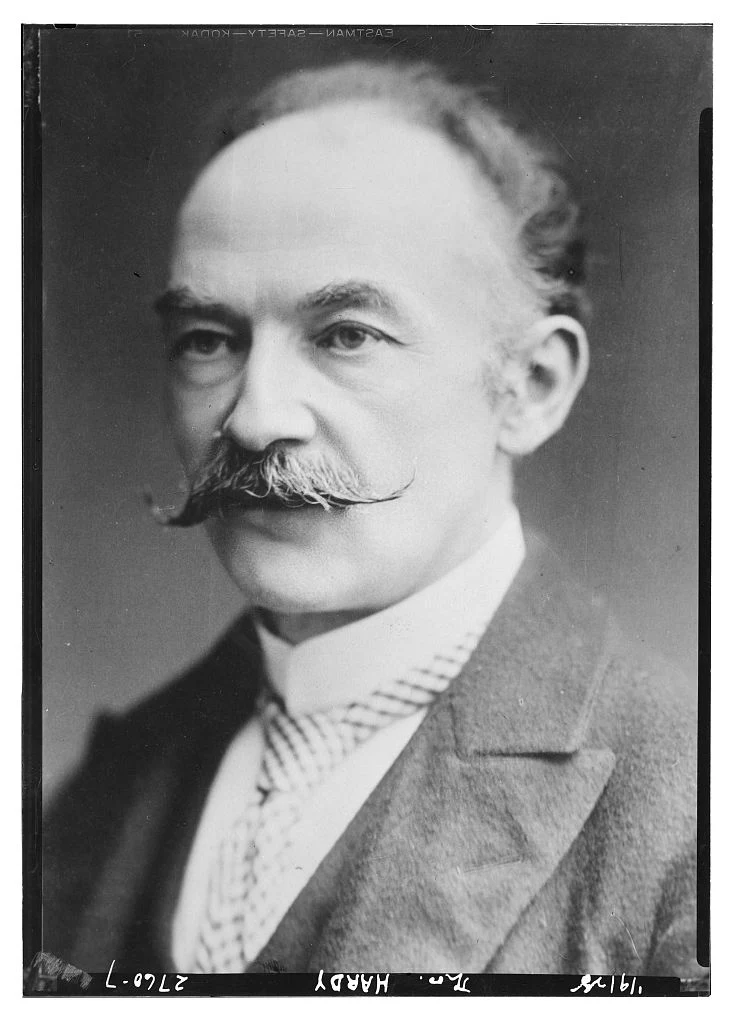
1840–1928
Thomas Hardy
Novelist, poet, short-story writer and architectThomas Hardy was an English novelist and poet whose imagined Wessex transformed the places, work and social pressures of southern England into fiction and verse.Read biographyQuick answers
Common questions
- When was Tess of the d’Urbervilles published?
- It appeared in The Graphic during the second half of 1891 and in three-volume book form near the end of that year. The serial included modifications and omissions.
- Is Alec really related to Tess through the d’Urbervilles?
- His family adopted the d’Urberville name. The apparent connection between their households is not the secure shared ancestry Tess’s parents initially imagine.
- Why is Angel Clare’s response important?
- He expects forgiveness for his own sexual past while rejecting Tess after her confession. The difference exposes a sexual double standard even in a man who thinks himself independent of convention.
- Does the book show Tess’s execution directly?
- No. Its final scene communicates the execution through the prison’s black flag, watched from outside by Angel and Liza-Lu. The narrator’s reference to justice is ironic.
Primary and institutional sources
How this history was checked
The British Library catalogue and Hardy Society establish publication context. The literary interpretation uses selected primary-text passages and Hardy’s prefaces; no full manuscript collation or claim to have inspected unavailable digitised leaves is made. This article was reviewed on 23 October 2026.
- Thomas Hardy / Project GutenbergTess of the d’Urbervilles: prefaces and selected chapters 1–15, 34–35, 43–52 and 55–59
- British LibraryAdd MS 38182: autograph manuscript, serial alterations and separately published scenes
- Thomas Hardy SocietyTess of the d’Urbervilles: serial and book publication, reception
- Library of CongressThos. Hardy: later author portrait, ggbain.13585
- Wikimedia Commons / Library of CongressExact portrait file, identity and public-domain record