
The short answer
A working lamp was one element in a much larger undertaking. Edison’s laboratory had to connect experiments with manufacturing, distribution, customers and daily operation. Following those connections explains why the electric lighting story continued after the celebrated demonstrations of 1879.
Connected components
What the lamp depended on
These functions had to work together; none alone provided a complete lighting service.
| Part of the undertaking | Purpose | Why it mattered |
|---|---|---|
| Lamp and circuit | Produce controllable indoor light | Individual switching and the electrical load affected the wider network. |
| Generator | Convert mechanical input into electrical supply | Efficiency affected the cost of operating many lamps. |
| Conductors and protective fittings | Connect buildings and manage distribution | Installation depended on insulation, fittings and access to streets. |
| Manufacture and operation | Produce components and maintain a service | A demonstration had to become a repeatable, working business. |
Chronology
A timeline of the turning points
Planning a complete service
Edison’s laboratory intensifies work on electric lighting, including the lamp and the equipment needed to supply it.
Carbon-filament experiments
The team tests carbon filaments and improved vacuum conditions; the often repeated October anniversary dates require caution.
Showing a connected installation
Menlo Park’s laboratory, nearby buildings and street lamps become part of public demonstrations.
A lamp patent
Patent 223,898 records a particular high-resistance carbon lamp and associated construction methods, not the entire future electricity industry.
Preparing for manufacture and distribution
Work extends to longer-lived lamps, production tools, insulated conductors, meters and other system components.
Holborn Viaduct
Edison’s London central station begins operation before New York’s Pearl Street station.
Pearl Street
The central station in lower Manhattan begins supplying its district.
Why design a system rather than a single lamp?
Electric lighting preceded Edison’s work. His challenge was to turn incandescent illumination into a service that customers could use in place of familiar gaslight. That required attention to cost, control and supply, as well as brightness. Gas distribution offered a commercial model: a central source, connections into buildings and a way to charge for use.
Parallel circuits allowed customers to switch individual lamps without interrupting every other light. High-resistance lamps were part of the same design problem, helping make the distribution network economically manageable. The lamp, circuit and conductors therefore influenced one another. Improving one component meant considering how it would operate with the rest, rather than treating a successful laboratory glow as a finished public utility.
What changed in the carbon lamp?
The laboratory explored platinum as well as carbon. Platinum’s expense made commercial supply difficult, while better vacuum techniques renewed the prospects of cheaper carbon. Experiments continued across materials and methods. The resulting light was not one unchanged object carried directly from a first trial into every customer’s building.
Patent 223,898, granted on 27 January 1880, describes a high-resistance carbon light-giving element in an evacuated glass enclosure, together with ways of making and connecting it. That specific document is more informative than the unrestricted claim that Edison invented electric light. The familiar October 1879 anniversary dates also need care: NPS’s timeline explicitly questions them, so this chronology does not assign the breakthrough an uncontested day.
Who worked on the supply side?
A lamp needed a suitable generator. Edison and his colleagues investigated designs used for arc lighting, then conducted experiments aimed at a more efficient supply for incandescent lamps. Charles Batchelor directed machine-shop work, and Francis Upton participated in the measurements and experiments. Their work makes the laboratory’s technical organization visible behind Edison’s name.
Efficiency concerned the relationship between useful electrical output and the mechanical power needed to obtain it. The team compared designs and measured performance rather than simply scaling up an existing machine. Rutgers’s account also notes parallel research by Elihu Thomson and Edwin Houston, without claiming to know whether it informed every Menlo Park experiment. Shared technical problems did not belong to one isolated inventor.
Sources for this section: [3]
What did the December 1879 demonstrations establish?
John Kruesi supervised preparations for an installation extending beyond a workbench. Staff wired the laboratory, nearby buildings and street lamps, drawing electricity from a generator in the machine shop. Visitors could see connected lights operating across different spaces. Demonstrating that arrangement helped explain what an electric service might offer.
An investor demonstration on 27 December preceded the public New Year holiday crowds. The attention was commercially useful but also interrupted laboratory work. Demonstration and readiness were different milestones: the team still had to improve reliability and compete with gas on cost. A successful evening in Menlo Park did not prove that every component was ready for continuous use throughout a city.
Sources for this section: [4]
How did experiments become manufactured infrastructure?
Development continued through 1880 and 1881. Filament research moved toward bamboo, while an underground model at Menlo Park provided a place to test components and estimate costs. Work on insulation, fuses, meters, sockets and fixtures addressed problems that an attractive lamp alone could not solve.
Manufacturing required its own equipment and organization. Workers developed tools and improved vacuum-pump arrangements for producing lamps; Upton took charge of the lamp factory. Operations in New York included separate businesses making dynamos, underground conductors and smaller fittings. These activities connected invention with repeated production and installation. City approval to lay conductors was another requirement: the street network was a public setting, not an extension of a private laboratory.
Sources for this section: [5]
Where does Pearl Street fit in the chronology?
Pearl Street began operating in lower Manhattan on 4 September 1882. It brought the generation-and-distribution project into commercial service for a local district. Its historical importance does not require describing it as the world’s first electric power station: Edison’s own Holborn Viaduct station in London had started on 12 January that year.
The sequence separates three achievements: making promising lamps, demonstrating an installation and operating a supply business. None makes the others unnecessary. Reading the dates alongside the equipment and workforce explains the scale of the undertaking more clearly than a single invention anniversary. It also leaves room for other inventors and enterprises whose electrical systems developed along different paths.
Continue the chronology
Related history guides
Biography context
Explore United States through connected lives
Thomas Edison
Explore the laboratories, business ventures and collaborators beyond the electric lighting project.
Explore the biographiesA different electrical enterpriseGeorge Westinghouse
Follow another manufacturer’s work on electrical systems without treating it as Edison’s own project.
Explore the biographiesConnected biographies
Compare the people behind electrical enterprises
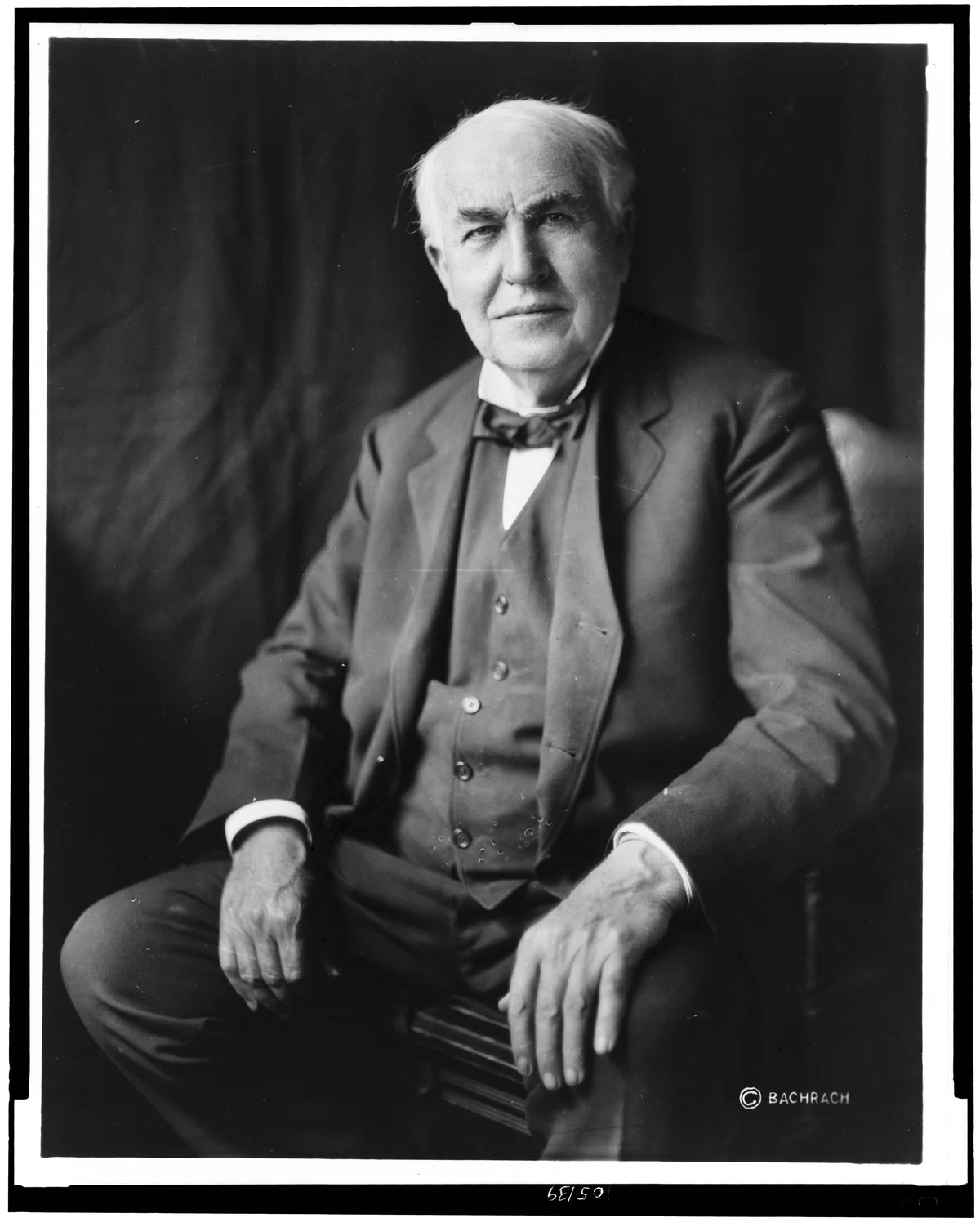
1847–1931
Thomas Edison
Inventor, laboratory organizer and industrial entrepreneurAn American inventor and entrepreneur whose laboratories connected experimental work with manufacturing, finance and commercial systems.Read biography
1846–1914
George Westinghouse
Inventor and founder of air-brake and electrical manufacturing companiesAn American industrial inventor whose air-brake business preceded his electrical company, where engineers developed power systems using contributions from William Stanley, Nikola Tesla and others.Read biographyQuick answers
Common questions
- Did Edison invent every form of electric lighting?
- No. Earlier experimenters had developed electric lights. His laboratory’s contribution concerned a practical incandescent lamp and a coordinated system for supplying and using it.
- Was the December 1879 demonstration the opening of Pearl Street?
- No. The demonstrations took place at Menlo Park. New York’s Pearl Street central station opened on 4 September 1882, after further development and manufacturing work.
- What does the 1880 lamp patent establish?
- Patent 223,898 records a particular high-resistance carbon lamp and associated methods. It is a specific technical document, not a patent on every form of electric light or public electricity supply.
- Did Pearl Street open before Edison’s London station?
- No. Rutgers’s chronology dates Holborn Viaduct’s opening to 12 January 1882 and Pearl Street’s to 4 September 1882. The locations and milestones should be named rather than collapsed into a worldwide first.
Primary and institutional sources
How this history was checked
The Edison Papers’ linked institutional essays and the original patent distinguish laboratory research, public demonstration, manufacture and commercial operation. The chronology does not repeat a disputed exact day for the 1879 breakthrough. This article was reviewed on 21 October 2026.
- Rutgers University, Thomas A. Edison PapersConceiving the System
- Rutgers University, Thomas A. Edison PapersThe Carbon-Filament Lamp
- Rutgers University, Thomas A. Edison PapersDesigning the Generator
- Rutgers University, Thomas A. Edison PapersDemonstrating the New Light
- Rutgers University, Thomas A. Edison PapersFrom Research to Development
- Rutgers University, Thomas A. Edison Papers1882 chronology
- United States Patent Office; Google PatentsThomas A. Edison, Electric Lamp, U.S. patent 223,898
- United States Patent OfficePatent 223,898 — original specification and drawings
- National Park ServiceThomas Edison National Historical Park — Timeline