
The short answer
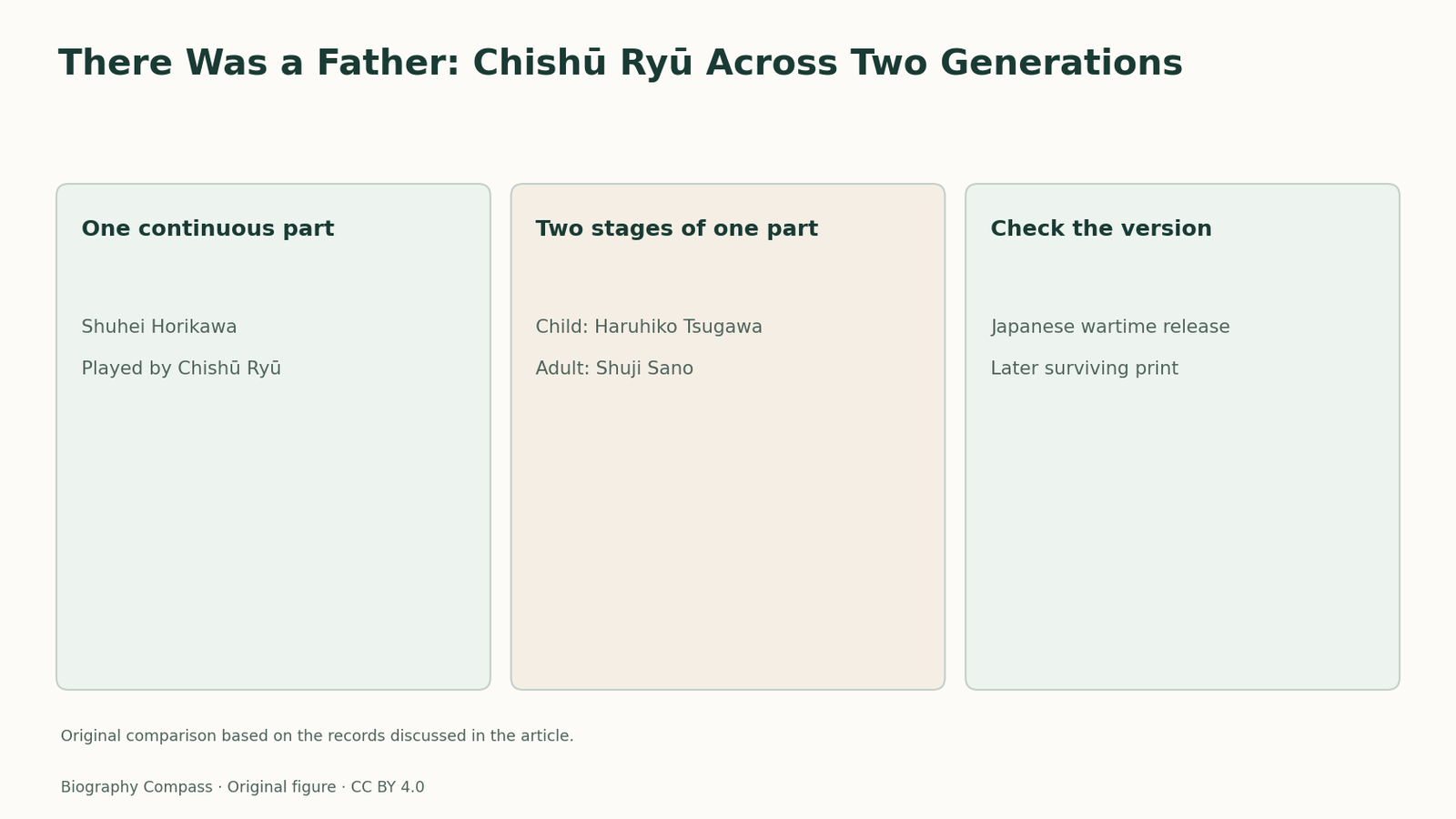
There Was a Father gives one performer the task of holding the father’s role together while two actors mark the son’s passage from childhood to adulthood.
Evidence comparison
How the family is cast
Criterion lists separate credits for the son at two ages.
| Character | Performer |
|---|---|
| Shuhei Horikawa | Chishū Ryū |
| Ryohei as a child | Haruhiko Tsugawa |
| Ryohei as an adult | Shuji Sano |
One father and two actors for the son
The cast list for There Was a Father is a compact description of how a long story can be produced. Ryū plays Shuhei Horikawa. Haruhiko Tsugawa plays Ryohei as a child, and Shuji Sano takes over as the adult. In a story told through one family relationship, the audience is asked to accept a change of performer as evidence of time passing. The father’s performer remains constant. That decision gives the film an acting problem and gives the viewer a way to think about continuity even before looking at particular scenes.
A separation with a purpose
The distributor presents Shuhei as a widowed teacher trying to arrange a future for his son. His decisions increase the distance between them. The striking feature of that setup is that care and separation can have the same cause. A father may judge a plan by what it offers a child years later, while the child experiences the present time apart. A reader can use the plot premise to ask which result a scene emphasises. That approach leaves room for an interpretation of duty without treating every act of separation as evidence of a single motive.
1942 is a release context
The film’s Japanese release during the Second World War places it within a production and censorship environment distinct from the one governing a later reissue. Criterion’s essay distinguishes references in the surviving print from possible expectations of a wartime release, including discussion of Ryohei’s army medical. This is a reason to label the version before analysing an absence. A surviving print offers direct evidence of what that print contains. The year of first release establishes a historical context, but a viewer needs further documentation before identifying what appeared in an earlier cut.
Use Ryū’s recollections at the right scale
Ryū’s account of Ozu’s rehearsals describes a long working relationship and the actor’s efforts to meet the director’s instructions. It can help a viewer ask about the timing and placement of a performance. A recollection across many films gives less certainty about the origin of any particular gesture. In a viewing notebook, place the interview in a column for working practice. Place specific gestures, speaking rhythms and differences between the father’s scenes with each son in a separate column for observations. This keeps the evidence from becoming a general claim that every scene was rehearsed in a documented way.
Test which actor carries the change
Watch for one comparable action before and after the younger performer gives way to the older one. It might be the son addressing his father or the father responding to a plan. Record whether the relationship feels different because the son speaks differently, because Ryū changes his response, or because the situation has altered. There may be evidence of more than one factor. Using the same descriptive terms on each side of the transition makes a precise question out of the film’s unusual casting arrangement and avoids asking the actors to provide an exact duplicate of each other’s performance.
Continue the chronology
Related history guides
Biography context
Explore Japan through connected lives
Connected biographies
People connected to the work
1904–1993
Chishū Ryū
Film actorChishū Ryū entered Japanese films in 1925 and moved from small roles to leads in Yasujirō Ozu’s films, including There Was a Father and Tokyo Story.Read biography1903–1963
Yasujirō Ozu
Film director and screenwriterYasujirō Ozu moved from silent comedy to carefully organised family dramas, developing long collaborations and a visual style recognised beyond Japan.Read biographyQuick answers
Common questions
- Who plays Ryohei in There Was a Father?
- Haruhiko Tsugawa plays the child and Shuji Sano plays the adult.
- What part does Chishū Ryū play?
- He plays Shuhei Horikawa, the widowed teacher who is Ryohei’s father.
Primary and institutional sources
How this history was checked
Dates, legal milestones and historical claims are checked against the official and institutional records below. This article was reviewed on 13 November 2026.