
The short answer
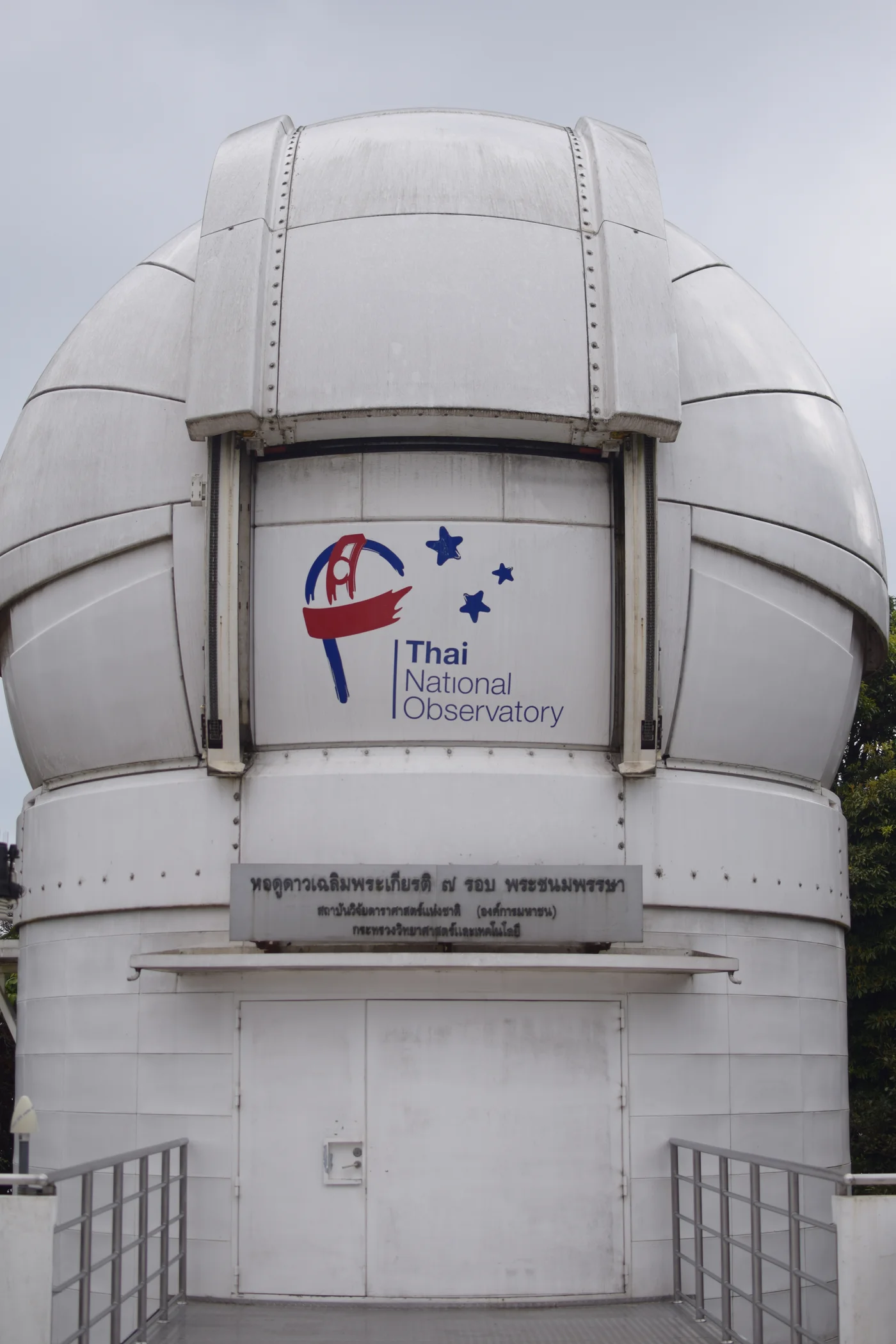
Thailand’s national observatory on Doi Inthanon was inaugurated on 22 January 2013. The facility paired a 2.4-metre reflecting telescope with instruments that can record images and spectra. What researchers can study depends on how those instruments collect light and on when observers can use them.
Making an observation
One telescope, different kinds of records
The telescope gathers light. Its attached equipment determines how that light becomes a measurement.
| Component | Role | What a researcher can record |
|---|---|---|
| 2.4-metre reflector | Collects and directs light | Light from the chosen object passes to an attached instrument. |
| Camera | Records images through selected filters | Location and brightness in one or more bands. |
| Spectrograph | Separates light by wavelength | Patterns used to study the object’s properties. |
Chronology
A timeline of the turning points
National observatory inaugurated
NARIT records the opening of the research site on Doi Inthanon.
Engineers operate the telescope and dome
The site uses a control room for observing work.
Observing schedules record allocated projects
Published cycles give programmes separate observing time.
Why Doi Inthanon is part of the instrument
NARIT lists the site at 2,457 metres above sea level. The dome and observing site matter to performance because cloud, weather and atmospheric conditions affect how much observing can be done and how sharp the data will be.
The telescope’s mirror is the largest optical element. A dome protects the system when it is idle and opens a view of the sky for observing. The site and the machinery are therefore part of the record of how the instrument is used.
Sources for this section: [1]
What a 2.4-metre aperture changes
A large mirror gathers light that can reach a camera or a spectrograph. A camera can follow a target’s brightness or position as it changes. A spectrum records how much light arrives at different wavelengths. The two outputs answer different questions about the same object.
NARIT documents a range of instruments attached to the telescope. That record is more specific than aperture alone: the mirror gives the facility light-gathering ability, while the selected equipment determines what researchers measure.
Sources for this section: [1]
Why published observing cycles matter
The national observatory has more potential observing projects than can run at any one time. Schedules list distinct proposals and dates. They provide evidence of planned access and show how several groups can use the same facility during a season.
To establish what data were obtained and how a project interpreted them, a reader must look beyond the schedule to observation logs and published research. A timetable explains allocation, while results report how the time was used.
Continue the chronology
Related history guides
How Thailand’s 40-Metre Radio Telescope Observed a Comet
Follow commissioning, calibration and a result from the separate 40-metre radio telescope.
Read the timeline1999–2000How Subaru Kept Its 8.2-Metre Mirror in Shape
Read how another optical telescope maintains the shape of its large primary mirror.
Read the timeline1923–1928What Bosscha’s Double Refractor Added to Astronomy
Compare the instrument records of a historical refractor in Indonesia.
Read the timelineConnected biographies
People connected to this history
Quick answers
Common questions
- When did Thailand’s national observatory open?
- NARIT records its inauguration on 22 January 2013.
- Why is it called the 2.4-metre telescope?
- The measurement refers to the diameter of its main reflecting mirror, not the height of the dome.
Primary and institutional sources
How this history was checked
Dates, legal milestones and historical claims are checked against the official and institutional records below. This article was reviewed on 19 November 2026.