
The short answer
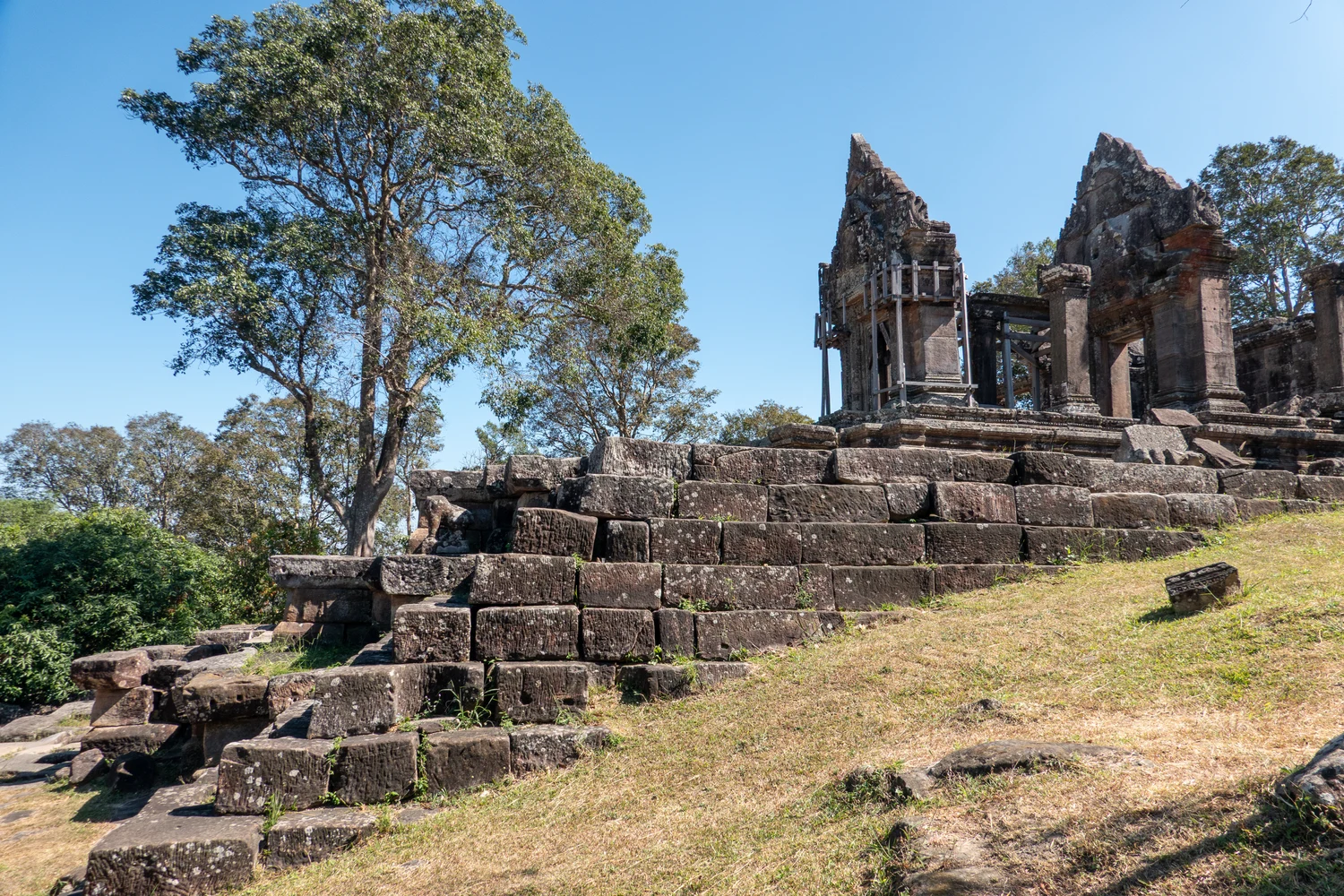
At Cambodia's Temple of Preah Vihear, a succession of sanctuaries, paved approaches and stairs follows an axis about 800 metres long. The complex sits on the Dangrek escarpment. These spatial features help explain why the World Heritage Committee listed it in 2008 as a major work of Khmer architecture.
Compare the records
Read the layout before individual carvings
The site's extended route organizes the relationship among architecture and terrain.
| Feature | Where it sits | Why it matters |
|---|---|---|
| Pavements and stairs | Along the rising approach | Links the sequence of sanctuaries |
| Sanctuaries and gateways | At stages along the axis | Divides the complex into spaces encountered in order |
| Escarpment | At the edge of the plateau | Explains part of the relationship between the approach and the setting |
| Criterion (i) | In the 2008 decision | Identifies the architectural basis for inscription |
Chronology
A timeline of the turning points
A sanctuary is established at the site
UNESCO dates the site's earlier history before most surviving buildings.
Principal surviving architecture takes shape
A succession of structures gives the site its long approach.
World Heritage Committee inscribes the temple
The decision recognizes the architecture under criterion (i).
Why the long approach is part of the design
Movement through the site organizes the visitor's view of each structure. Paved sections and stairs connect sanctuaries at different points on the slope. A carved opening may frame a view of the next stage of the approach before the visitor can see the entire building. UNESCO's description emphasizes how the route responds to the escarpment. This helps explain why a photograph of one gateway conveys only one part of the complex.
Sources for this section: [1]
Separate the early sanctuary from the buildings seen today
The World Heritage record traces a sanctuary at the site back to the ninth century, while most surviving temple fabric dates from the eleventh and twelfth centuries. The two dates describe different evidence. One gives the history of use of the location. The other dates the principal architectural ensemble visitors see. Reading the account in this order avoids attaching the earliest date to every structure along the approach.
What the 2008 decision recognized
The World Heritage Committee inscribed the Temple of Preah Vihear on the basis of criterion (i), the committee's criterion for a masterpiece of human creative genius. Its decision highlights the outstanding plan, decoration and relationship to the landscape. For questions about the property limits, the decision and official property maps are more precise than a photograph or travel account. A comparison with Koh Ker shows how widely Khmer temple planning could vary in response to a different site and royal project.
Continue the chronology
Related history guides
Vat Phou: The Temple and Champasak Cultural Landscape
Compare Preah Vihear’s escarpment axis with the mountain-to-river landscape at Vat Phou.
Read the timeline921–944 CE · 2023Koh Ker: Khmer Capital, Prasat Thom and UNESCO Listing
Compare the escarpment approach with the planned city and immense stone blocks at Koh Ker.
Read the timeline1992–2004Why Angkor Left the World Heritage in Danger List
See how a separate Cambodian World Heritage property was safeguarded over time.
Read the timelineConnected biographies
People connected to this history
Quick answers
Common questions
- When did the Temple of Preah Vihear enter the World Heritage List?
- The committee inscribed the temple in 2008 under criterion (i).
- What is distinctive about the layout of Preah Vihear?
- Sanctuaries are connected by pavements and stairs on an axis about 800 metres long.
Primary and institutional sources
How this history was checked
Dates, legal milestones and historical claims are checked against the official and institutional records below. This article was reviewed on 19 November 2026.