
The short answer
How did a transferred ligand constrain the interpretation of an electron-transfer reaction rather than merely identify an endpoint?
Read the evidence
Different records within the same investigation
The following comparison distinguishes the specific questions answered by the inspected records.
| Record or test | What it establishes | What remains different |
|---|---|---|
| Net redox change | Tracks electron accounting | Does not specify the full pathway |
| Ligand plus timing comparison | Constrains a bridge interpretation in the stated system | Other systems may use other pathways |
A balanced reaction leaves a pathway open
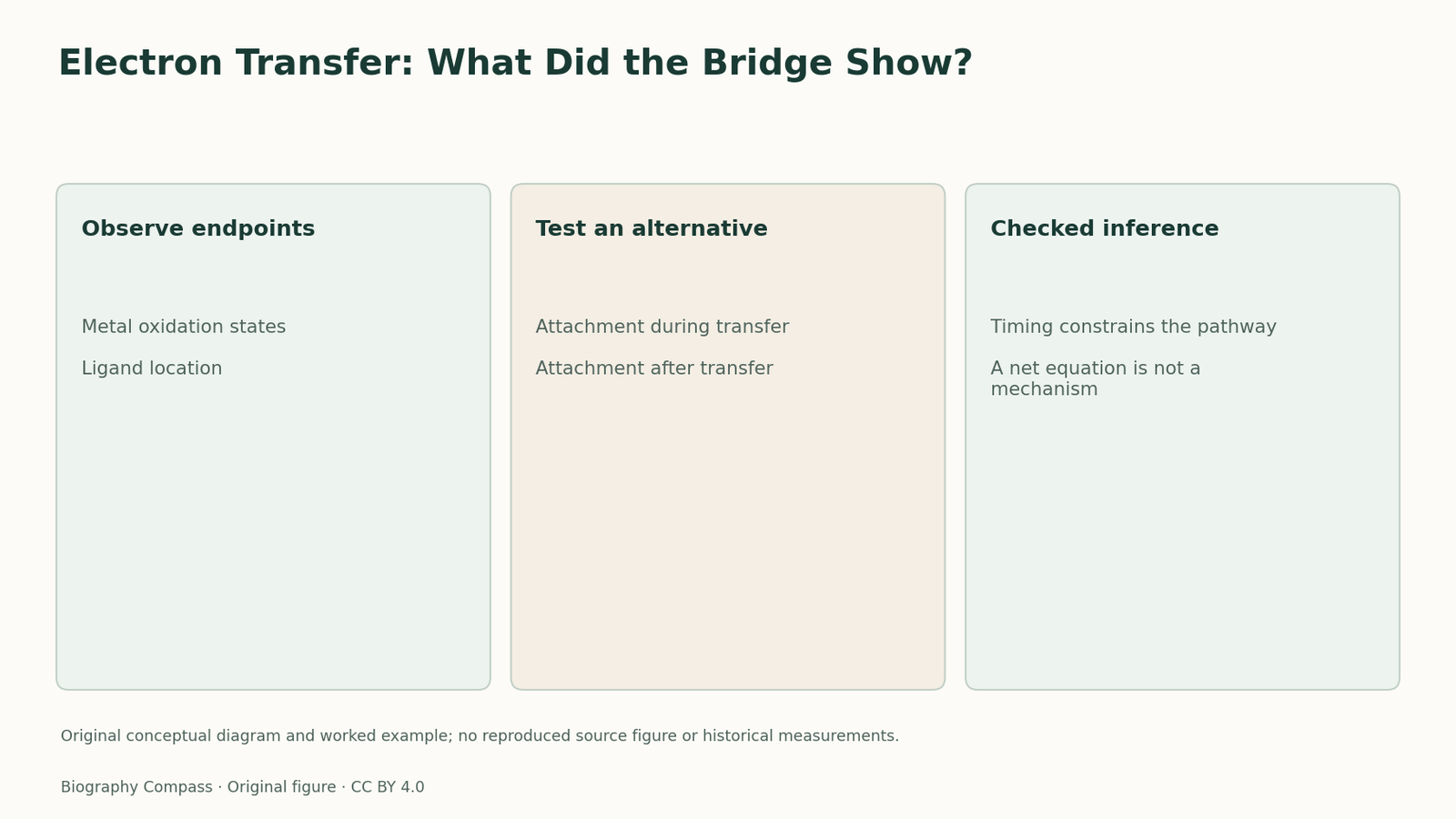
An oxidation–reduction equation identifies a change in electron accounting. It does not by itself describe how the reacting centres interacted. Taube’s work asked how coordination chemistry could make that pathway testable. His lecture connects the question with the contrast between complexes that exchange ligands rapidly and those that retain them more slowly. Such differences matter because a ligand found on a product might otherwise have arrived after electron transfer. A plausible mechanistic explanation must therefore account for the timing of ligand movement as well as the final oxidation states of the metals.
Sources for this section: [4]
What the chloride observation constrained
The account by Taube’s scientific colleagues describes chloride initially associated with cobalt and subsequently found associated with chromium in the reaction under study. Slow substitution by the relevant product supplied an important constraint against simply adding chloride after the oxidation step. This supported a pathway involving a ligand bridge between the centres. The claim is stronger than observing a colour change or completing an electron balance, because it addresses where a ligand travelled. It is also specific to a chemically characterised system; it does not say that every electron-transfer reaction must pass through the same kind of bridge.
Sources for this section: [3]
Keep the original publication sequence visible
The 1953 report names Taube, Myers and Rich; the 1954 expanded bridge-evidence paper names Taube and Myers. Those records should not be merged into a fictitious single publication or assigned one author list for convenience. Taube’s lecture provides a retrospective explanation of the questions behind the studies, including the importance of substitution behaviour. Comparing original metadata with that later account clarifies what each record contributes. It also makes a useful distinction between an experimental clue and a universal mechanistic classification: a bridge can explain one set of observations while other systems require another route.
Exercise: a tracer needs a timing argument
Imagine a fictional reaction in which a labelled ligand starts on metal A and is later found on metal B. Explanation One places transfer during the reaction; Explanation Two lets the ligand attach after the electron step. Can the final location alone choose between them? No. Now add the observation that the product exchanges this ligand far too slowly on the stated observation timescale for Explanation Two to account for the result. That additional comparison constrains the alternative. The example uses no historical values. Its answer shows why a tracer result and a substitution-rate argument are complementary, rather than two ways of merely restating the same endpoint. Conversely, if the product exchanges ligands rapidly on that timescale, the endpoint becomes less discriminating. The same labelled product could then fit both explanations, showing why a result must be interpreted with the behaviour of the system in which it was obtained.
Sources for this section: [3]
Continue the chronology
Related history guides
Biography context
Explore United States through connected lives
Connected biographies
Researchers and related approaches
1915–2005
Henry Taube
Inorganic chemist and university teacherRead Henry Taube’s Canadian upbringing, American academic career and electron-transfer research, with a careful explanation of ligand-bridge evidence.Read biographyQuick answers
Common questions
- Does ligand transfer alone settle timing?
- No. Substitution behaviour is needed to constrain when attachment could occur.
- Do all electron-transfer reactions require a ligand bridge?
- No. The historical evidence concerned a specified reaction system.
Primary and institutional sources
How this history was checked
The references below distinguish the original study from later explanations. The worked exercise and comparison are newly written for this article. This article was reviewed on 8 November 2026.
- Journal of the American Chemical Society, 1953Observations on the Mechanism of Electron Transfer in Solution
- Journal of the American Chemical Society, 1954Evidence for a Bridged Activated Complex for Electron Transfer Reactions
- Scientific colleagues, Inorganic Chemistry, 2006Henry Taube: Inorganic Chemist Extraordinaire
- Nobel Prize OutreachHenry Taube — Nobel lecture
- Nobel Prize OutreachHenry Taube — Facts
- Nobel Prize OutreachHenry Taube — Biographical