
The short answer
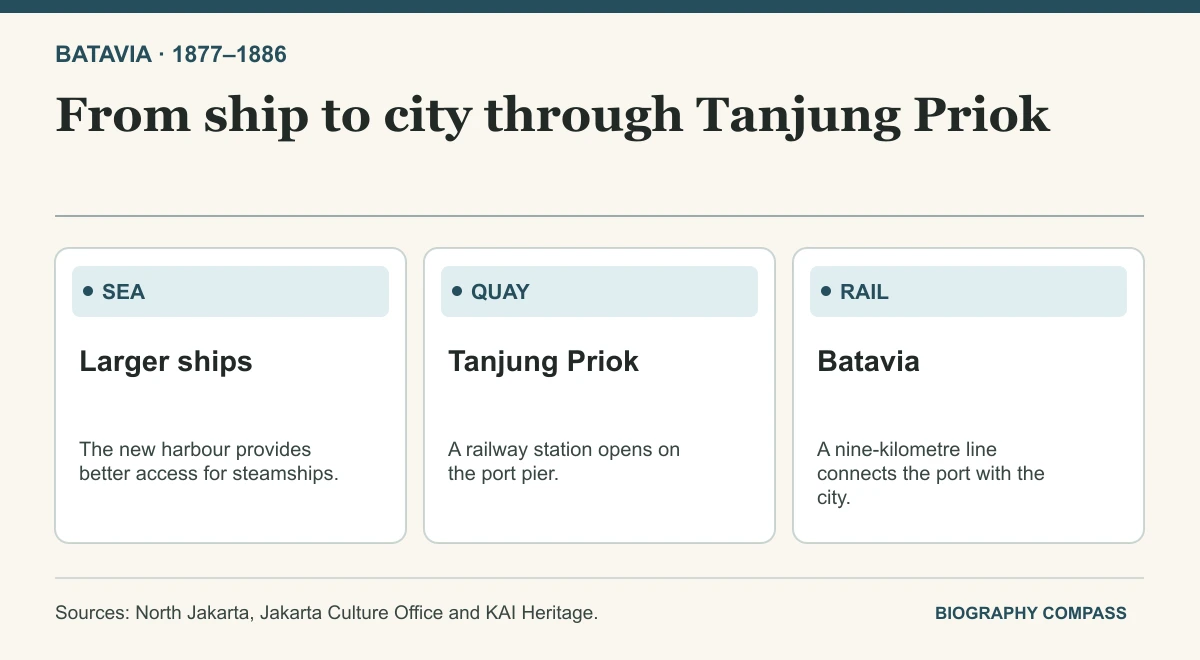
Batavia’s old harbour near the mouth of the Ciliwung remained linked to the city’s trading district but was shallow for larger vessels. In 1877, the colonial government began building a new port at Tanjung Priok. The project improved access for steamships and required a new land connection with Batavia.
Compare the records
How the ship-to-city journey changed
The harbour and its railway solved two successive parts of the same transport problem.
| Part of the journey | Constraint | What Tanjung Priok added |
|---|---|---|
| Approach to harbour | Shallow water at the older harbour | A new site designed for larger steamships |
| Transfer from ship | Cargo often moved between vessels and smaller craft | Berths where larger vessels could load or unload |
| Onward trip to the city | New port developed outside the old trading district | A railway linked the pier district to Batavia |
Chronology
A timeline of the turning points
Old harbour handles maritime trade
The harbour near Pasar Ikan serves a trading district clustered around the old city.
New harbour works begin
The colonial government starts construction at Tanjung Priok.
Railway opens
A station on the port pier opens with a railway to Batavia.
End of construction period in local history
North Jakarta dates the harbour works to 1877–1886.
The limits of the old harbour
The old port, known as Pasar Ikan and associated with Sunda Kelapa, lay near the mouth of the Ciliwung. North Jakarta’s history identifies shallowing as a reason for the move. Jakarta’s culture office connects the scale of the new works with larger steamships and the growth of maritime trade. Cargo handled offshore had to make another transfer. A harbour where larger ships could berth replaced part of that process with direct access to the quay.
Why the railway was part of the port’s usefulness
Building the harbour farther from the old city created a second problem: passengers and goods arriving at the new site still needed to reach Batavia or a connection beyond it. KAI records a nine-kilometre line to Batavia and the opening of a station on the pier on 2 November 1885. The station turned arrival at the port into a possible rail journey. The culture office’s account also records how passengers could change trains in Batavia for other destinations.
How to read the overlapping dates
North Jakarta describes harbour construction from 1877 to 1886. The rail opening in November 1885 is a dated event within that longer building period. The original pier station and the later station opened in 1925 also served the same port under the same name. Use the stated date and location when identifying which phase of the harbour or station a record describes.
Continue the chronology
Related history guides
How Batavia Opened Its First Electric Railway in 1925
Read how the port’s replacement station was inaugurated alongside the electric railway in 1925.
Read the timeline2015How Indonesia Launched the Tol Laut Freight Service
See how the harbour later served as the launch site for a national freight programme.
Read the timeline2016What New Priok’s First Container Terminal Added
Follow a later expansion of the port for container shipping at Kalibaru.
Read the timelineConnected biographies
People connected to this history
Quick answers
Common questions
- Why was Tanjung Priok built?
- Batavia needed a harbour that could receive larger ships as its old harbour became shallow.
- When did the first port railway open?
- The Tanjung Priok–Batavia railway and its pier station opened on 2 November 1885.
Primary and institutional sources
How this history was checked
Dates, legal milestones and historical claims are checked against the official and institutional records below. This article was reviewed on 19 November 2026.