
The short answer
The lamp that lights up on a bench is only one part of an electrical service. How much current each lamp draws affects the wires and generator needed to supply a building.
Reading the evidence
Lamp, circuit and service
The claims apply at different scales.
| Stage | Evidence | Question it cannot settle alone |
|---|---|---|
| Object | Identifies a preserved Swan lamp. | Performance of all early versions. |
| Circuit | Current demand follows from the stated model. | Light output or efficiency. |
| Service | Multiple loads share the distribution system. | How long a specific installation operated. |
Ask which lamp the record describes
The Science Museum has a lamp attributed to Swan. Its catalog supplies an object identity. The Smithsonian’s lighting account describes earlier work and points out that a relatively low-resistance carbon rod placed demands on the conductors supplying it. An object and a general design account can support a comparison without assuming the object preserves the exact resistance of the lamp demonstrated in 1879.
Put a date beside each version. Ask whether an article is talking about a trial, a surviving lamp or an ordinary manufactured example. Changes in the carbon element or enclosure can matter even when the name “Swan lamp” stays the same.
Move from one lamp to the circuit
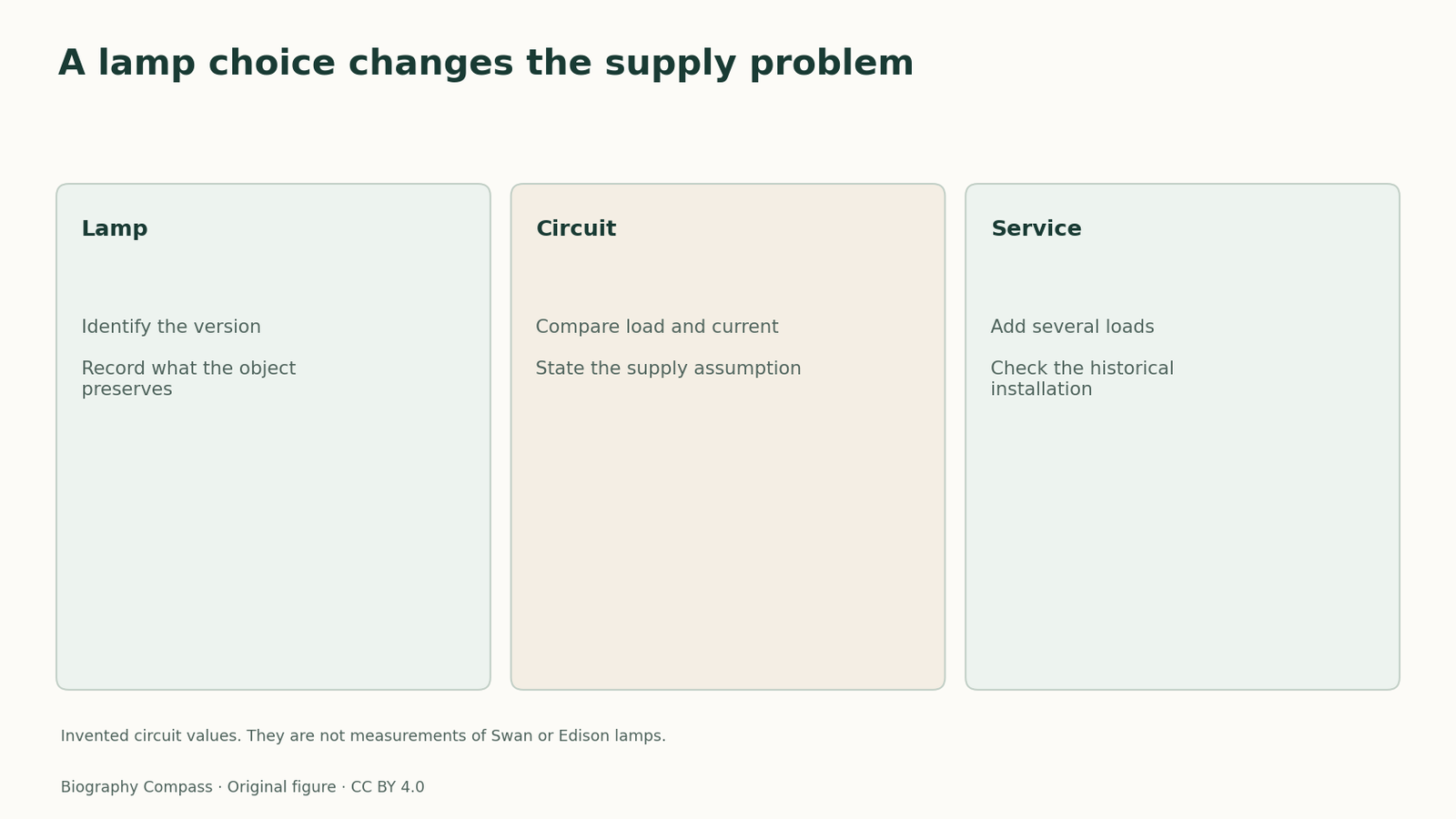
Consider an invented classroom supply of 10 volts. A purely resistive load of 5 ohms draws 2 amperes. A 10-ohm load draws 1 ampere at the same voltage. If ten of either kind were connected in parallel, their combined currents in this ideal case would be 20 and 10 amperes. The comparison helps show why an individual choice affects the supply network.
The numbers do not compare brightness or establish that the two loads do the same useful work. A glowing filament changes with temperature, and a distribution system has losses. Record those qualifications before applying the model to a historical claim.
Look for evidence at the scale of the claim
If the claim concerns sustained service, a report of a lamp glowing is an incomplete starting point. Seek the supply voltage, the number of lamps, the arrangement of the wires and evidence of regular use. The museum history helps explain why lighting engineers pursued both a workable lamp and the system that would carry electricity to it.
Sources for this section: [1]
Continue the chronology
Related history guides
Biography context
Explore United Kingdom through connected lives
Connected biographies
People in the records
1828–1914
Joseph Swan
Inventor and photographic materials researcherSwan worked on carbon lamps and photographic materials before entering electric lamp manufacture.Read biographyQuick answers
Common questions
- Why did lamp resistance matter to a lighting network?
- At a given supply voltage it affected the current each lamp drew, which in turn affected the demands on the wires and generator.
Primary and institutional sources
How this history was checked
Dates, legal milestones and historical claims are checked against the official and institutional records below. This article was reviewed on 5 November 2026.