
The short answer
The continuing presence of a president after the May 1961 coup can hide the scale of institutional change. Following who could legislate, govern and control political activity explains why retaining an office did not preserve the parliamentary republic.
Follow the powers, not only the titles
Where did authority sit?
This original comparison describes the main institutional change without treating the later 1963 election as retroactive authorisation of the coup.
| Institution | Second Republic before the coup | After the military takeover |
|---|---|---|
| National Assembly | Central legislative and parliamentary institution. | Dissolved; council exercises overriding legislative authority. |
| Prime minister and Cabinet | Executive government led by Chang Myon. | Overthrown and replaced by military-directed government. |
| President Yun Posun | Head of state in the parliamentary constitution. | Remains nominally until March 1962 while council holds decisive power. |
| Governing framework | Parliamentary constitution after the 1960 transition. | Emergency military arrangements, followed by a new presidential constitution and 1963 elections. |
Chronology
A timeline of the turning points
Parliamentary Second Republic
Constitutional change after Rhee’s fall places executive government under Prime Minister Chang Myon; Yun Posun is president.
Coup
Officers overthrow the government, declare martial law and dissolve the Assembly.
Military governing council
The Supreme Council for National Reconstruction becomes the central governing body.
Emergency governing law
Parts of the Constitution are suspended and the council receives overriding authority.
Yun resigns
The nominal presidency no longer continues under Yun Posun.
New constitutional framework
A referendum and promulgation establish a presidential framework.
Election and inauguration
Park wins the presidential election and takes office in December; the military council’s rule ends.
Start with the system the coup displaced
After the 1960 uprising against Syngman Rhee, South Korea adopted a parliamentary form of government. The National Assembly was central to choosing and sustaining executive leadership. Chang Myon served as prime minister, while Yun Posun occupied the presidency as head of state. Their responsibilities were different, and their political factions were often at odds.
This institutional starting point clarifies the target of the coup. Officers did not merely replace one president with another. Their seizure of power removed the Cabinet’s ability to govern through the parliamentary framework and dissolved the Assembly that gave that government its authority.
Force establishes a new centre of decision
On 16 May 1961 officers led by Park Chung-hee seized key positions and brought down Chang’s administration. The National Institute of Korean History describes the coup as a military overthrow of the Second Republic. The new leadership declared martial law, announced its takeover and ordered the dissolution of political institutions.
The coup’s proclamations presented anti-communism, an end to corruption, economic reconstruction and eventual return to civilian government as goals. Those statements explain how the officers justified their action; they did not supply an electoral mandate. The immediate source of their control was military force and the inability or unwillingness of existing authorities to reverse it.
A council substitutes for separated institutions
The military leadership first organised a Military Revolutionary Committee, followed by the Supreme Council for National Reconstruction. In June an emergency governing law declared the council the state’s highest authority until a new Assembly and government were established. It suspended parts of the existing Constitution and brought major governing powers under the military body.
The change altered more than the names at the top. Decisions that had depended on parliamentary debate, Cabinet responsibility and constitutional limits could be made through the new command structure. Park consolidated his position within the council during the following weeks. Internal military politics now mattered directly to the exercise of state authority.
Yun’s remaining presidency was a different kind of continuity
Yun Posun stayed in office after the coup and resigned in March 1962. The title’s survival can suggest that the old constitutional order continued, but the president no longer stood above an operating parliamentary government. The council controlled the decisive institutions and the legal framework under which they worked.
A contemporary American situation report records Yun criticising Chang’s administration during discussions with U.S. representatives. Later histories also describe his weak resistance to the takeover. The evidence makes his response part of the explanation, while the structural point remains broader: a nominal head of state could remain even as the system that defined the office’s normal role was displaced.
Control reached political speech and adjudication
The new regime restricted parties and political activity and reorganised the press. National Archives’ history describes closures justified as purification of journalism. Revolutionary courts and special punishment arrangements created further means of dealing with opponents and people classified by the regime as threats or offenders.
These changes reduced opportunities to organise a competing account of government or challenge its actions. Public promises of reform operated alongside coercive institutions. Describing both is necessary to understand the new state: its capacity to implement a programme grew through powers that also curtailed political participation and ordinary safeguards.
The 1963 transition changed the form of rule
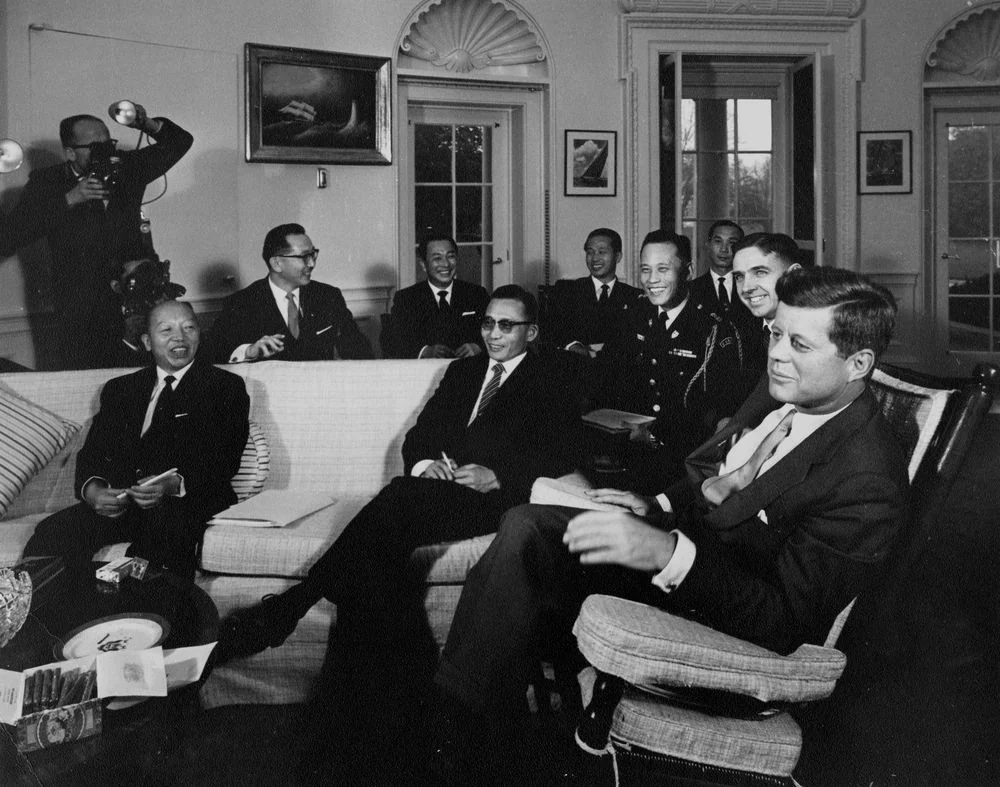
The military government announced changing timetables for a return to civilian rule. In November 1961 Park reaffirmed a pledge to transfer government in 1963 during talks with Kennedy. A new constitutional framework was approved in December 1962, and the 1963 elections led to Park’s presidency and the Third Republic.
The result was not a restoration of Chang’s parliamentary administration. Executive authority returned to a presidential system, and the coup’s leader won the new office. The comparison below therefore tracks three states of government: parliamentary rule before the coup, military-council supremacy and the subsequent presidency. This sequence explains continuity of personnel alongside a succession of different institutional forms.
Connected biographies
Read the connected biographies
1917–1979
Park Chung-hee
Military ruler and presidentPark Chung-hee seized power in South Korea through the 1961 military coup and served as president from 1963 until his assassination in 1979. His government pursued export-led industrial development while restricting political competition, civil liberties and dissent.Read biography1897–1990
Yun Posun
Independence activist, public official and presidentYun Posun was a South Korean politician whose career connected independence activity, early post-liberation government and the parliamentary Second Republic. He remained president after the 1961 coup before resigning in 1962, and later contested elections against Park Chung-hee.Read biographyQuick answers
Common questions
- Did Yun Posun immediately cease to be president on 16 May?
- No. He remained in office until March 1962, but the military council controlled the decisive governing powers.
- Was Chang Myon president?
- No. He was prime minister and head of the parliamentary executive; Yun Posun was president.
- Did the 1963 election restore the pre-coup system?
- No. It led to a presidential government under a new constitution rather than a return to Chang’s parliamentary administration.
Primary and institutional sources
How this history was checked
Official records, primary legal or publication documents and institutional histories support the narrative. Source-specific conflicts and access limits are recorded in the private research notes. This article was reviewed on 27 October 2026.
- National Institute of Korean HistoryYun Posun: independence activity, the Second Republic and later opposition (Korean)
- National Archives of KoreaRediscovering Cabinet minutes: 1961 coup and the 1962 constitutional process (Korean)
- National Institute of Korean HistoryThe May 16 military coup: context and seizure of power (Korean)
- National Institute of Korean HistoryRevolutionary pledges issued during the May 16 coup: primary text and commentary (Korean)
- U.S. Department of State, Office of the HistorianFRUS, 1961–1963, Volume XXII, document 215: coup situation report, 16 May 1961
- National Archives of KoreaSupreme Council for National Reconstruction and emergency governing arrangements (Korean)
- National Archives of KoreaLiterary and press cases: closures and revolutionary courts after the coup (Korean)
- John F. Kennedy / University of California, American Presidency ProjectJoint statement following discussions with Chairman Chung Hee Park, November 1961
- Academy of Korean StudiesPark Chung-hee: education, military career, coup and presidency (Korean)