
The short answer
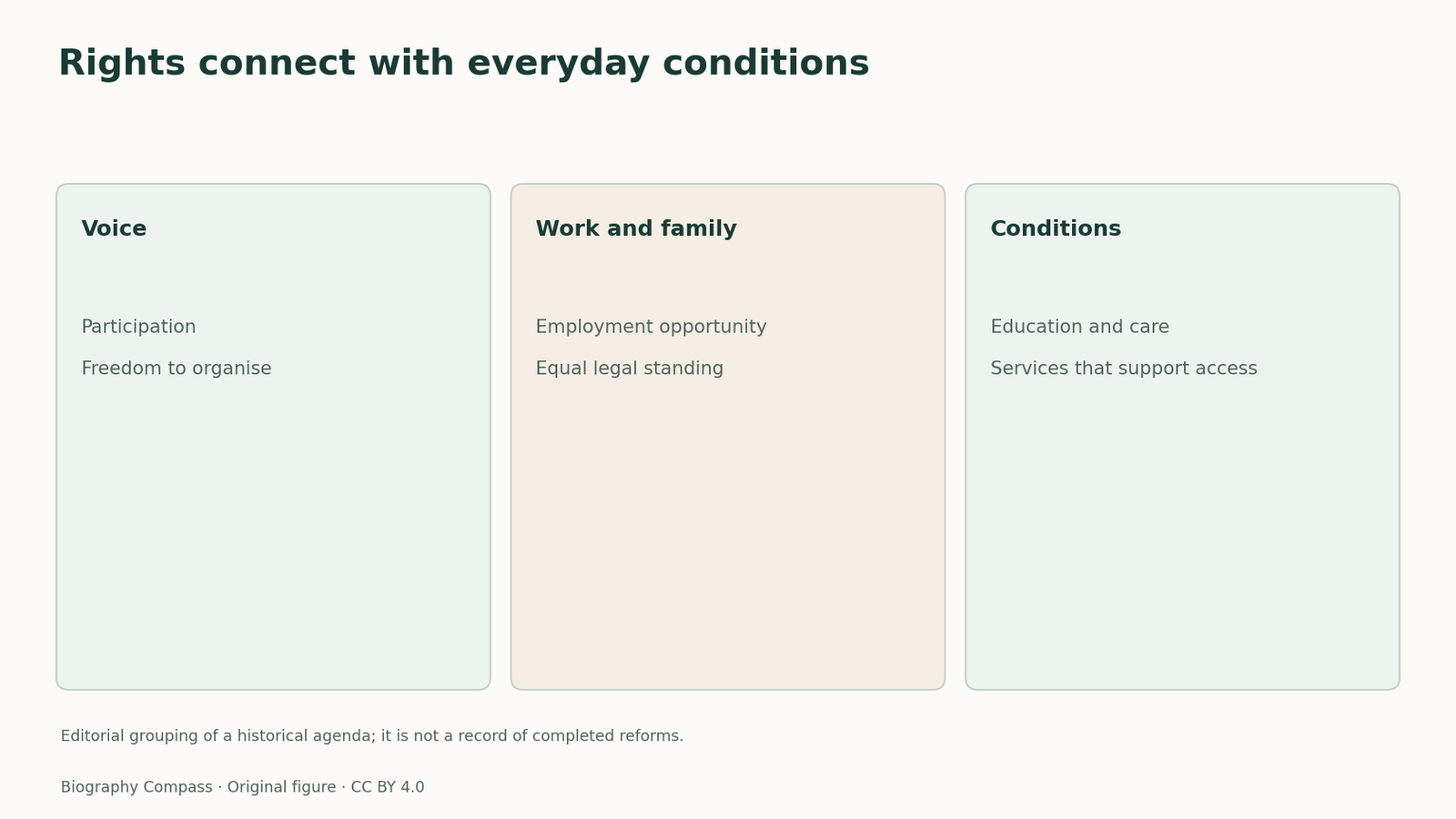
The charter did not ask readers to choose between national liberation and women’s equality. It connected the two, while naming the work, family responsibilities and legal restrictions that shaped women’s lives.
Evidence and interpretation
Four connected areas of the programme
Read these as a connected agenda, not an outcome table.
| Record | Demand area | Further question |
|---|---|---|
| Political voice | Voting, election and organisation | Who could participate in practice? |
| Employment | Opportunity and pay | How did a workplace apply its rules? |
| Family and property | Equal legal standing | What rules and practices needed change? |
| Public provision | Education, care and household services | Which institution could deliver the provision? |
Chronology
A timeline of the turning points
Founding conference
The Federation of South African Women adopted its charter in Johannesburg.
Public mobilisation
Women’s organising continued into the anti-pass march.
An organisational document
FEDSAW was launched in Johannesburg on 17 April 1954. SAHO’s organisational history identifies a steering group including Ray Simons, Helen Joseph, Lilian Ngoyi and Amina Cachalia, and a federation bringing different women’s organisations together.
That context matters: the charter was adopted by an organisation, not issued as a state law or written as the manifesto of one heroic individual.
Sources for this section: [2]
Read the demands together
The charter sought voting and electoral rights, equal opportunities and pay, equality in property and family relations, and education and services supporting children and households. It also called for freedom of movement and participation in organisations.
Its argument linked political, racial and economic exclusion with women’s subordinate status. The text also challenged men who demanded freedom while withholding equality from women. That tension should remain visible in a summary of the liberation struggle.
Sources for this section: [1]
An agenda is not an implementation report
The document is strong evidence of what its adopters resolved to pursue. It does not show how fully every demand was shared, what happened in every household or when a particular reform took effect.
A later history of the 1956 march can show continuing mobilisation. It cannot make the 1954 charter and the later demonstration the same event. Ngoyi’s leadership career connects them, but dates and document types still matter.
Sources for this section: [3]
Make a connection map
Choose one invented organising problem: a parent cannot attend an evening meeting because affordable childcare is unavailable. Put “political participation” and “care provision” on the same map. Explain the connection without claiming that this particular incident appears in the charter.
Reference answer: access to a formal right can depend on practical conditions. The exercise illustrates how to read linked demands, not a newly discovered historical case. To research an actual example, add local records rather than treating the charter as a record of every individual experience.
Continue the chronology
Related history guides
Biography context
Explore South Africa through connected lives
Connected biographies
People behind the records
Quick answers
Common questions
- Was the charter adopted in 1956?
- No. It was adopted in 1954; the major anti-pass march followed in 1956.
Primary and institutional sources
How this history was checked
Read the selected records below alongside this explanation. A later recollection, an advocacy text and a court ruling answer different questions; cited excerpts do not stand for a complete archival survey. This article was reviewed on 4 November 2026.