
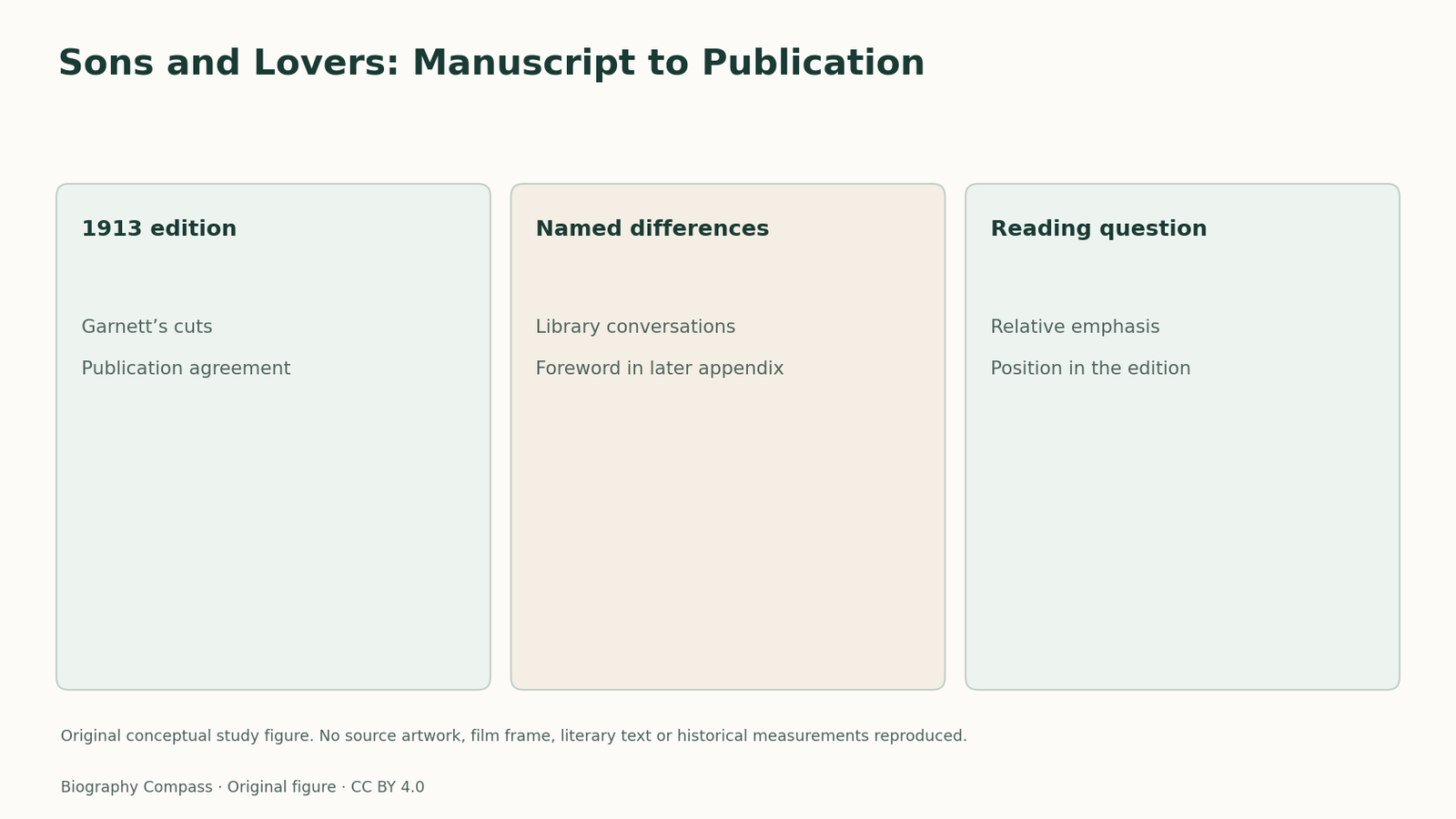
The short answer
What can editorial and manuscript records explain about the novel’s published form?
Read the evidence
Sources, interpretation and production roles
The records answer different questions about this work. The final exercise is an original teaching model.
| Record or question | Supported reading | Boundary or contrast |
|---|---|---|
| 1913 publication | Garnett edited for length and particular wording within a negotiated publication. | The process cannot be reduced to one motive for every cut. |
| Library scenes and foreword | Independent scholarship identifies missing reading material and a later appendix. | Relative emphasis and textual position are different effects. |
| Original exercise | Compare a relationship outline with and without shared-reading scenes. | The model does not reconstruct missing fictional dialogue. |
Two different reasons to cut
Sons and Lovers appeared in 1913 after Edward Garnett edited Lawrence’s manuscript for Duckworth. Nottingham’s exhibition identifies reductions in length and particular erotic wording. Neil Roberts’s accessible chapter summary adds a practical context: Lawrence gave permission for cuts while valuing an agreement that offered income. These records resist a simple picture in which an editor only removed sexual material against an author’s unwavering refusal. They show a professional negotiation whose individual changes still need to be examined separately.
A concrete loss of intellectual companionship
The University of London Press chapter gives an example with interpretive consequences. It notes the excision of Paul and Miriam choosing books in Bestwood Library and the abridgement of some conversations about books and ideas. Its account argues that these changes gave greater relative weight to the love affair than to intellectual companionship. That is a specific scholarly reading of named alterations, rather than a universal rule that every cut damages a novel in the same way. The example makes editorial history relevant to how a relationship is understood.
Sources for this section: [8]
A foreword in a different position
The same chapter notes that a foreword absent from the original 1913 edition appears as Appendix I in the 1992 Cambridge edition. Helen and Carl Baron’s edition therefore makes another piece of writing available while identifying its place outside the main narrative. Location matters: an appendix is not the same reading experience as a foreword encountered before chapter one. The point is not to reconstruct an unread complete manuscript, but to identify a documented difference between kinds of access to a work.
An original edition-comparison task
Make two hypothetical outlines of a relationship. One contains meetings, disagreements and shared reading; the other retains meetings and disagreements but shortens the reading scenes. What becomes more prominent even if no retained sentence changes? A supported answer identifies the relative emphasis created by selection. The omitted dimension has less space to develop. This original exercise models the interpretive question raised by the documented library material; it does not invent missing dialogue or present a new collation of the novel.
Sources for this section: [8]
What to record before comparing passages
For a reading group, note publisher, date, editor and whether a passage appears in the narrative or an appendix. Then distinguish a change in wording from a change in position or relative emphasis. The 1913 edition establishes what that publication made available, while the 1992 edition offers a later scholarly arrangement. Neither label alone explains every difference. The useful result is a concrete reading practice: identify the edition, locate the alteration and ask which relationship or argument becomes easier to see.
Continue the chronology
Related history guides
Biography context
Explore United Kingdom through connected lives
Connected biographies
People and related creative practices
1885–1930
D. H. Lawrence
Novelist, poet and essayistD. H. Lawrence wrote fiction and poetry about family, work and intimacy while negotiating publishers, censorship and different editions.Read biography
1882–1941
Virginia Woolf
Novelist, essayist, critic and publisherVirginia Woolf was an English novelist, critic and publisher whose experiments with consciousness and time changed modern fiction and feminist literary argument.Read biography1879–1970
E. M. Forster
Novelist, critic and essayistE. M. Forster explored class, intimacy and imperial power in novels whose personal connections meet material and institutional limits.Read biographyQuick answers
Common questions
- Does restored mean untouched?
- No. An editor still explains which witnesses and decisions establish the later text.
- What does the 1913 edition show?
- It shows the text available to readers in that edition, rather than the full contents of every surviving draft.
Primary and institutional sources
How this history was checked
Sources include production records, institutional collections and the specifically identified passages discussed here. Interpretations and teaching models are distinguished from credits and publication facts. This article was reviewed on 7 November 2026.
- Nottinghamshire Heritage GatewayD. H. Lawrence
- Eastwood Town CouncilD. H. Lawrence
- University of NottinghamConflict with publishers
- University of NottinghamThe Cambridge Edition
- University of NottinghamEditing DH Lawrence: Introduction
- University of NottinghamThe Heinemann Edition
- Neil Roberts / Liverpool University Press, Cambridge CoreEpilogue, 1912–1913
- University of London PressA fire fed on books: books and reading in Sons and Lovers