
The short answer
How does a domestic wartime task become the organising subject of a modern painting?
Read the evidence
Sources, interpretation and production roles
The records answer different questions about this work. The final exercise is an original teaching model.
| Record or question | Supported reading | Boundary or contrast |
|---|---|---|
| Catalogue record | Dates the painting 1915 and specifies oil on canvas. | Material and date do not supply every possible interpretation. |
| Family/sketchbook evidence | Identifies Madge and a sustained practice of using family models. | Familiarity does not mean the composition was unstaged. |
| Original reading plan | Connects wartime activity with the arrangement of a seated figure. | It does not assign an invented symbolic meaning to every shape. |
A wartime activity inside a room
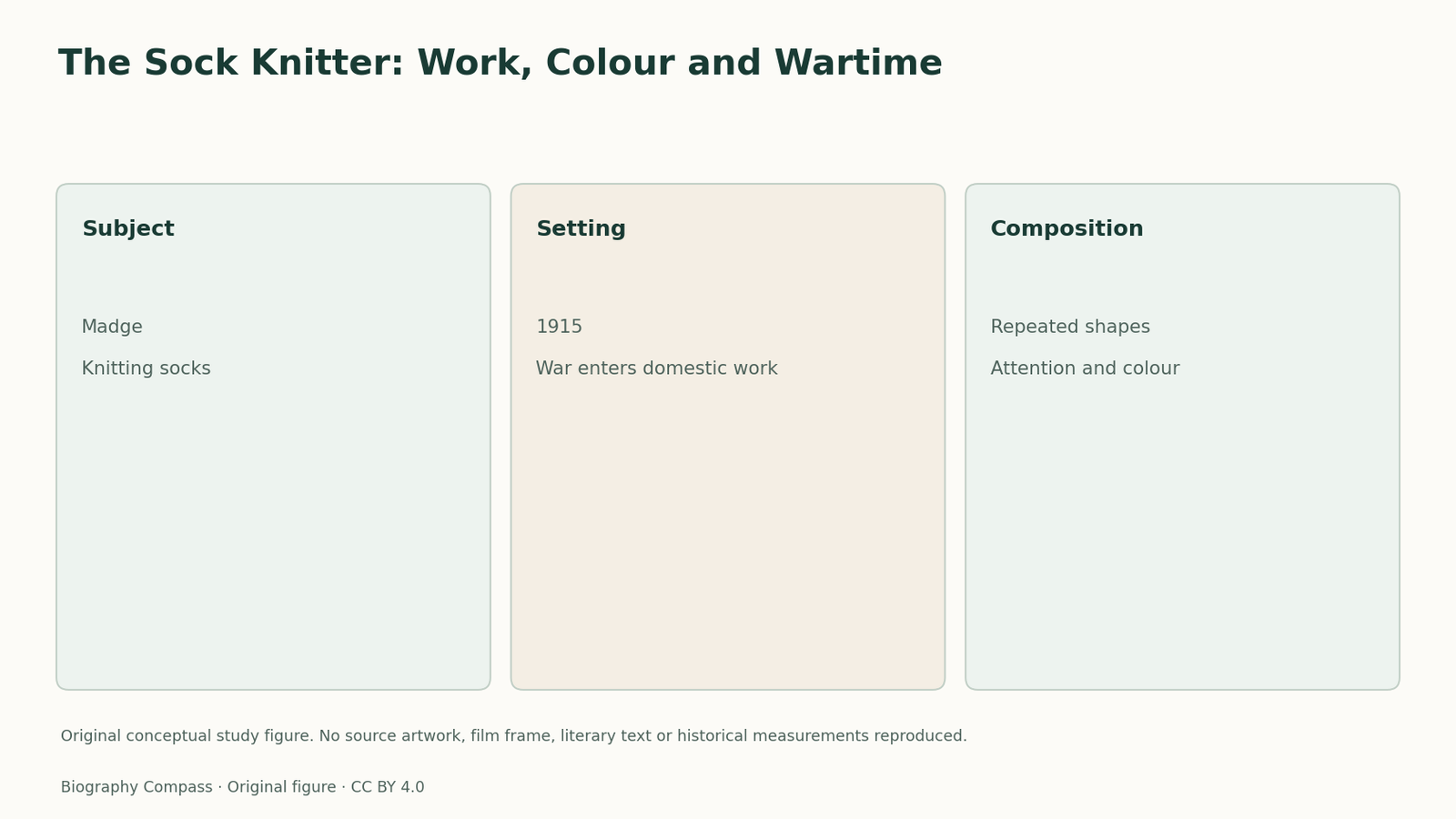
The Sock Knitter is a 1915 oil painting of Grace Cossington Smith’s sister Madge. The activity has a specific wartime setting: she was knitting socks during the First World War. That connection gives a quiet domestic subject a public dimension. The painting need not show a battlefield to belong to the visual culture of war. Equally, its significance is not exhausted by identifying what was being made.
From a sitter to a structure
The NGA exhibition discussion emphasises the composition’s taut organisation and repeated pyramidal patterns. These descriptions suggest a useful way of approaching the painting: first identify the seated figure and the task, then consider how bodily position, clothing and surrounding forms organise attention. The catalogue identifies a canvas approximately 62 centimetres high. This is an intimate encounter with a figure, not a monumental public scene, even though the activity points beyond the room.
A family model is not an unstaged instant
Smith’s sketchbooks and related early works place Madge within a wider practice of drawing family members. The exhibition also describes posed and costumed family compositions. Knowing a sitter therefore changes the questions we ask, but does not turn a painting into an unmediated record of everyday behaviour. A family relationship can offer repeated access and close observation while the painter remains responsible for arranging colour, position and emphasis. In this case, the physical task also involves repetition over time. That makes the comparison with repeated painted forms productive, while stopping short of claiming that every angular pattern literally imitates a particular stitch. The seated pose also gives the task a visible duration. The painting brings attention to ongoing work while using a fixed arrangement, joining the historical activity with the conditions of a still image.
Original exercise: connect action and form
Make a two-column plan for a short interpretation. In the first column write three kinds of information: person, activity and historical setting. In the second write three compositional questions: where attention gathers, which shapes recur and how the surrounding space supports the figure. A possible answer links Madge’s knitting to wartime work in the first column, then uses the museum’s account of repeated angular forms to explain visual organisation in the second. Combine them in two sentences without claiming that each painted shape is a coded military symbol. This model distinguishes a supported historical association from an invented symbolic dictionary. It also produces a richer account than either “a woman knitting” or “a war painting” alone. Readers can use the same structure when comparing the work with another seated portrait, while preserving the different histories of the two images.
Continue the chronology
Related history guides
Biography context
Explore Australia through connected lives
Connected biographies
People and related creative practices
1892–1984
Grace Cossington Smith
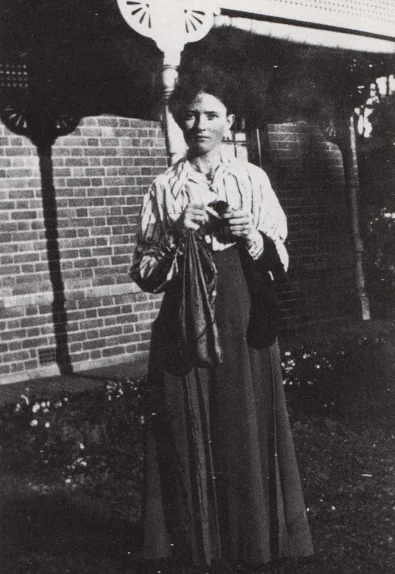
Australian modernist painterGrace Cossington Smith developed a sustained modernist practice from family subjects and public events to large paintings of colour-filled interiors.Read biography1908–1970
Rita Angus
PainterA New Zealand painter whose precise compositions make ordinary signs of human presence unusually visible.Read biography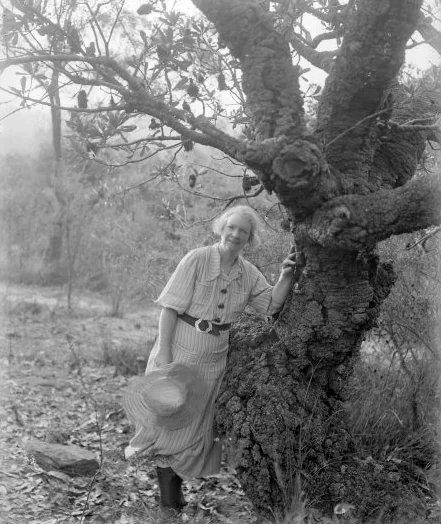
1875–1963
Margaret Preston
Australian painter and printmakerMargaret Preston combined European training, Japanese print interests and Australian plant subjects while pursuing a contested vision of national art.Read biographyQuick answers
Common questions
- Why is The Sock Knitter connected with the First World War?
- The model’s sock knitting is identified as a wartime activity in the NGA’s account.
Primary and institutional sources
How this history was checked
Sources include production records, institutional collections and the specifically identified passages discussed here. Interpretations and teaching models are distinguished from credits and publication facts. This article was reviewed on 8 November 2026.