
The short answer
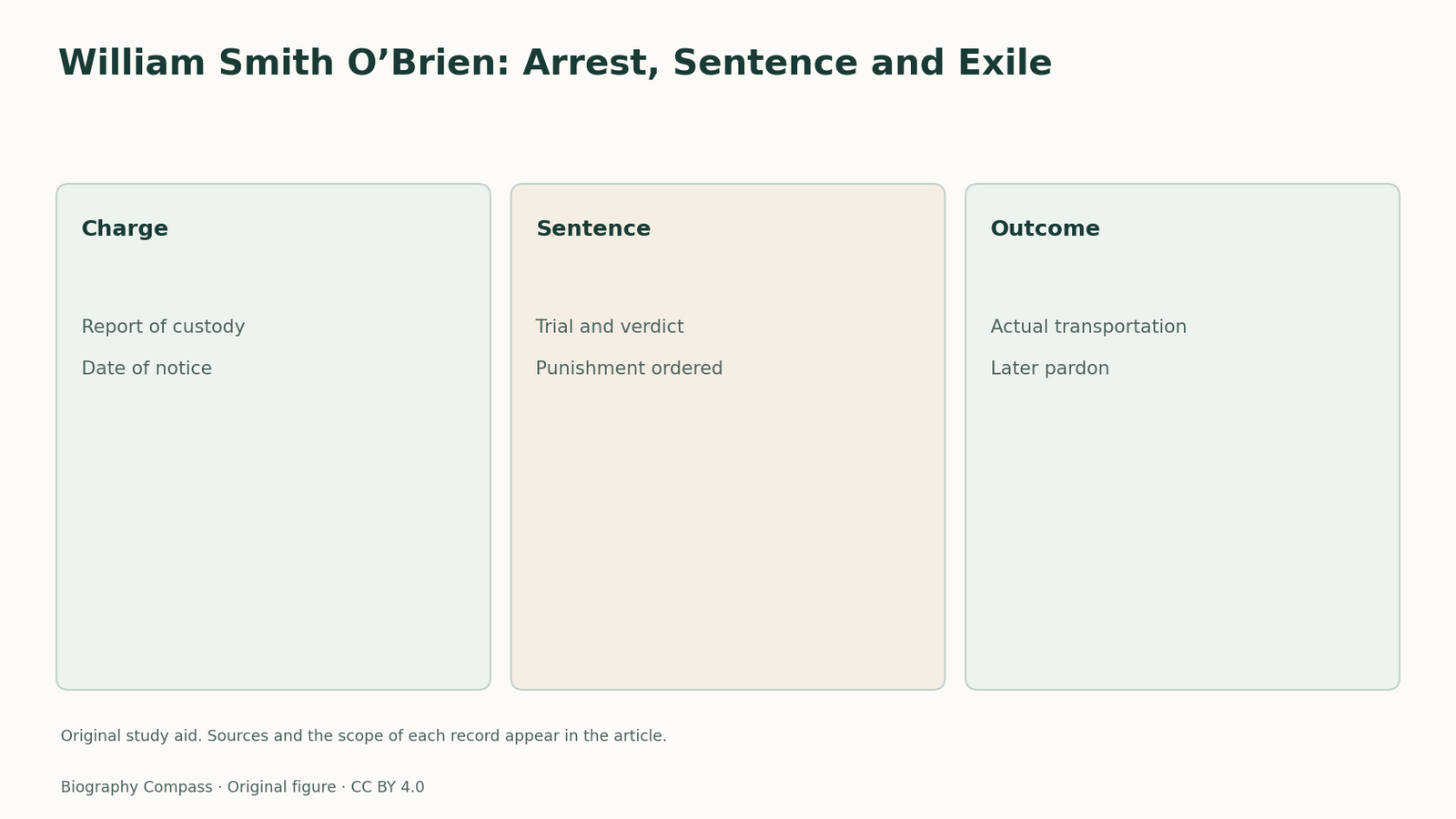
A contemporary announcement of arrest can sound final when read by itself. The O’Brien record requires four separate dates and a distinction between sentence and outcome.
Evidence and interpretation
What each record can establish
Read each record in the context in which it was produced.
| Record | Evidence it supplies | Limit of inference |
|---|---|---|
| Commons notice | Arrest and a stated charge | The court’s eventual decision |
| Trial chronology | Conviction and death sentence | The sentence as carried out |
| Exile archive | Material for tracing transportation and later travel | A prisoner’s views without the relevant passage |
Chronology
A timeline of the turning points
Commons announcement
The Speaker reports that O’Brien is held on a treason charge.
Conviction
A court at Clonmel convicts O’Brien and his colleagues.
Pardon
An unconditional pardon permits return to Ireland.
Read the notice for its immediate purpose
The Commons record reports a letter to the Speaker from the lord lieutenant. It announces a member’s arrest and detention in Kilmainham. The parliamentary clerk is recording what the House was told about custody. Note the date of the sitting separately from the date assigned to the arrest. A statement that a person faces a charge supplies no verdict.
The letter reproduced in Hansard dates from 6 August and refers to an arrest on the previous day. The Dictionary of Irish Biography dates the arrest at Thurles to 7 August. This study records the Commons sitting as 8 August and attributes the arrest dates to their respective accounts.
Record the sentence and what followed
The October trial led to convictions and death sentences. The authorities then arranged transportation, and O’Brien went to Van Diemen’s Land. Mark these as separate entries. If a timeline lists only the sentence, a reader could assume that it was carried out. If the timeline lists only transportation, it omits the earlier decision and the change in punishment.
Sources for this section: [2]
Use the finding aid as a map
The National Library finding aid connects trial papers, journals and travel records. A farewell address is also catalogued under the names of four men. Catalogue records let you locate items and distinguish creators. To argue that O’Brien regarded one condition of exile in a particular way, request the relevant journal passage or letter. The finding aid is an entry point to the evidence, not his testimony.
Build a status ledger
Give each row a date, institution and status: arrested, convicted, sentenced, transported or pardoned. Add a column for the source of each entry. When a source offers only a charge or a proposed punishment, leave the next field blank until another record supplies the outcome. This reading exercise also works for an archive in which the execution of an order is documented far from the issuing court.
Continue the chronology
Related history guides
Biography context
Explore Ireland through connected lives
Connected biographies
People behind the records
1803–1864
William Smith O’Brien
Parliamentarian and Young Ireland leaderO’Brien moved from parliamentary advocacy into Young Ireland and was transported after the failed 1848 rising.Read biographyQuick answers
Common questions
- Why distinguish a death sentence from its execution?
- A sentence states what a court ordered. Commutation and transportation changed what occurred in this case.
Primary and institutional sources
How this history was checked
The records below support the chronology and the evidence comparison. The reading exercise is original. This article was reviewed on 5 November 2026.