
The short answer
A ten-year vision, an implementation programme and a funded project are different objects. Reading them together helps explain what was proposed, who was assigned to organise delivery, and which later evidence would be needed to demonstrate results.
Record comparison
Compare the evidence
Keep the record, its authority and the claim being tested together.
| Record | What it establishes | What remains separate |
|---|---|---|
| Recommendations | A proposed design and resource categories | Not an expenditure outturn |
| Implementation announcement | A framework and assigned next steps | Not proof of service outcomes |
Chronology
A timeline of the turning points
Committee design
Recommendations and cost categories.
Publication
Implementation framework announced.
A committee design with several contributors
The 2017 Sláintecare report emerged from the all-party Committee on the Future of Healthcare, chaired by Róisín Shortall. It acknowledged the Trinity health-policy team led by Steve Thomas. Its vision was a universal, single-tier service organised around need. The recommendations distinguished expansion of ongoing services from a €3 billion transitional and legacy programme over six years.
That distinction is useful before comparing money. A recurring service obligation is not interchangeable with one-off infrastructure, training or system change, even if both are expressed in euros.
Sources for this section: [1]
An implementation framework is another stage
The government approved the Implementation Strategy on 17 July 2018; Harris published it on 8 August. It set four goals and ten strategic actions for the first three years. A programme office and advisory council were part of its governance, and a more detailed action plan was still to follow.
The release records a step toward implementation. It cannot by itself demonstrate that waiting times, access or clinical outcomes had improved. A subsequent action plan, expenditure account and evaluation would answer progressively different questions.
Sources for this section: [2]
A project fund is not the entire reform budget
The 2019 Integration Fund announcement earmarked €20 million for that year, described as the first full year of implementation. It placed the fund alongside a wider action-plan and governance process.
Compare the stated object and period before calculating a share. The project fund is not automatically the whole transition programme, nor does “earmarked” mean every euro had already been spent. The two announcements support different claims, so a ratio without matching boundaries could mislead.
Sources for this section: [3]
Worked task: separate annual cost from a one-off fund
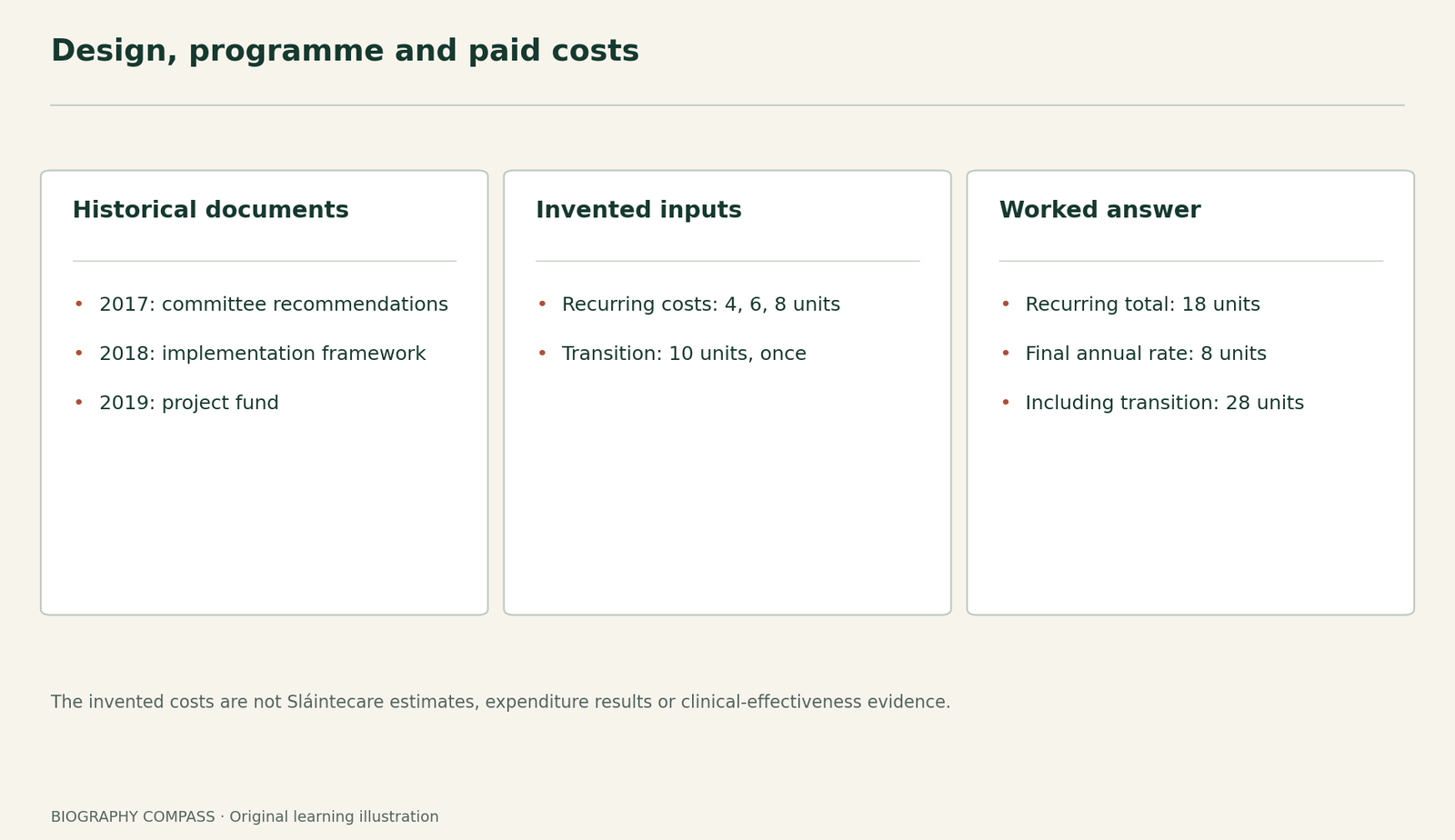
Use a wholly invented programme. Its recurring service costs are 4 units in year one and increase by 2 units in each of the next two years. A separate transition fund pays 10 units once, in year one. Assume these are the only costs and every planned payment occurs. Find the three-year recurring total, the final annual run rate and the total including transition.
Reference answer: annual recurring costs are 4, 6 and 8 units; their sum is 18. The final annual run rate is 8, not 18. Including the one-off payment gives 28 units. Do not add the transition fund again in years two and three. These supplied values explain a comparison problem; they are not estimates of Sláintecare’s cost, actual expenditure or clinical effectiveness.
Continue the chronology
Related history guides
Biography context
Explore Ireland through connected lives
Connected biographies
People connected with these records
born 1986
Simon Harris
Tánaiste and finance ministerHarris moved from disability advocacy into government. He became Fine Gael leader and Taoiseach.Read biographyQuick answers
Common questions
- Can one add a final annual run rate to a multi-year total?
- Only after checking whether that annual cost is already included; otherwise the same payment may be counted twice.
Primary and institutional sources
How this history was checked
Compare each record’s date, author and stated purpose. The supplied tasks and reference answers are original learning material. This article was reviewed on 30 October 2026.
- Oireachtas Committee on the Future of HealthcareSláintecare Report, May 2017: selected recommendations
- Department of HealthHarris publishes Implementation Strategy, 8 August 2018
- Department of HealthSláintecare Integration Fund launch, 2019
- Department of the TaoiseachTwenty-Seventh Dáil: government tables