
The short answer
The title of a series and the title of a single drawing work at different scales. Sitting Allowance is a useful case for practicing how to read both.
Reading the evidence
What each record establishes
Keep the subject of each record and the conclusion it can support in separate columns.
| Record | What can be read | What remains separate |
|---|---|---|
| 2007 event | The historical prompt for the series. | The dates of making and showing. |
| 2009 notice | Venue, exhibition and group of works. | An individual sheet’s precise media. |
| Object record | A named institutional subject and mixed materials. | The names or actions of depicted people. |
Separate the event from the response
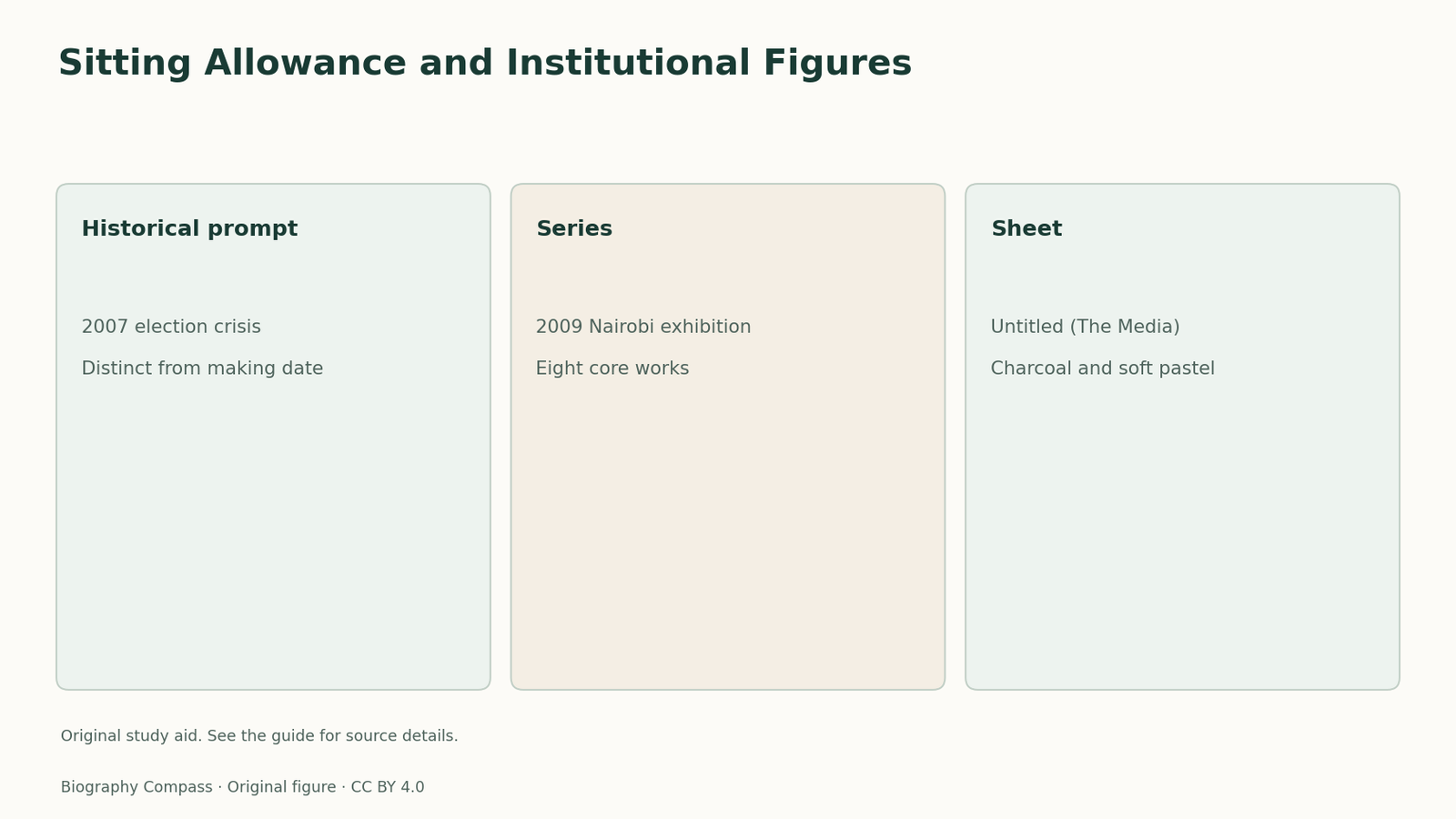
The 2009 notice announces a solo show at the Goethe-Institut in Nairobi and describes eight core drawings. It links them to the crisis after the 2007 election. That separation of years is consequential. The artworks look back at the event; their exhibition is an occasion for viewing the response.
Use the notice to establish the setting and scope of the show. It supplies neither a complete account of the crisis nor a roster of individual people in the drawings. The artist’s arrangement of figures gives readers a different kind of access to the subject than an election report would provide.
Move down to an individual sheet
The gallery record calls one 2009 drawing Untitled (The Media) and describes charcoal and soft pastel on paper. The bracketed subject gives a reader an institution to consider. It does not give each depicted person a name. The record also shows why a broad description of the exhibition as a charcoal series can coexist with a more specific material entry for one sheet.
Write the series and object titles on separate lines. Beside each, record the question it helps answer. The series tells you where the drawing belongs; the individual record narrows what can be said about its title and material.
Read repeated forms
Try observing only how bodies are grouped before interpreting the label. Would a change in spacing alter your sense of hierarchy or routine? Write one observation about the arrangement and one question about the institution named in the title. This method leaves space for interpretation without turning the drawing into literal documentation of an event.
Continue the chronology
Related history guides
Biography context
Explore Kenya through connected lives
Connected biographies
Explore the people behind the records
b. 1980
Peterson Kamwathi
Visual artist and printmakerA Kenyan artist who uses drawing and printmaking to explore how groups occupy public space.Read biographyQuick answers
Common questions
- Do the drawings provide named portraits of officials?
- The cited sheet’s record names an institutional subject. It does not identify the individuals depicted.
Primary and institutional sources
How this history was checked
Selected first-person, exhibition and collection records support the factual claims. The reading exercise and comparison are editorial interpretations. This article was reviewed on 5 November 2026.