
The short answer
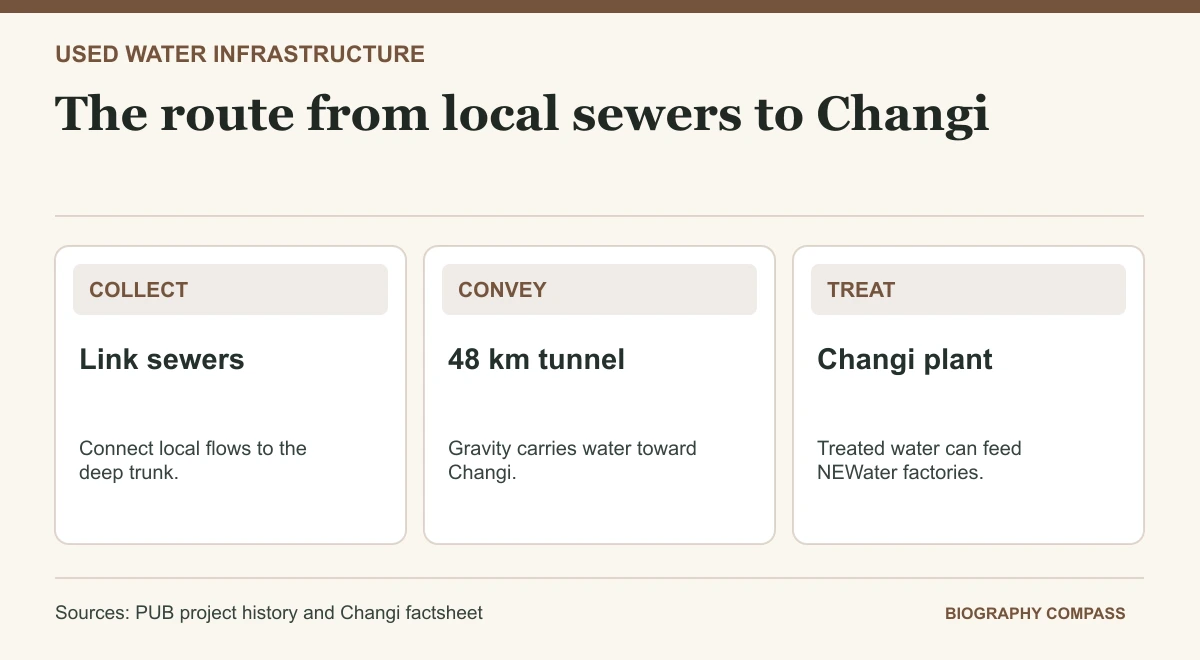
A household sewer and a NEWater tap belong to different ends of Singapore’s water system. Phase 1 of the Deep Tunnel Sewerage System joined local sewers to a gravity tunnel and a central treatment plant at Changi. Part of the treated water could go on to a separate purification step.
Reading the records
The route from local sewers to reclaimed water
The names in the records refer to different stages of a single journey.
| Stage | Facility | Function |
|---|---|---|
| Collect | Link sewer | Feeds the deep tunnel. |
| Convey | Deep tunnel | Moves used water by gravity. |
| Treat | Changi Water Reclamation Plant | Treats the incoming used water. |
| Purify further | NEWater factories | Use treated effluent as feedstock. |
Chronology
A timeline of the turning points
Phase 1 complete
PUB dates completion of the first phase to 2008.
Plant commissioning
The Changi factsheet dates commissioning to the same year.
Official opening
PUB’s annual report records the opening milestone.
What comes before the deep tunnel
Local flows enter link sewers, which connect to the deep trunk. PUB’s Changi factsheet identifies 48 kilometres of main tunnel and 60 kilometres of link sewers for Phase 1. Adding the two lengths can help describe the network covered by that account. It would give a misleading answer to the narrower question of how long the main tunnel itself was.
Why gravity leads to a central plant
The deep tunnel conveys used water from the eastern half of Singapore for treatment at Changi. The reclamation plant uses a compact site with stacked treatment facilities and parts of the plant underground. Concentrating treatment in one place gives the design of the collection tunnel and the design of the downstream plant a direct relationship. Both had to handle the water arriving through the same route.
Commissioning and opening mark different events
PUB dates the plant’s commissioning to 2008 and its official opening to 2009. The factsheet also describes two co-located NEWater factories that use treated effluent from the reclamation plant. The year of the Changi plant opening belongs to the history of regional sewerage. Singapore’s earlier public launch of NEWater at Bedok and Kranji belongs to the history of purification and supply.
Continue the chronology
Related history guides
Connected biographies
People in this history
Quick answers
Common questions
- When did Phase 1 finish?
- PUB gives 2008 for Phase 1 completion and 2009 for the Changi plant’s official opening.
- Does the tunnel make NEWater?
- It carries used water. Treatment and further purification happen downstream in distinct facilities.
Primary and institutional sources
How this history was checked
Dates, legal milestones and historical claims are checked against the official and institutional records below. This article was reviewed on 19 November 2026.