
The short answer
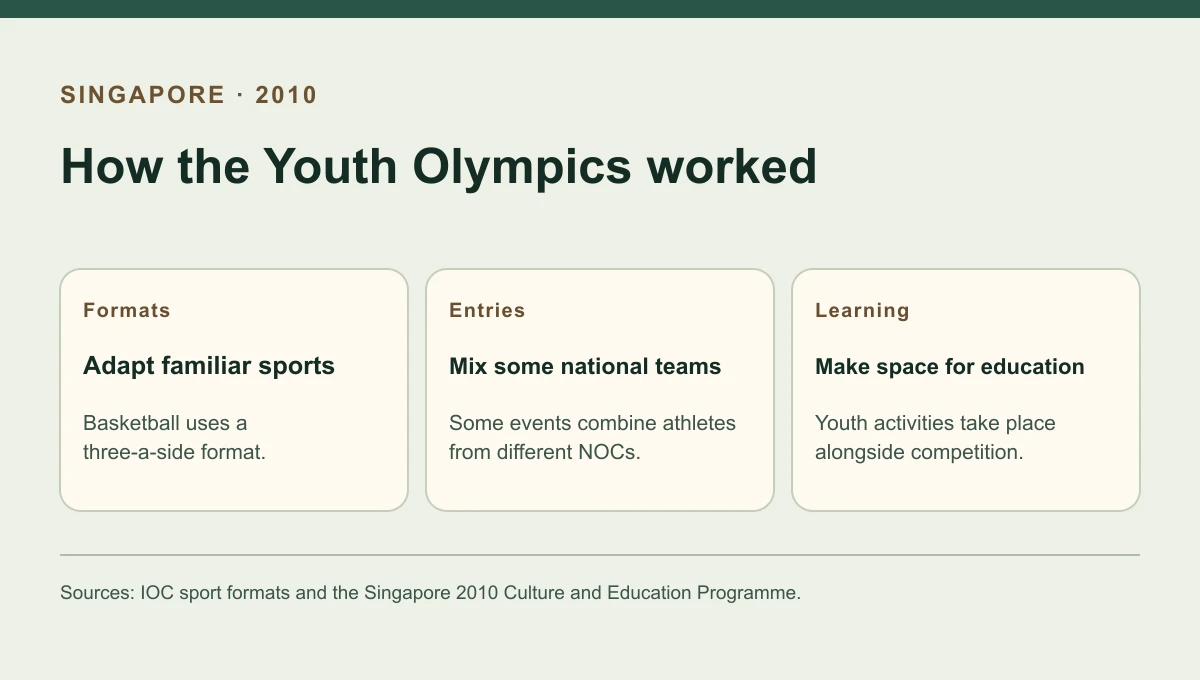
At the inaugural Youth Olympic Games in Singapore, athletes competed and took part in an education programme within the same event. Some competitions used formats unfamiliar from the senior Olympics. A single team could also include athletes from different National Olympic Committees in selected events, giving international encounters a place inside competition as well as outside it.
Compare programme choices
How Singapore designed a youth event
The Games varied competition rules, team composition and educational activities.
| Choice | Example | Effect |
|---|---|---|
| Adapt the event | Three-on-three basketball | An Olympic sport is played in a different format. |
| Mix selected entries | Some teams include athletes from different NOCs | A result can belong to a mixed team rather than one delegation. |
| Run a learning programme | Workshops and a session with Olympic champions | Athletes also meet and learn outside their contests. |
Chronology
A timeline of the turning points
The IOC and organisers select formats
Some familiar sports receive a modified event or team arrangement.
The first Youth Olympics open
Competition and the education programme share the same event period.
The IOC documents what actually took place
The closing account records participation and examples of the innovations used.
A familiar sport with a different format
The IOC announced 26 sports, matching the sports on the planned London 2012 programme while changing how some were contested. The basketball example makes that distinction clear. Three players per side competed in a half-court game, so the name of the sport did not specify its event format. Looking at the announced rules shows how organisers could vary an event without having to add a wholly separate sport.
Why the composition of a team matters
The IOC closing record lists examples of mixed National Olympic Committee and mixed-gender events at Singapore. Those are different design choices. One can bring athletes representing different delegations together, while the other changes which athletes compete together by gender. A team result may therefore require a closer look at the event record than a national medal table provides.
What happened away from competition
The Culture and Education Programme organised activities alongside the event schedule. The IOC describes workshops and direct conversations with experienced Olympians, including pole vaulters Sergey Bubka and Yelena Isinbaeva. The education programme gave athletes another way to use the days they spent together. Singapore’s format survives in the record as a combination of sport design and a programme for participants between contests.
Continue the chronology
Related history guides
How Singapore Opened the 2015 SEA Games at Its New Stadium
Compare the demands of a subsequent multi-sport event hosted in Singapore.
Read the timeline2023How Cambodia Hosted Its First SEA Games in 2023
See how a later Southeast Asian host organised its own athlete facilities.
Read the timelineConnected biographies
People connected to this history
Quick answers
Common questions
- Was Singapore 2010 the first Youth Olympic Games?
- Yes. It was the first Summer Youth Olympic Games and the inaugural Youth Olympic edition.
- What were two features of the event?
- Some sports used altered formats or combined athletes from different delegations, and the Games included a Culture and Education Programme.
Primary and institutional sources
How this history was checked
Dates, legal milestones and historical claims are checked against the official and institutional records below. This article was reviewed on 19 November 2026.
- International Olympic CommitteeFirst Youth Olympic Games officially under way in Singapore
- International Olympic CommitteeSingapore 2010 adopts new sport formats
- International Olympic CommitteeSuccessful Singapore Youth Olympic Games come to a close
- Singapore Youth Olympic Games Organising CommitteeCulture and Education Programme