
The short answer
A shorter overlap can change one geometrical contribution without answering every electrical question. Read the historical process and patent as different kinds of evidence.
One contribution and the total
Contribution and total
Invented capacitances, all in fF.
| Quantity | Before | After |
|---|---|---|
| Overlap term | 32 | 8 |
| Other term | 24 | 24 |
| Total | 56 | 32 |
Chronology
A timeline of the turning points
Process development
Museum chronology.
Joint patent
Klein and Faggin.
Two technical questions
The museum history places Faggin and Klein's silicon-gate work among earlier self-alignment contributions. Their later joint patent describes controlling turn-on voltage through a doped semiconductor gate, and explains how alignment reduces edge capacitance. Those are connected mechanisms, not identical quantities.
The patent summary varies the gate impurity concentration to alter turn-on behaviour. Its process description separately centres the gate between source and drain edges. A record can therefore support both an electrostatic argument and a geometric one without making them interchangeable.
An original geometry exercise
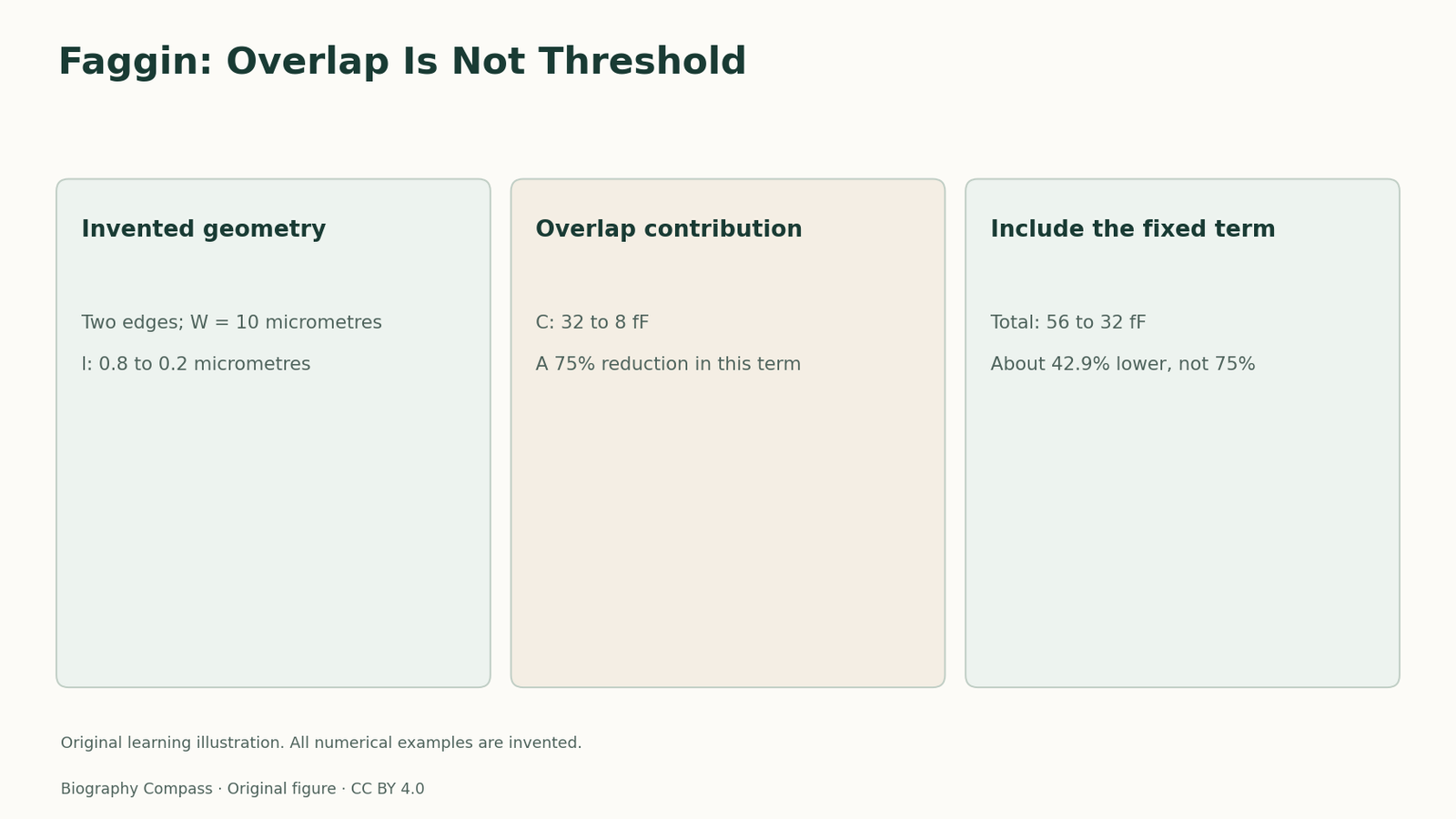
Assume a fictional device has two equal rectangular overlaps. Define C = 2 c W l, with areal coefficient c = 2 fF per square micrometre, width W = 10 micrometres and overlap length l = 0.8 micrometres. Change only l to 0.2 micrometres. Compute the overlap contribution before and after.
Sources for this section: [1]
Reference answer
Initially C = 2 times 2 times 10 times 0.8 = 32 fF. Afterwards C = 8 fF, a 75% reduction in this contribution. If an unchanged additional capacitance is 24 fF, the totals are 56 and 32 fF: the total falls by 24/56, about 42.9%, rather than 75%.
Sources for this section: [1]
The limit of the inference
This calculation stipulates geometry and an areal coefficient; it does not calculate doping, threshold, resistance, load or frequency response. A capacitance reduction cannot be promoted into an equally large speed increase without a circuit model. No historical dimensions or production yields are reconstructed.
Even in a simplified resistance-capacitance timing model, the relevant time scale would involve a resistance multiplied by the total capacitance. A percentage change in only one capacitance term does not supply that total, and a threshold voltage is not a capacitance at all.
Sources for this section: [1]
Continue the chronology
Related history guides
Biography context
Explore United States through connected lives
Connected biographies
A career behind the record
Quick answers
Common questions
- Is a smaller overlap a threshold-voltage measurement?
- No. A gate material and its doping also affect turn-on behaviour.
Primary and institutional sources
How this history was checked
Original records and selected institutional histories support the historical discussion. Invented examples are labelled and are not reconstructed experiments. This article was reviewed on 31 October 2026.
- Computer History Museum, The Silicon Engine1968: Silicon Gate Technology Developed for ICs
- Thomas Klein and Federico Faggin / United States patent recordUS 3673471 A: Doped semiconductor electrodes for MOS type devices
- National Inventors Hall of FameFederico Faggin: Microprocessor
- Computer History MuseumFederico Faggin: 2009 Fellow
- Erik Franco / Politecnico di Milano,19 December 2024Federico Faggin: interview at the 2024 Colloquia Doctoralia