
The short answer
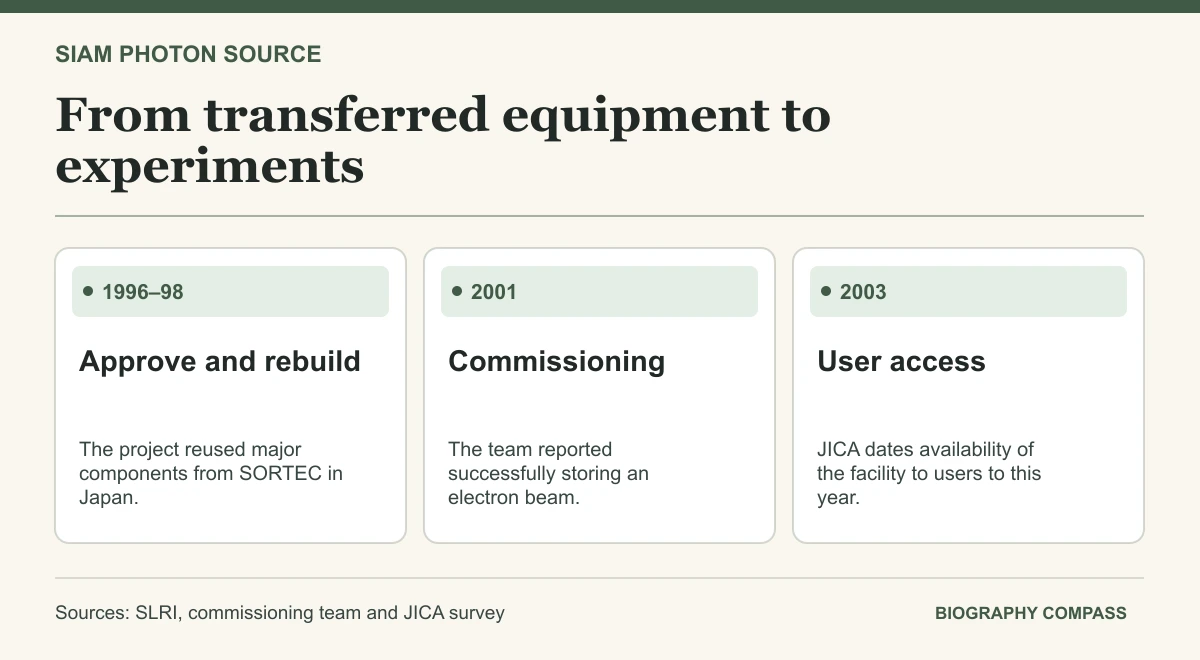
Thailand’s Siam Photon Source used components transferred from Japan’s SORTEC laboratory. The team rebuilt the system in Nakhon Ratchasima before making the resulting light source available for experiments. The dates of approval, commissioning and user access show how equipment became a national research facility.
Compare the records
From components to a user facility
Inherited equipment, commissioning results and open experimental access are different things to document.
| Stage | What the record shows | Question it answers |
|---|---|---|
| Transfer and rebuilding | Components came from Japan and were redesigned for the Thai facility. | Where did the initial equipment come from? |
| Commissioning | The team reported storing an electron beam. | When had the reconstructed system first shown this capability? |
| User access | Experiments could be submitted and scheduled. | When could a wider research community use the facility? |
Chronology
A timeline of the turning points
Cabinet approves the research centre project
The planned centre would develop the Siam Photon Source.
Japanese equipment transfer milestone
JICA’s survey traces major components to the former SORTEC facility.
A beam is stored
The project team reported filling the storage ring on this date.
User access milestone
JICA’s survey dates availability to users to 2003.
SLRI established under new legal arrangements
The successor public organisation took responsibility for the facility.
Why the SORTEC equipment mattered
The cabinet approved the Siam Photon Project in 1996 and established a centre to develop it. Major parts came from the former SORTEC laboratory in Japan. The Thai project redesigned components for the new research facility at the Technopolis of Suranaree University of Technology. That history explains why national research infrastructure can have a foreign equipment lineage as well as a domestic design and operating history.
Which date marks a working machine
The project team reported successfully filling the storage ring with an electron beam on 17 December 2001. JICA’s account places first light in 2001 and records availability to users in 2003. Commissioning and experimental access measure different outcomes. The first establishes what the machine could do under test. The latter concerns a facility that could support researchers’ experiments.
Continue the chronology
Related history guides
How Thailand’s 40-Metre Radio Telescope Observed a Comet
Compare the route from first detection to scheduled science at Thailand’s radio observatory.
Read the timeline1963–1979How Thailand’s Applied Research Corporation Became TISTR
Compare a different Thai public institution that supplied laboratory services to outside users.
Read the timelineConnected biographies
People connected to this history
Quick answers
Common questions
- Where did the Siam Photon Source’s original components come from?
- Major parts came from Japan’s former SORTEC laboratory and were rebuilt for Thailand’s facility.
- Was the 2001 milestone the opening to users?
- It marked commissioning and first light in the JICA chronology. The same survey dates availability to users to 2003.
Primary and institutional sources
How this history was checked
Dates, legal milestones and historical claims are checked against the official and institutional records below. This article was reviewed on 19 November 2026.
- Synchrotron Light Research InstituteInstitutional history of the Siam Photon Project
- Synchrotron Light Research InstituteThe history of the synchrotron
- Japan International Cooperation AgencySurvey of the Siam Photon Source project and first operation
- Siam Photon Source teamStatus of the Siam Photon Source, report on the December 2001 stored beam