
The short answer
How can alternating magnetic moments produce a diffraction peak where the chemical pattern would cancel?
Read the evidence
Two contributions to a pattern
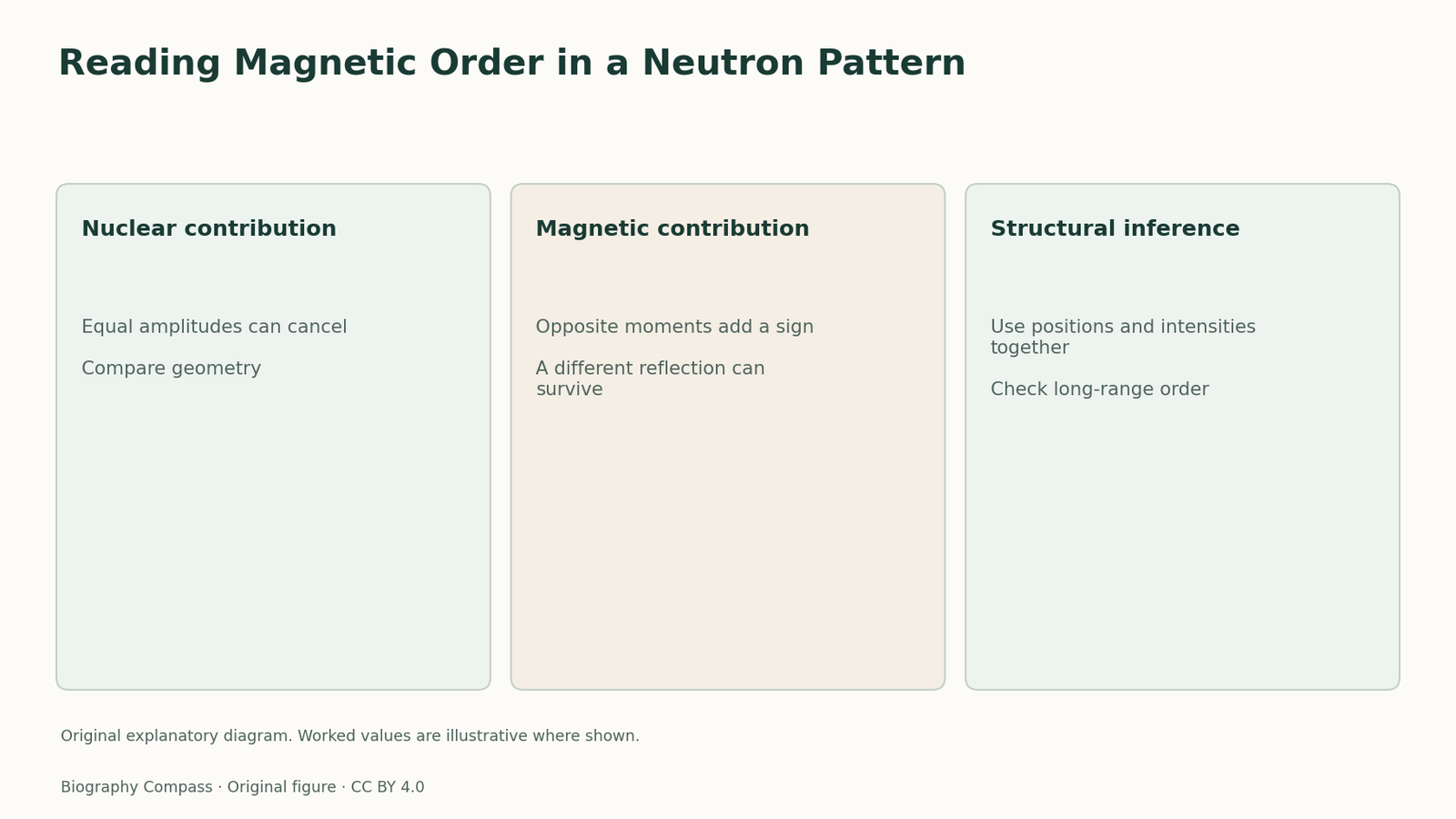
The illustration compares amplitudes at one chosen geometry.
| Contribution | Site amplitudes in the example | Sum |
|---|---|---|
| Nuclear arrangement | 1 and −1 | 0 |
| Alternating magnetic signs | 1 and 1 after including phase | 2 |
| Actual measurement | Intensity varies across many reflections | Compare a complete model |
An average can hide a pattern
An antiferromagnet can have neighbouring magnetic moments that point in opposite directions. Adding them over a large region can yield little net moment even when the arrangement is highly regular. Diffraction asks a different question from measuring net magnetization. Scattered waves arrive with phases determined by their origins and by the scattering geometry. A repeating arrangement can give strong intensity in some directions because the amplitudes add there. The order can thus be inferred from a pattern in reciprocal space even when a simple average over the moments is close to zero.
Chemical and magnetic scattering carry different information
A neutron interacts with nuclei and also has a magnetic moment. Its scattering from a crystal can reflect the atomic arrangement, the arrangement of moments or both. If magnetic order repeats over a longer distance than the relevant chemical arrangement, additional reflections can occur. Their interpretation depends on their positions, intensity and the proposed magnetic pattern. One extra peak is a clue, not a complete determination. The case of manganese oxide is useful because comparing candidate arrangements is essential to understanding why the new reflections matter.
An invented two-site phase comparison
Suppose two sites contribute equal nuclear amplitudes. At a particular scattering geometry, the phase factor for the second site relative to the first is minus one. The two nuclear terms then add as 1 minus 1, giving zero. Now assign opposite magnetic signs to the same sites. Multiplying the second magnetic contribution by both its opposite sign and the minus-one phase gives another plus one, so the two magnetic terms add as 1 plus 1. This simplified example ignores polarization, geometry and actual scattering strengths. It shows how a reflection can distinguish two periodic contributions.
Sources for this section: [2]
Short-range and long-range evidence
The original report discusses magnetic scattering before long-range order is inferred. Broad features can be related to correlations over short distances. A sharper diffraction feature can instead indicate that the pattern repeats coherently across many sites. The difference matters because neighbouring moments can be correlated without maintaining that relation across a large crystal. An interpretation should therefore preserve how the observed feature changes with conditions and how it compares with the calculated pattern. A label such as magnetic scattering covers more than one kind of evidence.
How to read the evidence beside other neutron work
Shull and Smart’s question was spatial: which arrangements of moments can account for the pattern? A measurement of changes in neutron energy would introduce a different question about excitations or motion. To evaluate a claimed magnetic structure, check which reflections are expected from the nuclei, which extra features track magnetic ordering and whether their positions agree with the proposed repetition. Those checks make the original achievement precise. It established a route to studying an ordered arrangement of moments that is not visible in the total moment alone.
Continue the chronology
Related history guides
How Nickel Scattered Electrons into a Peak
Read the Davisson–Germer nickel result, compare an angle scan with a wavelength prediction, and see why a peak needs the crystal geometry.
Read the timeline1950sHow Electron Scattering Mapped Charge
Read how a proton’s elastic scattering response changes with momentum transfer, and work through an original example of phase cancellation.
Read the timelineBiography context
Explore Oak Ridge, Tennessee, United States through connected lives
Connected biographies
Researchers and collaborators
1915–2001
Clifford Shull
Experimental physicist of neutron scatteringFollow Clifford Shull from Carnegie Tech and NYU to Oak Ridge and MIT, with Ernest Wollan and J. Samuel Smart’s roles in developing neutron diffraction.Read biography1918–2003
Bertram Brockhouse
Experimental physicistBertram Brockhouse developed neutron-scattering methods at Chalk River that revealed atomic and magnetic motion, then built a teaching and research programme at McMaster.Read biography1890–1971
Lawrence Bragg
Crystallographer and research directorCrystallographer and shared physics laureate.Read biographyQuick answers
Common questions
- Can opposing moments still diffract coherently?
- An ordered alternation gives a repeating pattern, even if its net moment is small.
- Do the example amplitudes reproduce MnO data?
- They illustrate phase and sign only. Real intensities require the experimental geometry and a material model.
Primary and institutional sources
How this history was checked
Dates, legal milestones and historical claims are checked against the official and institutional records below. This article was reviewed on 13 November 2026.