
The short answer
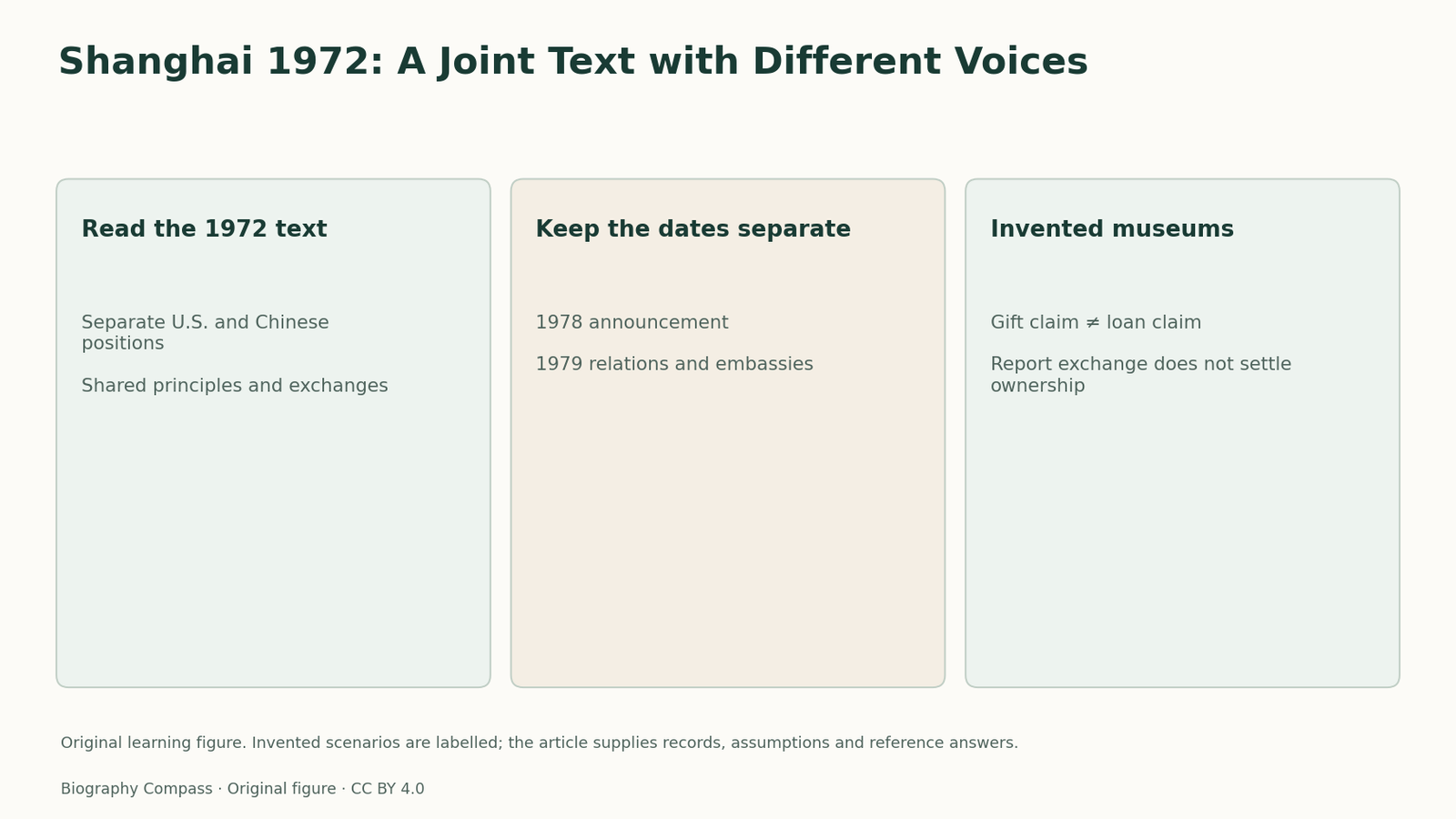
A joint document need not make every sentence a shared position. The Shanghai text preserves differences while setting out areas of cooperation; the identity of each speaker is part of the evidence.
Read the specified record
Identify the speaker and the act
A document can preserve disagreement and organise cooperation at the same time.
| Textual element | What to retain | What not to merge |
|---|---|---|
| Separate position | The named speaker and proposition. | Every sentence into a shared belief. |
| Shared undertaking | The specified action both accept. | Cooperation into agreement on every dispute. |
| Later communiqué | Its own announcement/effective dates. | 1972 and 1979 into one event. |
Chronology
A timeline of the turning points
Joint statement
Separate positions and shared principles.
Formal relations
Effective date in the later communiqué.
Three kinds of statement in one document
The English text dated 27 February 1972 first separates the U.S. and Chinese statements, then identifies principles the two sides accepted. Later passages again distinguish their positions on Taiwan before returning to exchanges, trade and continuing contact.
That organisation gives the reader a practical method: mark the speaker before summarising the proposition. A sentence printed in a jointly issued document does not become a jointly endorsed claim simply because it shares a page with one. The grammar preserves part of the political disagreement.
Sources for this section: [1]
What acknowledgement refers to
In the Taiwan passage, the U.S. formulation acknowledges a position attributed to Chinese people on both sides of the Strait and says the United States does not challenge it. The Chinese formulation makes its own sovereignty claims.
Retaining the embedded speaker prevents a misleading shortcut. Reporting that another party holds a view is not grammatically identical to restating that view as one’s own proposition. This is a reading of the dated English text, not a judgment on sovereignty or a comprehensive statement of either government’s policy today.
Normalisation has a different documentary date
Carter’s 15 December 1978 address reproduced a further communiqué establishing diplomatic relations from 1 January 1979 and embassies from 1 March. Those are distinct announcement, effective and institutional dates.
The 1972 opening therefore should not be collapsed into the later establishment of formal relations. A historical sequence can contain important intermediate steps without treating the first step as the completion of everything that followed.
Sources for this section: [2]
Original classification task and reference answer
Invent a joint statement between museums A and B. It says: A maintains that a painting was a gift; B maintains that it remains a loan; both agree to exchange conservation reports. Classify the three propositions as A’s position, B’s position or shared action. Does exchanging reports settle ownership?
Reference answer: the gift claim belongs to A, the loan claim to B, and report exchange is the shared action. Cooperation does not, by itself, resolve the incompatible ownership claims. Now repair this historical caption: “Nixon’s 1972 statement created the embassies described in Carter’s 1978 announcement.” Preserve the separate speakers and the 1979 effective dates rather than transferring a later commitment backwards.
Continue the chronology
Related history guides
Biography context
Explore United States through connected lives
Connected biographies
A connected working life
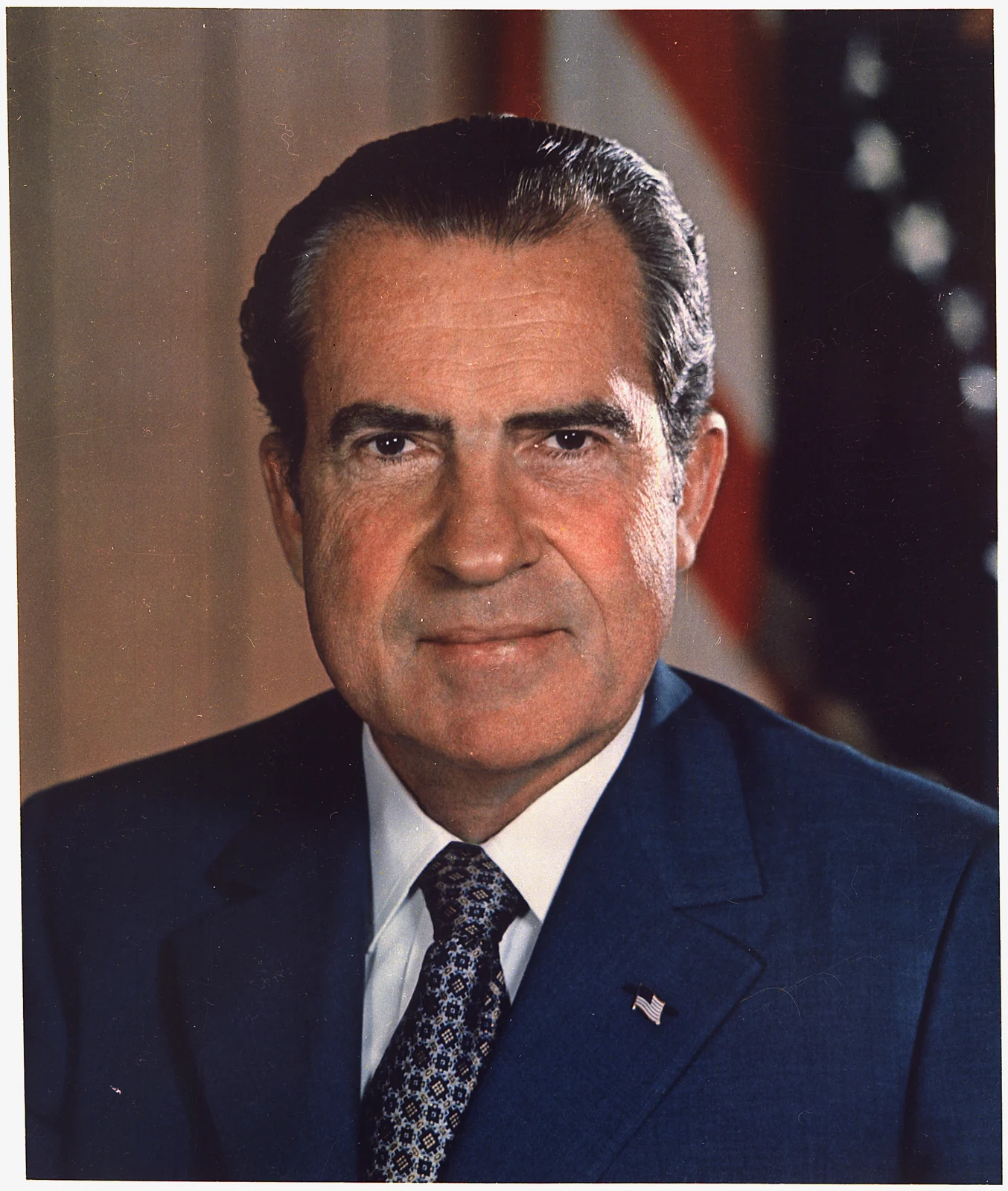
1913–1994
Richard Nixon
President and foreign-policy strategistHis career asks how diplomatic achievements can coexist with a collapse of public authority, bringing policy and accountability into the same story.Read biographyQuick answers
Common questions
- Does the museum exercise reproduce a diplomatic negotiation?
- No. Its objects and claims are invented to make speaker attribution inspectable.
Primary and institutional sources
How this history was checked
The study identifies selected records and their dates. Its invented examples are learning models, with reference answers supplied in the article. This article was reviewed on 31 October 2026.